
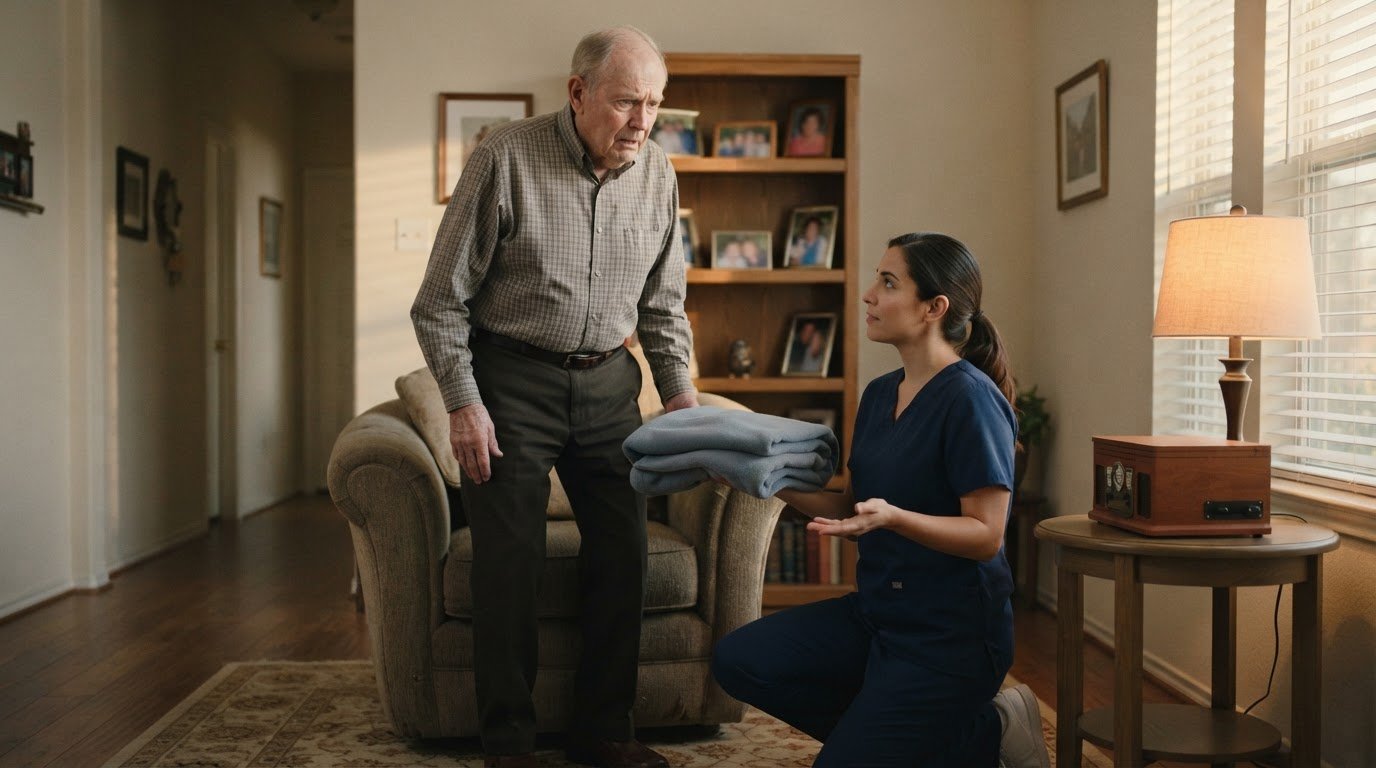
Reassurance is usually more helpful than arguing about what a person with dementia sees or hears. Learning how to handle dementia hallucinations starts with staying calm, recognizing the person’s feelings, and helping them feel safe without insisting their experience isn’t real.
Hallucinations are particularly associated with dementia with Lewy bodies and Parkinson’s disease dementia, but they can also occur with Alzheimer’s disease. This can be frightening and confusing for families, especially when it’s difficult to distinguish a hallucination from a delusion or a misinterpretation of something in the room.
This guide explains how to respond with empathy, consider possible causes, and distinguish hallucinations from other experiences. It also covers gentle ways to redirect attention, including conversation, music, and calming activities, as well as practical considerations when hallucinations occur alongside Lewy body dementia.
Key Takeaways
- Stay calm, acknowledge the person’s feelings, and offer reassurance instead of arguing about what they see or hear.
- Consider whether health, sensory, medication, or environmental factors could be contributing, and share changes with their healthcare provider.
- Notice whether the experience is a sensory perception, a firmly held belief, or a misreading of something in the surroundings.
- Try a gentle change of focus, such as talking about a familiar photo, listening to soothing music, or moving to a calmer space.
- Because hallucinations are more common with Lewy body dementia, note when they happen and what is going on around the person.
1. Reassuring someone experiencing hallucinations
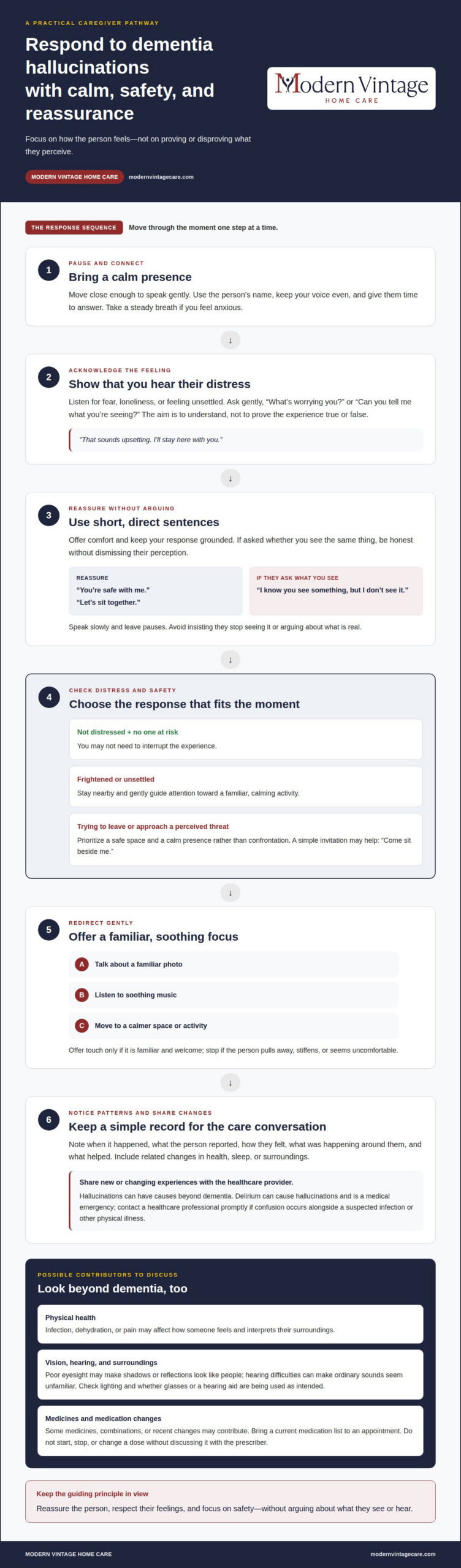
If you’re learning how to handle dementia hallucinations, start by noticing the person’s feelings. A calm response can ease fear without asking them to deny their experience. Move close enough to speak gently, use their name, and give them time to answer. For example, say, “You seem worried. I’m here with you.” Avoid arguing about what’s real or insisting they stop seeing it. These responses can leave someone feeling unheard and more distressed.
Offer reassurance in short, direct sentences. You might say, “You’re safe with me,” or, “Let’s sit together.” If the person asks whether you see the same thing, be honest without dismissing them: “I know you see something, but I don’t see it.” This acknowledges their perception while keeping your response grounded. Speak slowly and leave pauses between sentences, especially if the person seems confused or frightened.
Listen for the feelings behind the hallucination. Ask, “What’s worrying you?” or, “Can you tell me what you’re seeing?” The goal isn’t to prove or disprove the experience, but to understand whether the person feels threatened, lonely, or unsettled. If they describe a frightening visitor, you could respond, “That sounds upsetting. I’ll stay here with you.” Acknowledging the emotion shows that you take their distress seriously.
Your body language matters, too. Sit facing the person, make gentle eye contact, and keep your voice even. Knowing how to handle dementia hallucinations also means noticing whether your own anxiety is affecting the moment. Pause and take a steady breath before responding. If touch is familiar and welcome, offer a hand, gentle pat, or hug. Watch the person’s reaction and stop if they pull away, stiffen, or seem uncomfortable. Comfort should respect their choices and sense of control.
Before deciding what to do next, assess whether the experience is frightening or creating immediate danger. If the person isn’t distressed and no one is at risk, you may not need to interrupt. If they’re afraid, stay nearby and gently guide their attention to a familiar, calming activity. If they try to leave or approach a perceived threat, prioritize a safe space and a calm presence rather than confrontation. A short phrase such as “Come sit beside me” may help.
Hallucinations can have causes beyond dementia, so share new or changing experiences with the person’s healthcare provider. The National Institute on Aging says its Alzheimer’s and related Dementias Education and Referral (ADEAR) Center can be reached at 800-438-4380. A simple record of what happened, how the person felt, and what helped can also make it easier to describe the experience during a care conversation. When reassurance doesn’t settle distress, that clear information can support the next step.
2. Are hallucinations and delusions only caused by dementia?
No. Dementia can contribute, but hallucinations and delusions can also have physical, sensory, medication-related, or environmental causes. An infection, dehydration, or pain may affect how someone feels and interprets their surroundings. If a person with Alzheimer’s becomes frightened or confused, note what changed and when, then share those details with their healthcare provider.
Sensory changes can also affect what someone perceives. Poor eyesight may make shadows or reflections look like people, while hearing difficulties can make ordinary sounds seem unfamiliar. Vision problems may also be associated with visual hallucinations known as Charles Bonnet syndrome. Check whether the lighting creates confusing shadows and whether glasses or a hearing aid are being used as intended. These observations can help a healthcare provider assess possible causes.
Medication can matter, too. Some medicines can contribute to hallucinations, and combinations may affect a person differently. Medicines for Parkinson’s disease can trigger hallucinations; other prescriptions, over-the-counter medicines, or recent changes may also be relevant. Caregivers can bring a current medication list to a healthcare appointment, including dementia medicines such as rivastigmine. Don’t start, stop, or change a dose without discussing it with the prescriber. Regular medication reviews can help identify medicines or combinations that may be contributing.
Seek medical help if hallucinations are new, frequent, distressing, or affecting daily life. Delirium can cause hallucinations and is a medical emergency. If a person develops confusion alongside a suspected infection or other physical illness, contact a healthcare professional promptly. A provider can assess health conditions, consider medication effects, and decide whether adjustments or further evaluation are appropriate. Record when the experiences happen, what the person reports, and any related changes in health, sleep, or surroundings.
Treatment depends on the cause and how much distress or risk the symptoms create. Non-drug approaches are the first line for behavioral symptoms of Alzheimer’s. Antipsychotic medication may be considered when symptoms are severe and other approaches haven’t worked, but these medicines are associated with increased risks of stroke and death in older adults with dementia. If prescribed, treatment should be regularly reviewed with the healthcare provider. For practical support with keeping medication routines organized, explore medication management support.
3. How to distinguish hallucinations from delusions or misperceptions
Start with what the person says they’re experiencing. A hallucination is a sensory perception without an external object or event causing it. Someone might see a child in an empty room, hear a voice when nobody spoke, or smell smoke without a source. Hallucinations can involve any of the five senses. Visual experiences are common, but the person may also describe sounds, tastes, smells, or touch.
A delusion is different: it’s a strongly held belief without supporting evidence. For example, someone might believe a family member stole their wallet, even after it’s found in a drawer. Paranoia is a type of delusion involving suspicion or mistrust, such as believing that others intend harm. The person’s fear or certainty can be real, even when the belief itself isn’t supported.
A misperception involves a real cue that the person interprets incorrectly. A coat hanging in a dim room might look like a stranger; a reflection could seem like another person. Before labelling the situation, check the surroundings. Turn on the lights, look for shadows or reflections, and listen for sounds from a television or another room. This may make the actual cue easier to identify.
Ask a gentle question to understand what happened. Try, “What did you notice?” or, “Did you see someone, or did something in the room look like a person?” The answer may clarify whether the person reports a sensory experience, holds a belief, or is responding to an object or sound. Don’t turn the conversation into a test. Focus on the person’s feelings and whether they seem frightened or at risk.
Keep a brief record for the doctor, noting the person’s words, the time, the surroundings, and any recent changes. For example, record whether a figure appeared near a window at dusk or a voice seemed to come from a television. Include related symptoms or signs of illness, such as confusion that started suddenly or a suspected infection. These details help a healthcare provider consider possible causes and decide what assessment is appropriate.
Hallucinations and delusions can both occur with dementia, but one doesn’t prove the other is present. Nearly half of people living with any form of dementia, including Alzheimer’s disease, may experience delusions. A person may also misinterpret a real object without having either symptom. Tell the doctor about experiences that are new, recurring, upsetting, or disruptive. A clear description of what the person sees or believes is more useful than arguing over whether it’s true.
4. Using conversation, music, and activities as distractions
Make the home safer by improving lighting, clearing clutter from walkways, and reducing shadows that could be mistaken for people or objects. Add nightlights where needed, and move furniture if it creates confusing shapes or narrow paths. These practical changes can reduce misinterpretations while helping someone with dementia move around more comfortably.
First, notice what may be drawing the person’s attention. A loud television, reflections in a window, or a busy room can add confusing sensory input. Turn off violent or upsetting programs, lower background noise, and soften bright, flashing lights. If a mirror seems to trigger distress, cover it or move it from view. The aim isn’t to prove what’s real, but to create a calmer setting.
Conversation can gently shift the person’s focus. Invite them to talk about a familiar photograph, a treasured keepsake, or a favorite part of their day. Use one clear prompt, such as, “Tell me about this picture,” then give them time to respond. Familiar topics can engage the person without asking them to explain or defend their experience.
A familiar activity may also help redirect attention. Offer to fold towels, look through a photo album, water a plant, or sort a small collection of safe household items. Choose something the person already enjoys and can do comfortably. If they lose interest or become more upset, stop and try a quieter option instead of pressing them to continue. The activity should feel inviting, not like a test.
Music can shift the mood without requiring conversation. Try a familiar, soothing song at a comfortable volume and watch the person’s response. If they seem calmer, stay nearby and let the music continue; if it increases agitation, turn it off. A short walk or a move to a well-lit room with other people present may also distract someone from a frightening experience, as long as the change feels safe and welcome.
Keep the transition simple. Say, “Let’s sit in the living room,” or, “Would you like to walk with me?” Avoid sudden movements or crowded spaces. If moving to another room doesn’t help, return to a familiar place and reduce noise or visual clutter. Fatigue and stress can affect behavior, so a quiet pause, a drink of water, or a comfortable seat may help more than another activity. Notice which surroundings and approaches ease distress, then use those observations to shape a calmer routine.
5. Hallucinations and Lewy body dementia
Hallucinations are more common with dementia with Lewy bodies and Parkinson’s disease dementia than with Alzheimer’s disease, though they can occur with Alzheimer’s too. Delirium is different: it can cause hallucinations and is a medical emergency, so new or rapidly worsening confusion needs urgent medical attention.
With Lewy body dementia, visual hallucinations may be vivid, detailed, and realistic. Someone might describe seeing people or animals who aren’t there; these images may last several minutes and recur. The person may seem calm, frightened, or uncertain, so note both what they report and how the experience affects them. Their response can help caregivers decide whether immediate support is needed.
Alzheimer’s disease can also involve hallucinations, often as the disease progresses, but their presence alone doesn’t identify the type of dementia. The experience can involve any sense, and physical illness, medication effects, or sensory changes may contribute. A clinician considers the person’s wider symptoms and health history rather than relying on a single report of seeing a figure or hearing a voice.
Delirium deserves special attention because it may signal an urgent medical problem. If hallucinations appear alongside a sudden change in awareness or confusion, seek medical help promptly. Don’t assume a new symptom is simply part of the person’s usual dementia. Tell the healthcare provider what changed, when it began, and whether other signs of illness appeared.
To identify patterns, record when hallucinations occur and what is happening around the person. Note the lighting, shadows, reflections, fatigue, and changes in routine. For example, seeing a stranger near a mirror may point to a visual trigger worth addressing. Turning on lights, reducing shadows, adding nightlights, or covering a confusing mirror may make the surroundings easier to interpret.
Stay with the person if they seem frightened, but don’t act as though the hallucination is real. A calm response and a change of focus can support comfort without reinforcing confusion. Because antipsychotic medicines can cause severe harmful reactions in people with dementia with Lewy bodies, medication decisions need careful medical oversight. If your family needs ongoing support with dementia-related daily care, explore Alzheimer’s and dementia care.
Modern Vintage Home Care: Alzheimer’s & Dementia Care
Modern Vintage Home Care provides Alzheimer’s & Dementia Care for families who need consistent, personalized support at home. When hallucinations or changes in behavior make daily routines harder to manage, compassionate companionship and personal care can support comfort, dignity, and familiar routines. Care can be tailored to the person’s needs and the family’s concerns, whether support is needed with everyday activities or to give family caregivers time to rest. Contact Modern Vintage Home Care to discuss support for your family.
Build a steadier path forward
A thoughtful plan for how to handle dementia hallucinations can begin with a family conversation about what feels respectful and reassuring to the person. Agreeing on a calm, consistent approach can help relatives feel more prepared when difficult moments arise. Keep the person’s preferences and dignity at the center, and adapt the plan as their needs change.
Care needs can also extend beyond responding to hallucinations. Modern Vintage Home Care offers Alzheimer’s & Dementia Care, 24-Hour Care, and Companionship for families seeking support with daily life. The right kind of help depends on the person’s routines and the support their family needs.
If you’re considering added care, contact Modern Vintage Home Care to discuss your family’s needs. A supportive next step can help you care with greater confidence while honoring the person you love.
Frequently Asked Questions
What are hallucinations?
Hallucinations are sensory experiences that seem real to the person but don’t come from anything actually present. Someone might report a voice in an empty room, a taste with no apparent source, or an animal others can’t see. To describe the experience clearly, note which sense is involved and what the person reports, rather than assuming every unusual statement is a hallucination.
Are hallucinations and delusions only caused by dementia?
No. Dementia can be one cause, but hallucinations or delusions may also relate to physical illness, dehydration, pain, sensory changes, medications, or confusing surroundings. Someone who seems to see a person in a dim room, for example, may be misinterpreting a shadow. Tell the healthcare provider about new or recurring experiences, relevant health changes, and medicines.
How are these behavioral symptoms treated?
Treatment begins by looking for possible causes and reducing distress through supportive, non-drug approaches. A healthcare provider may assess health conditions, sensory changes, and medications before considering other options. Antipsychotic medicines may be considered for severe symptoms when other approaches haven’t worked, but they carry increased risks for older adults with dementia. The provider weighs those risks and reviews treatment regularly.
What causes hallucinations in dementia, and which types are common?
Hallucinations may relate to dementia-related brain changes, but illness, medication effects, dehydration, pain, vision or hearing problems, and environmental misinterpretations can also contribute. Visual hallucinations are the most common in dementia, such as seeing a person or animal who isn’t there. Experiences can also involve hearing, smell, taste, or touch. Tracking what the person reports can help you describe patterns to their healthcare provider.
How should caregivers respond when a person with dementia is hallucinating?
Respond calmly, give the person your attention, and focus on the emotion they express. A simple “I’m here with you” can offer connection without agreeing that the hallucination is real. If they’re receptive, sit nearby or offer familiar comfort. Families in Sugar Land, Missouri City, and SW Houston can also seek in-home dementia care support when daily caregiving becomes harder to manage.
What should caregivers avoid saying or doing during a dementia hallucination?
Avoid arguing, demanding proof, or telling the person they’re making it up. Those responses can deepen distress without changing what they perceive. Don’t pretend that you also see or hear the experience, since treating it as reality may add confusion. Avoid sudden touch or crowding, too. Instead, ask before offering a hand, notice the person’s response, and give them space if they seem uncomfortable.
When do dementia hallucinations require urgent medical attention?
Seek immediate medical help if hallucinations involve multiple senses or if you suspect delirium, which can be a medical emergency. Also take seriously any experience that creates immediate danger, such as the person trying to flee from a perceived threat. Stay with them if it’s safe, reduce nearby hazards, and explain to emergency or healthcare professionals what changed and what the person is experiencing.
Can infections, dehydration, medications, or vision problems trigger hallucinations in dementia?
Yes. Infections, including bladder or kidney infections, dehydration, medicines, and worsening vision can contribute to confusion or hallucinations. Shadows or reflections may also be misread when eyesight is poor. Tell the person’s healthcare provider about these experiences and any recent health or medication changes. Don’t stop or adjust medication independently; a prescriber can review possible side effects and decide whether changes are appropriate.
