
A bond is a financial safeguard, not a guarantee that a caregiver will always act honestly or perform perfectly. When considering bonded and insured caregivers in Sugar Land, understand what protections may apply if theft, damage, or an injury occurs during care. Caregiver screening offers a separate layer of reassurance.
It makes sense to want clear answers before inviting someone into a loved one’s home. A bond and insurance serve different purposes, and neither replaces careful caregiver screening or a thoughtful match with the person receiving care.
This article explains what a caregiver bond can and can’t do, how insurance relates to common in-home risks, and why screening matters when care involves personal routines, mobility, or memory changes. It also covers how caregiver availability and client matching can shape a reliable care arrangement, so your family can weigh protections alongside the quality and consistency of support.
Key Takeaways
- A caregiver bond and insurance address different risks, so understanding each can help you assess what protections a care arrangement may offer.
- Hiring a caregiver directly can make the family responsible for employment, payroll, and coverage obligations.
- Screening and skill assessment matter alongside financial protections, especially when care includes personal assistance or support for memory changes.
- Caregiver availability affects continuity; an agency may be able to arrange a replacement when an assigned caregiver can’t work.
- Care that fits a person’s routines, needs, and preferences can support a more comfortable in-home arrangement.
Liability risks of hiring caregivers directly
Hiring directly can make a family the caregiver’s employer, not simply the recipient of home care services. That change affects injury claims, payroll responsibilities, and who handles a damaged item.
Agency and Independent Caregiver Differences
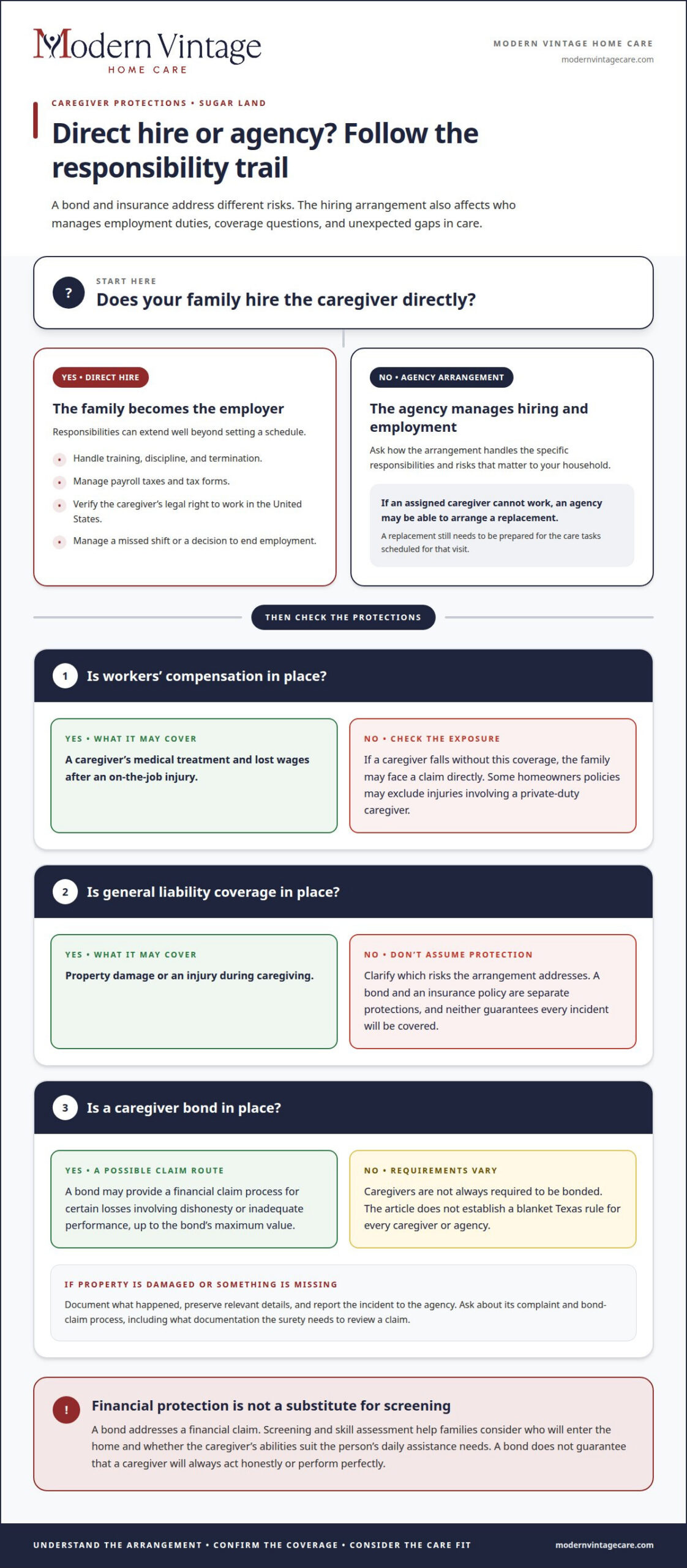
With an agency arrangement, the agency manages hiring and employment responsibilities. When a family hires directly, those responsibilities fall to the family. For Sugar Land households, that difference can affect who handles training, discipline, termination, and workplace injuries. A bond may offer a claim route for certain losses, while insurance addresses other risks. Neither guarantees that every incident will be covered.
When a family hires an independent caregiver, it becomes the employer and handles training, discipline, and termination. The family also takes responsibility for payroll taxes, tax forms, and verifying the caregiver’s legal right to work in the United States. These duties extend beyond setting a schedule and can affect how the family manages the working relationship if care needs change or a concern arises.
Insurance gaps can create additional risks. General liability insurance may cover property damage or an injury during caregiving. Workers’ compensation may cover a caregiver’s medical treatment and lost wages after an on-the-job injury. Some homeowners policies may exclude injuries involving a private-duty caregiver. For example, if a caregiver falls in the home without workers’ compensation coverage, the family may face a claim directly.
Bonding and Insurance Requirements
A bond and an insurance policy are separate protections, and caregivers are not always required to be bonded. Some states require bonds for caregivers working through professional agencies, but that does not establish a blanket Texas rule for every caregiver or agency. For Texas families, the practical question is whether a bond, liability coverage, and workers’ compensation address the risks in their particular arrangement.
Responding to Damage or Theft
A bond can provide a financial claim process for certain losses involving dishonesty or inadequate performance, up to the bond’s maximum value. It does not guarantee perfect conduct. If property is damaged or something is missing, document what happened, preserve relevant details, and report the incident to the agency. Ask about its complaint and bond-claim process, including what documentation the surety needs to review the claim.
Caregiver continuity matters, too. If an assigned caregiver cannot work, an agency may provide a replacement, helping families maintain their care schedule. With direct hiring, the family manages the employment relationship and must handle a missed shift or a decision to end employment. That responsibility can become especially difficult when regular home care supports daily routines.
Caregiver availability and response times
A care schedule depends on more than the hours a family hopes to cover. The type of help, preferred routine, and caregiver availability all shape coverage planning. Someone who needs help getting dressed each morning, for example, may need a different schedule from someone seeking companionship on selected afternoons. Describing these routines helps clarify the support the household needs.
Response time depends on what a family means by “response.” It might mean arranging an initial schedule, answering a question about a shift, or addressing an unexpected absence. These are different needs. A home care agency can explain how its scheduling process handles each one, so families know what to expect rather than assuming every request follows the same timeline.
Coverage may change when an assigned caregiver cannot work. An agency may provide a replacement to help preserve a planned routine. The replacement still needs to suit the person’s care needs and the tasks scheduled for that visit. For example, a shift involving hands-on personal assistance calls for a caregiver prepared for those duties, not simply someone who can arrive.
Families can make scheduling discussions more useful by sharing practical details, such as:
- The days and parts of the day when support is needed.
- Tasks the caregiver is expected to help with during each visit.
- Routines or preferences that make a change in caregiver easier to manage.
- Which family member should receive updates about a schedule change.
Caregiver continuity also matters. Familiarity can help a caregiver follow someone’s usual mealtimes, preferred activities, and household routines. Predictable duties and agreed compensation can support a more stable working arrangement. If a family’s needs change, such as adding a visit after a change in mobility, updated scheduling details help an agency understand the new coverage request.
Before care begins, families benefit from a clear picture of the planned schedule and how an absence is handled. A schedule that reflects both care tasks and daily rhythms gives the agency practical information for coordinating coverage. If support needs change, sharing the new routine helps keep the plan relevant. Families can use care planning support to describe the schedule that would work best at home.
Caregiver screening and background checks
A bond addresses a financial claim, while screening helps assess who will enter a home and what care tasks they can perform. Bonded businesses that work in customers’ homes typically conduct background checks. For families arranging home care in Sugar Land, that distinction matters because paperwork alone cannot show whether a caregiver’s abilities suit a person’s daily assistance needs.
Screening involves more than reviewing background information. A caregiver may be kind and dependable yet lack experience with a particular task. Helping someone with limited mobility, for example, calls for different abilities than providing companionship during a conversation. The care plan should match the caregiver’s demonstrated skills to the support the person needs.
A quality home care agency can explain how it selects caregivers and assesses their skills. That matters when care includes hands-on personal assistance or support for someone with dementia or Alzheimer’s. Families hiring an independent caregiver directly need to assess that person’s abilities, especially when mobility or memory changes make daily routines more complex.
Practical examples show why assessing skills matters. If someone needs help bathing or getting dressed, the caregiver should be prepared for those specific tasks. If dementia affects familiar routines, the caregiver’s ability to respond calmly and follow those routines is relevant. Screening and training can help connect a caregiver’s capabilities to the actual work, rather than relying on a general impression.
Several questions are distinct, and each points to a different part of the decision:
- Background: Has the business conducted employee background checks?
- Task readiness: Has the caregiver’s ability to provide the planned assistance been assessed?
- Care fit: Does the caregiver’s experience relate to the person’s needs, such as limited mobility or memory changes?
- Bond protection: Does a bond provide a financial claim process for a qualifying loss?
Licensing, certification, bonding, and screening each mean something different. Licensing is often required to provide professional services, while certification indicates proficiency in caregiving tasks. A bond relates to financial protection, and a background check relates to screening. Treating these terms as interchangeable can obscure what each says about a care arrangement.
The useful outcome for families is a clearer connection between a person’s needs and a caregiver’s abilities. A home care plan that lists specific tasks, such as help with dressing or support around dementia-related routines, gives skill assessment a practical focus. This helps distinguish general confidence from preparation for the actual services being arranged.
Matching caregivers with clients
A suitable match connects someone’s care needs, daily routines, and preferences with a caregiver’s abilities. Someone who needs help getting dressed, for example, may need different support from someone seeking conversation and help with shopping. A clear match gives the care arrangement a practical starting point based on what happens during an ordinary day.
Readiness for specific tasks is one part of a good fit. If a client has limited mobility, planned assistance may involve moving safely around the home or using the bathroom. If memory changes affect a familiar routine, patience and a calm approach can matter during meals or when getting ready for bed. The match should reflect the actual tasks, not just a general description of care.
Personal preferences shape the experience, too. One person may enjoy conversation during meal preparation, while another prefers quiet and a predictable routine. A client may value a caregiver who respects established habits, such as a preferred breakfast or time for a walk. Sharing these details makes the plan more individual and gives the caregiver useful context for daily interactions.
Useful matching details include:
- Daily tasks: bathing, dressing, shopping, or meal preparation.
- Routine: preferred mealtimes, activities, and rest periods.
- Communication: how the person likes to receive reminders or encouragement.
- Care considerations: mobility limitations or dementia-related changes.
Family input can clarify what a client may find hard to express. A relative might explain that a parent feels more comfortable with advance notice before a routine changes. Another family member may describe how the person responds when offered choices while getting dressed. Such examples help distinguish a genuine preference from a task that simply needs completing.
Matching also requires a realistic view of the caregiver’s role. A bond relates to financial protection, not whether a caregiver’s approach suits a particular client. A caregiver may be bonded yet still be a poor fit for someone’s communication style or daily needs. The care plan and the caregiver’s demonstrated abilities should align with each scheduled task.
Needs can change over time. A client who once needed companionship during an afternoon visit may later need more help with dressing or household routines. When that happens, the family’s description of day-to-day changes can help update the match. Clear expectations about tasks, preferences, and communication give everyone a useful basis for adjusting care.
Must Texas home care agencies be bonded and insured?
Caregivers are not always required to be bonded, and some states require bonds for caregivers working through professional agencies. This distinction matters in Texas: a bond, liability insurance, and workers’ compensation are separate protections, not interchangeable terms. Families should understand what each addresses when considering the safeguards in an agency arrangement.
An agency that employs caregivers can explain its bond, insurance, and workers’ compensation coverage. These protections address different situations. Liability insurance may cover issues arising during work in the home, while workers’ compensation relates to an employee’s work injury. A surety bond can provide a financial recovery process for qualifying claims, such as theft or dishonesty, up to the bond’s maximum value.
For families, the practical question is not only whether a bond exists, but also whether the agency employs caregivers or uses private contractors. Some agencies that hire caregivers as private contractors typically do not provide additional liability coverage because they do not take responsibility for those caregivers as traditional employees. That arrangement can leave the person receiving care responsible for tax obligations, legal issues, and insurance coverage.
Documentation helps clarify an arrangement. Families can ask a home care agency for its license number and documents showing its bond, liability insurance, and workers’ compensation coverage. Those records help distinguish a bond from an insurance policy and show which protections apply to employees. They also clarify how coverage relates to work performed in the home.
Consider a caregiver injured in a fall while working in a client’s home. Workers’ compensation may cover the caregiver’s medical treatment and lost wages. Liability insurance may address other issues arising during work, such as property damage. A bond serves a different function, including a possible financial claim for theft or dishonesty. No single document proves that every possible loss is covered.
Bonding also differs from licensing and certification. A bond is a financial protection mechanism; licensing concerns authorization to provide professional services, while certification indicates proficiency in caregiving tasks. Each answers a different question. When assessing an agency’s safeguards, families should consider the employment arrangement, coverage documents, and purpose of each protection.
To discuss in-home care needs and the safeguards that matter to your family, connect with Modern Vintage Home Care.
Modern Vintage Home Care
Modern Vintage Home Care helps families connect in-home support with a loved one’s daily needs and routines. If you’re weighing caregiver protections alongside the right kind of assistance, the care plan should reflect both practical needs and personal preferences.
Support may include Alzheimer’s and dementia care, companionship, or personal care. A loved one, for example, may need help with daily routines while also benefiting from familiar, respectful companionship. Discussing those needs can clarify what support would fit your family’s situation.
If you’re considering in-home care in Sugar Land, contact Modern Vintage Home Care to discuss your family’s needs.
Take the Next Step Toward Care That Feels Right
Choosing care is also an opportunity to shape everyday life at home. Your loved one’s comfort, routines, and sense of independence deserve a central place in the conversation. Consider what would help them feel respected and at ease, as well as what would give your family greater confidence in the arrangement.
When considering bonded and insured caregivers in Sugar Land, focus on the relationship you want care to support. A thoughtful conversation can bring your family’s priorities into view and clarify what kind of help feels appropriate. You do not need to have every detail decided before you begin. Start with what matters most to your loved one and your family.
If you’re ready to talk through your family’s needs, contact Modern Vintage Home Care. A caring next step can begin with a simple conversation.
Frequently Asked Questions
Why is it important to get a home health care bond?
A caregiver bond can offer a financial claim process for certain losses, such as theft or dishonesty, up to the bond’s limit. It does not replace insurance or establish a caregiver’s clinical qualifications. If a family is concerned about missing belongings, for example, it should understand that a surety company reviews the claim and provides compensation if it finds merit. A bond does not guarantee perfect performance.
Are Your Sugar Land Caregivers Certified and Background Checked?
All caregivers undergo rigorous background checks. Background screening and certification are different: screening relates to a person’s background, while certification indicates proficiency in caregiving tasks. Families can consider how a caregiver’s abilities fit the planned support, such as help with dressing or daytime companionship. Screening is one part of evaluating care; it does not describe every skill relevant to a loved one’s needs.
Can I Customize a Care Plan for My Loved One in Sugar Land?
Yes. Care in Sugar Land can be tailored to your loved one’s routines and support needs. A plan might reflect preferred mealtimes, the kind of companionship someone enjoys, or assistance with daily activities. For someone living with dementia, structured routines and familiar activities may be important considerations. Sharing what makes your loved one comfortable helps shape support around their individual circumstances rather than a generic schedule.
How do caregiver bonds work?
A caregiver bond is a surety-backed financial arrangement that may allow a client to seek compensation for a qualifying claim. The surety company reviews the claim and provides monetary compensation if it finds merit, up to the bond’s maximum value. A claim involving alleged theft, for instance, may be reviewed through this process. A bond does not promise that every claim will be approved or every loss repaid.
How do you maintain high-quality care?
Care quality depends on matching support to a person’s needs and keeping the plan relevant as those needs change. Modern Vintage Home Care provides individualized Alzheimer’s and dementia support, companionship, personal care, and medication reminders. A family may describe changes in daily routines or the kind of assistance that feels comfortable. That information helps personalize care and supports communication about a loved one’s experience.
What Does “Bonded & Insured” Mean?
“Bonded” generally refers to a surety bond that can provide a financial claim route for certain losses. “Insured” refers to coverage under an insurance policy, which may address covered liability or work-related risks. These terms describe different protections, not a guarantee of a particular care outcome. A bond claim and an insurance claim, for example, follow different processes, and each depends on the circumstances and applicable coverage.
What Safety Measures Are in Place for In-Home Care in Sugar Land?
In-home support can include automated check-ins and medication reminders to help reinforce a client’s care plan. Alzheimer’s and dementia support may also include structured routines and safety-focused measures, such as safety plugs. These supports are intended to fit the person’s home and daily needs. A consistent routine, for example, can make everyday activities more familiar for someone experiencing cognitive changes.
What payment options are available?
Payment arrangements depend on the care selected, and a customized quote is provided after a no-obligation consultation. Medicare and most health insurance plans typically don’t cover non-medical home care. Certain non-medical expenses may be tax-deductible when they exceed 7.5% of adjusted gross income, according to the IRS. Families can use the consultation to discuss the type and level of support needed and understand the associated quote.
