

What if the first step toward helping your parent isn’t asking them to accept care, but asking what matters most to them? If you’re convincing a stubborn parent to accept help, repeated arguments can leave you worried about safety and unsure how to respect their independence. Their resistance may be about more than the practical support itself. It can reflect concerns about privacy, control, or having someone unfamiliar in their home.
It’s understandable to want to act when you see a need, but a calmer conversation is more likely when your parent feels heard and involved. This guide will help you understand what may be behind their reluctance, raise concerns without blame, and offer a small first step they can choose. We’ll explore ways to make support feel collaborative, from starting with companionship to considering personalized in-home care that fits familiar routines. The goal isn’t to take over. It’s to support your parent’s safety and well-being while preserving as much choice and independence as possible.
Key Takeaways
- Look beyond a refusal to understand whether your parent is concerned about privacy, familiar routines, or losing control.
- Choose a calm moment and describe one specific concern with care, rather than leading with blame or a list of problems.
- When convincing a stubborn parent to accept help, offer choices that preserve their say in what support looks like.
- Compare family assistance, a short visit, companionship, and regular support to find a manageable first step.
- Explore personalized in-home care in Sugar Land and Houston to support daily needs while keeping familiar routines central.
Why a Parent May Resist Help, and What Their Refusal Could Mean
Repeated refusals can leave family members worried, tired, and unsure whether to raise the subject again. You may see a task becoming harder and want to step in, while your parent experiences the offer as a challenge to their independence. That tension doesn’t necessarily mean they reject every kind of support. A parent might refuse help with bathing but welcome a ride to an appointment, or object to a new person in the home while accepting help from family.
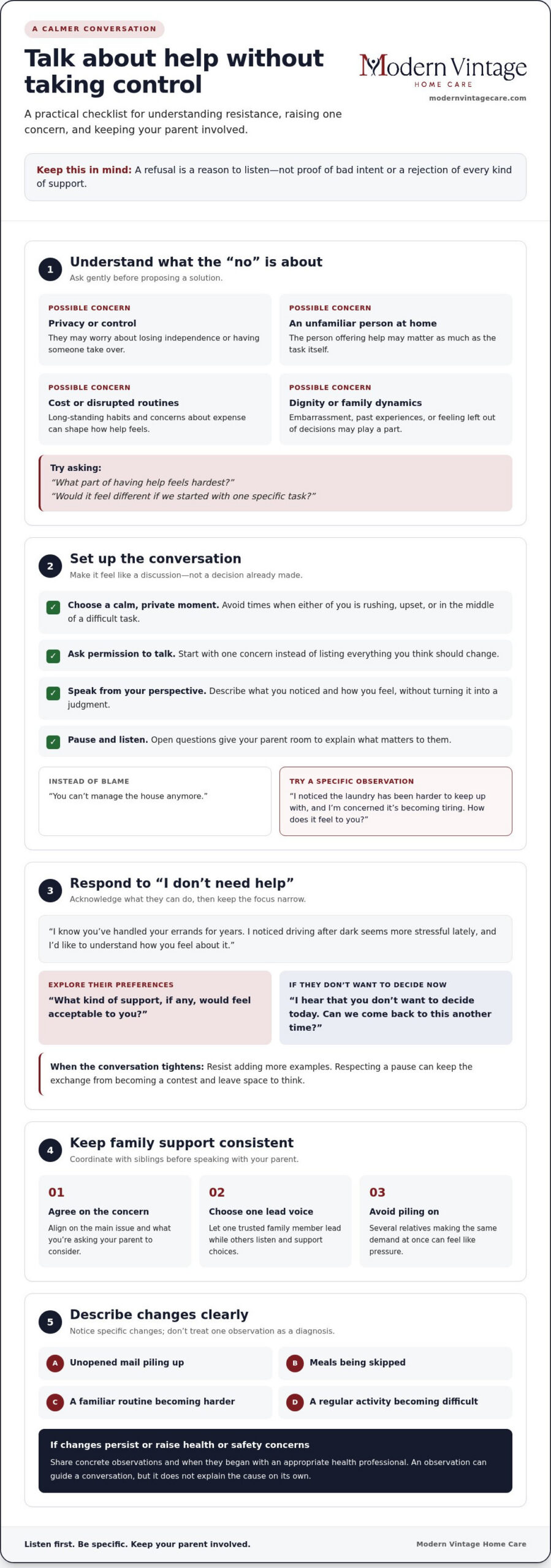
Before deciding what to do next, try to understand what the “no” applies to. A refusal is a reason to listen, not proof of bad intent. Asking what feels uncomfortable can reveal whether the concern is about one task, the person offering help, or the idea of needing assistance at all.
What might be behind a parent’s refusal?
There may be more beneath the surface than a wish to manage alone. Your parent could be protecting their privacy, worrying about cost, feeling uneasy about an unfamiliar person, or trying to keep long-standing routines intact. These are possibilities, not assumptions. Ask gently: “What part of having help feels hardest?” or “Would it feel different if we started with one specific task?”
Past experiences and family dynamics can shape the answer. Perhaps help once felt intrusive, or a disagreement among relatives has made your parent wary of losing a say. Embarrassment can also make a practical offer feel deeply personal. Needing assistance with dressing, meals, or household tasks may touch on identity and dignity. In some families, ideas about respect and duty influence whether a parent feels comfortable accepting support from their children. The concept of filial piety, for example, relates to respect and family responsibilities, though its meaning varies across people and cultures. Listening without correcting your parent’s feelings can help clarify what support, if any, feels acceptable.
Separate the task from the solution. If your parent says no to help with meals, ask whether the concern is the food, the timing, or having company in the kitchen. Their answer may point to a different kind of assistance or show that the issue needs more conversation.
When should a family take concerns more seriously?
Pay attention to specific changes in daily life rather than labeling your parent stubborn. For example, you might notice unopened mail piling up, meals being skipped, difficulty keeping up with a familiar routine, or a once-regular activity becoming hard to manage. One observation doesn’t explain why a change is happening, and it isn’t a diagnosis. It can, however, help you describe your concern clearly and ask what your parent has noticed.
If changes persist or raise health or safety concerns, discuss them with an appropriate health professional. Share concrete observations and when they began, rather than presenting a checklist as proof that your parent needs care. A professional can help assess concerns, and family support can then be considered in light of your parent’s preferences. When convincing a stubborn parent to accept help, this distinction matters: you can take a concern seriously without assuming you already know its cause or deciding every next step for them.
How to Discuss Help Without Making Your Parent Feel Controlled
The way you begin can shape whether the conversation feels like a partnership or a decision already made. Choose a calm, private moment when neither of you is rushing, upset, or in the middle of a difficult task. Ask permission to talk, and focus on one concern rather than presenting a case for everything you think should change.
Be specific and speak from your own perspective. Instead of “You can’t manage the house anymore,” try, “I noticed the laundry has been harder to keep up with, and I’m concerned it’s becoming tiring. How does it feel to you?” Then pause. Open questions such as “What would make this easier?” or “What would you want to stay exactly the same?” give your parent room to explain their priorities.
Listen for the feeling behind the answer, and reflect it before suggesting solutions. If your parent says, “I don’t want someone taking over,” you might respond, “You want to stay in charge of your home and your routine.” That doesn’t mean you have to agree on every detail. It shows you’ve heard what matters to them and can make it easier to explore options together.
“Could we talk through one concern together and see if there’s a small change you’d feel comfortable choosing?”
What can you say when your parent says, “I don’t need help”?
Avoid debating whether they’re right. Acknowledge what they can do, then name one concern without turning it into a judgment: “I know you’ve handled your errands for years. I noticed driving after dark seems more stressful lately, and I’d like to understand how you feel about it.” Follow with, “What kind of support, if any, would feel acceptable to you?” Their answer may be no for now, or it may identify a limited option they’re willing to discuss.
If the conversation tightens, resist the urge to add more examples. You can say, “I hear that you don’t want to decide today. Can we come back to this another time?” Respecting a pause isn’t giving up. It keeps the exchange from becoming a contest and leaves space for your parent to think.
How can siblings keep the conversation consistent?
Before speaking with your parent, agree on the main concern and what you’re asking them to consider. Choose one trusted family member to lead the conversation while others listen and support your parent’s choices. Several relatives raising the same demand at once can feel like pressure, even if everyone means well.
Keep siblings aligned after the conversation, too. Share what your parent said, distinguish their actual words from your interpretations, and avoid bringing the same request to them separately. If family members disagree, work through that privately rather than asking your parent to settle it.
For families considering a gradual, collaborative approach, Modern Vintage Home Care’s in-home support can add assistance while keeping familiar routines in view. Taking time to listen first can help make any next step feel more like a choice than a demand, an important part of convincing a stubborn parent to accept help.
Compare First Steps: From Family Help to In-Home Support
Support doesn’t have to begin with a large change. Comparing options can help your parent see that accepting assistance doesn’t mean giving up control of their home or routine. The right first step depends on what they want to keep doing, what feels difficult, and what kind of help they’re willing to consider.
Use the table as a conversation starter, not a ranking. The level of control and disruption to routines will vary with your parent’s preferences and how the support is arranged.
| First step | Parent’s control | Routine disruption | Practical assistance |
|---|---|---|---|
| Help from family | Often feels familiar, especially if your parent chooses what to delegate. | Can be low when help fits an existing visit or routine. | A relative might assist with errands, meal preparation, or a household task. |
| A short visit | Your parent can help decide the purpose and timing. | May be limited if planned around their usual schedule. | A visit can focus on one agreed task or give family members a chance to spend time together. |
| Companionship | Your parent can shape how they spend time with a companion. | Can fit around preferred activities and familiar routines. | Offers social company and may provide support during everyday activities. |
| More regular in-home support | Choices about routines and the type of assistance remain part of the conversation. | Requires more planning, though support can be tailored to daily patterns. | May include personal care, medication management, or assistance shaped around changing needs. |
Matching help to one specific need, such as company during a routine activity or assistance with a daily task, can make a change feel more manageable. It keeps the focus on a clear purpose, a familiar schedule, and your parent’s choices.
Could a small, specific task be an easier starting point?
For some parents, a brief visit or companionship may feel less daunting than regular assistance. For others, a different first step may make more sense. Invite your parent to choose the task, timing, or routine that matters most to them. You might agree to try one arrangement, then review it together and adjust it if it doesn’t feel right. Treat the first step as an experiment, not a permanent commitment.
When might specialized or more regular support fit better?
If memory changes affect familiar routines, safety, or everyday activities, the family may want to explore specialized memory care. Needs can also shift enough that more regular support, including 24-hour care, becomes part of the discussion. Consider these options with your parent’s preferences and daily patterns in mind. Families looking into memory-related support can also explore a specialized dementia home care guide.
A Step-by-Step Plan for Introducing Help and Responding to ‘No’
A thoughtful plan can keep the conversation focused on your parent’s priorities, not on winning an argument. The aim isn’t to secure agreement to every kind of help at once. It’s to understand what matters to them and see whether there’s one next step they’re willing to consider.
- Prepare. Write down one or two observable concerns and the specific change you hope to discuss. For example, note that a familiar household task has become harder rather than describing your parent as unable to manage. Choose one speaker and a calm, comfortable setting, and be ready to listen without requiring an immediate decision.
- Ask. Start by checking whether it’s a good time to talk. Explain why the subject matters to you, then invite your parent’s view. A shared goal might be making a daily routine feel easier while helping them stay in charge of how it’s done.
- Listen. Give your parent time to respond without correcting or interrupting. Reflect what you hear in your own words, then ask if you understood. Their answer may clarify what concerns them, even if they’re not ready to accept your suggestion.
- Offer choices. Keep options limited and connected to the concern you raised. Ask whether your parent would rather consider help with one task, a short visit, or no change for now. Specific choices can make the discussion feel more manageable than a broad demand to “get help.”
- Agree on one next step. If your parent is open to an option, make the plan clear: what support they’re considering, how it fits into their routine, and when you’ll talk about how it feels. A small, parent-chosen step is enough to begin.
- Revisit. Set a time to check in, or agree to return to the subject later. Review what worked and what didn’t without treating the first arrangement as a permanent decision. If your parent says no, acknowledge the answer and leave room for another conversation.
How should you prepare before bringing up help?
Before you speak, separate what you’ve observed from what you fear might happen. A clear example is more useful than a long list of past frustrations. Decide what you hope to learn from the conversation, too. Your goal may simply be to understand which parts of a routine your parent wants to keep doing independently.
What can you do if your parent still refuses?
Try, “I hear that you don’t want to make a change now. Would it be okay if we talked about it again if things feel different?” Then let the subject rest. Keep ordinary family contact warm, rather than making every call or visit about care. If your parent’s priorities or daily needs change, ask permission to revisit options.
If there’s immediate danger or an urgent health concern, don’t rely on a family conversation alone. Seek appropriate professional support. For a gradual discussion about support at home, explore personalized in-home care options. A patient, choice-centered approach can make convincing a stubborn parent to accept help less about persuasion and more about finding a next step that respects their priorities.
In-Home Care for Independence in Sugar Land & Houston
Accepting support doesn’t have to mean leaving home or giving up familiar routines. In-home care brings assistance into the setting your parent knows, with the type of help shaped around their daily life and preferences. For families in Sugar Land, Missouri City, and southwest Houston, Modern Vintage Home Care offers options that range from companionship to more regular support as needs change.
For a parent who feels uneasy about a major change, it may help to discuss support in terms of what they want to keep doing. Would they like company during the day, help with a personal care routine, or assistance that fits around familiar activities? Their answers can guide a conversation about a manageable first step, rather than making care feel like an all-or-nothing decision. This person-centered approach can make convincing a stubborn parent to accept help feel less like persuasion and more like planning together.
What kinds of support can families explore at home?
Companionship offers social connection and company during everyday activities. Personal care provides assistance with daily needs, while Alzheimer’s and dementia care focuses on safety, routines, and quality of life at home for people with memory-care needs. If a family is discussing more extensive support, 24-hour care is another option as needs evolve.
Modern Vintage Home Care also provides automated check-ins and automated medication reminders. These options support a care plan but don’t replace understanding what your parent wants or what assistance would be useful. The appropriate combination depends on the person’s needs, preferences, and family priorities. A parent may value help with one routine while preferring to continue other activities independently.
How can families begin exploring local support?
Start by sharing what your parent is comfortable with, which routines they want to preserve, and which daily needs are prompting the conversation. For instance, explain that your parent prefers a familiar morning schedule or wants to choose when companionship fits into the day. Those details help keep the discussion focused on the person, not just the family’s concerns.
If ongoing assistance is part of the conversation, explore how 24-hour home care support can fit your family’s needs and your parent’s preferences. A discussion can begin with questions and one concern, without requiring an immediate commitment. Families considering a supportive next step with Modern Vintage Home Care can share their parent’s priorities and discuss in-home support shaped around them. The aim is to respect your parent’s choices while offering practical support in familiar surroundings.
Let the Next Step Grow From Your Parent’s Priorities
Your parent doesn’t have to agree to every kind of support before your family can move forward. A willingness to talk, name one concern, or consider a small change can be meaningful progress. Keep inviting their perspective, and allow the plan to adapt as their wishes and needs evolve.
If you’re convincing a stubborn parent to accept help, it may ease the conversation to explore options together rather than arrive with a decision already made. Modern Vintage Home Care offers personalized companionship and personal care, along with specialized Alzheimer’s and dementia care for families in Sugar Land, Missouri City, and southwest Houston. Start with what your parent wants to preserve and what support might feel comfortable.
Talk with Modern Vintage Home Care about a supportive next step. A patient, respectful conversation can open the door to help that honors your parent’s choices and supports the life they know.
Frequently Asked Questions
How do you convince a stubborn parent to accept help?
You’re more likely to make progress by understanding what your parent wants to protect than by trying to win an argument. Ask what feels uncomfortable about the specific kind of help you’re discussing, then respond to that concern rather than repeating your original pitch. If they worry about losing control, ask which decisions they want to keep making. Agreeing on one practical, parent-led option can open a conversation without demanding a broad commitment.
What should I say when my elderly parent refuses help?
Keep your reply calm and specific: “I understand you don’t want help with that. Could you tell me what concerns you most?” Avoid telling them they’re being unreasonable or bringing up several past incidents to prove your point. If they answer, reflect the concern in your own words and ask whether there’s a different kind of support they’d consider. If they don’t want to talk, respect the pause and preserve a connection beyond care discussions.
Can you make a parent accept in-home care?
You generally can’t make a parent welcome support simply by insisting, and pressure may increase mistrust. Instead, focus on what they can choose: the task, how help fits into a familiar routine, and which personal boundaries matter to them. In-home care can include different forms of assistance, so discuss the particular need rather than treating care as one all-or-nothing decision. If decision-making capacity or immediate safety is a concern, seek appropriate professional guidance.
How do I talk to a parent about getting help without upsetting them?
You can’t guarantee your parent won’t feel upset, but a thoughtful approach may make the discussion easier. Choose a private moment when neither of you is tired or rushing, and ask permission to raise one topic. Use a concrete observation, such as a task they’ve said is tiring, rather than a judgment about their abilities. Keep your tone curious, allow silence, and ask what would make the situation feel more comfortable to them.
What if a parent refuses help but I am worried about their safety?
Describe the specific situation that worries you and share ongoing changes with an appropriate health professional. For example, explain that your parent has had difficulty following a familiar routine without trying to diagnose the reason yourself. If there’s immediate danger or an urgent health concern, seek appropriate urgent or emergency support rather than waiting for agreement about routine care. Keep notes on what you observe and when, so you can communicate clearly with professionals.
How can families introduce dementia care when a parent resists?
Keep the conversation grounded in your parent’s comfort and everyday routines, not in a label or an argument about memory. You might discuss help with maintaining a familiar schedule or making daily activities feel more supported. Specialized Alzheimer’s and dementia care focuses on safety, routines, and quality of life at home. It doesn’t diagnose cognitive changes or replace medical care. Families in Sugar Land, Missouri City, and southwest Houston can explore support shaped around individual needs.
When should I bring up the conversation again after my parent says no?
There’s no single timetable that fits every family. Before ending the conversation, ask whether your parent would be open to discussing it again and what would make that feel appropriate. If they prefer to wait, let the topic rest while keeping regular calls or visits warm and varied. Revisit sooner if a concrete change in daily needs or safety gives you a new reason to talk, and explain what has changed rather than repeating the same request.