
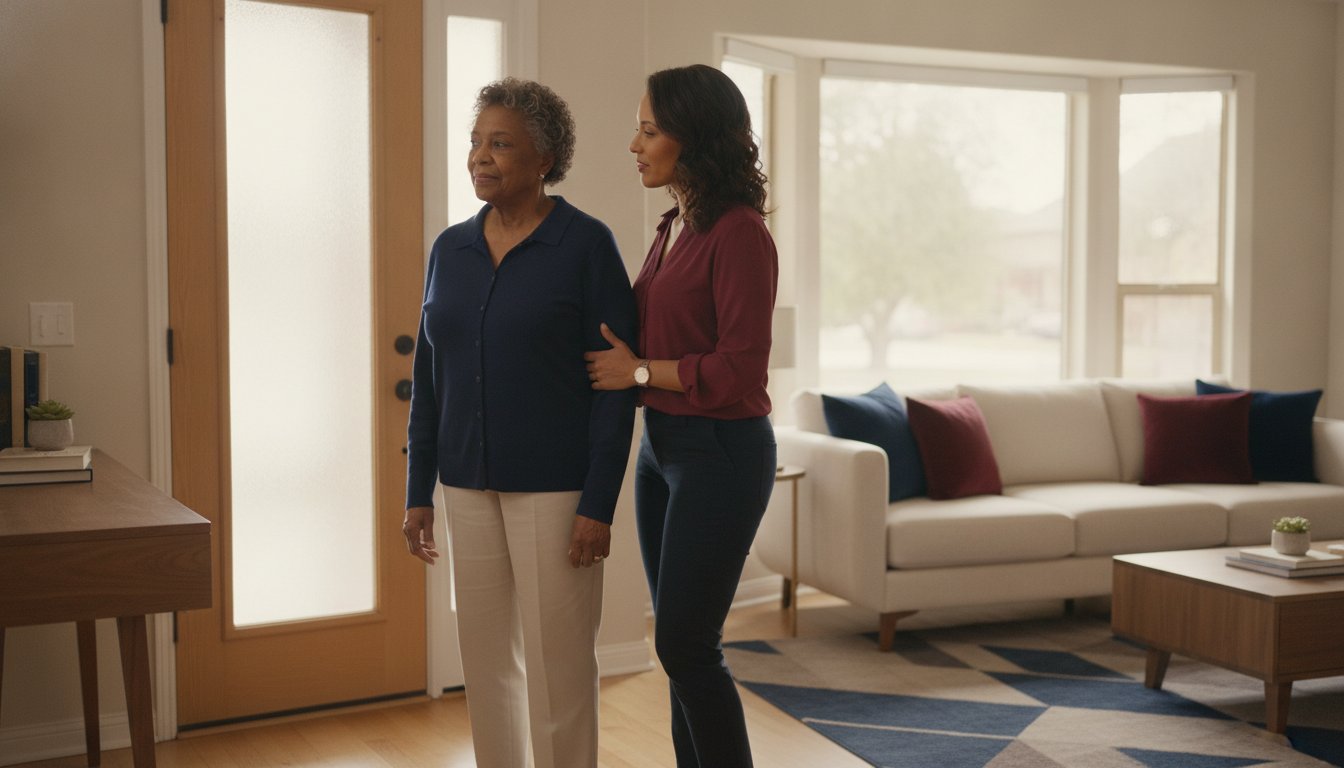
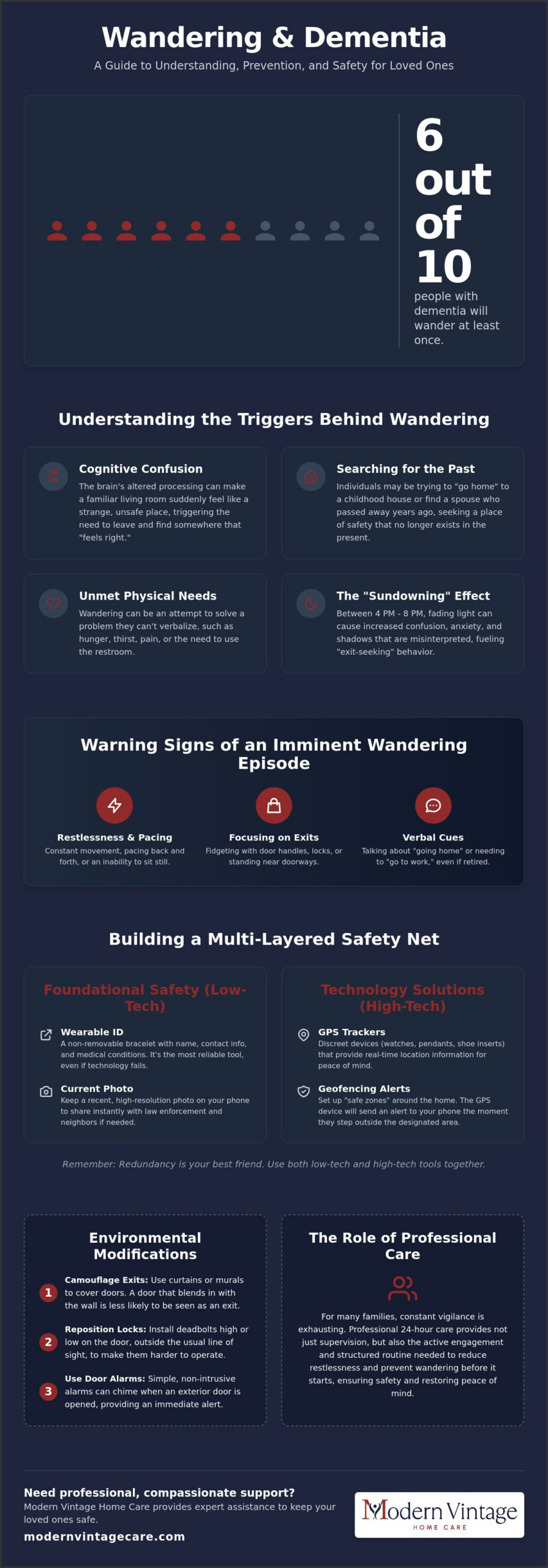
Did you know that 6 out of 10 people living with dementia will wander at least once? For the 7.4 million Americans currently living with Alzheimer’s, this impulse to move is not a behavior to be stopped, but a need to be met. If you’ve spent your nights listening for the click of a door latch or felt the sharp spike of panic when a room is suddenly empty, you aren’t alone. It’s natural to feel exhausted by the constant vigilance required for wandering prevention for dementia patients while trying to preserve your loved one’s dignity and independence.
We’re here to help you move from a state of constant worry to one of prepared confidence. You’ll learn how to identify the specific physical and emotional triggers that lead to wandering and master the environmental strategies needed to keep your loved one safe at home. This guide explores practical modifications, the latest in wearable safety technology, and person-centered supervisory techniques that provide a reliable safety net. By understanding the “why” behind the movement, you can create a secure sanctuary that protects your relative’s well-being and restores your own peace of mind.
Key Takeaways
- Understand why a familiar living room can suddenly feel unfamiliar and how this confusion triggers the urge to move.
- Discover why wearable identification and GPS tracking are essential tools for maintaining a reliable safety net.
- Learn how to use simple environmental changes, like camouflaging exit doors and repositioning locks, to reduce the impulse to leave.
- Explore how professional 24-hour care provides the active engagement needed for effective wandering prevention for dementia patients.
- Whether you are at home or away, a clear response plan ensures you know exactly where to look if an incident occurs.
Understanding Why Wandering Occurs in Dementia Patients
Wandering isn’t a sign of defiance or “bad” behavior. It’s a direct result of cognitive changes that alter how the brain processes the world. When we focus on wandering prevention for dementia patients, we must first recognize that the individual isn’t trying to be difficult. They’re often responding to an internal logic that no longer matches our shared reality. Understanding this perspective is the first step toward creating a safer environment.
One of the most disorienting aspects of dementia is the failure of spatial recall. A living room where someone has sat for thirty years can suddenly feel completely foreign. In an instant, the familiar patterns of the carpet or the placement of a chair stop making sense. To the person with dementia, their own home might suddenly look like a busy bus station or a waiting room where they don’t belong. This confusion triggers a deep-seated need to move and find somewhere that “feels” right. For a deeper look at these cognitive shifts, Understanding Dementia-Related Wandering provides helpful context on how these patterns develop and affect daily life.
This “searching” instinct often draws them toward the past. They might be looking for a childhood home or a spouse who passed away years ago. The brain is attempting to find a place of safety and familiarity that no longer exists in the present. Other times, the trigger is purely physical. A person who can’t find the words to say they’re thirsty, hungry, or in pain might simply start walking as a way to escape the discomfort. They aren’t walking “away” from you; they’re walking “toward” a solution to a need they can’t express.
The Impact of Sundowning on Wandering
As the sun begins to set, many families notice a shift known as sundowning. Between 4 PM and 8 PM, confusion often peaks and the urge to “go home” intensifies. Fading light creates long shadows that the brain may misinterpret as obstacles or strangers, leading to high anxiety. This fear fuels “exit-seeking” behavior. Providing a well-lit, calm environment during these hours is a vital part of wandering prevention for dementia patients, as it helps ground them when their surroundings feel most threatening.
Identifying Who is at Highest Risk
Certain signs suggest that a wandering episode is imminent. If you notice your loved one pacing, fidgeting with door handles, or talking about “going to work” after years of retirement, it’s time to increase supervision. The “first time” an individual wanders is often the most dangerous because the family is caught off guard. Sudden changes in medication or a disruption in a steady daily routine can also trigger restlessness. Recognizing these red flags allows you to intervene with reassurance before they reach the door.
Immediate Safety Strategies and Technology Solutions
Ensuring safety requires a multi-layered approach. It’s not just about one gadget; it’s about building a net that catches your loved one before a situation becomes critical. While we focus on wandering prevention for dementia patients, we must accept that even the most vigilant family needs a backup plan. By combining physical identification with digital tools, you create a fail-safe that works even when you’re resting.
Start with the basics: identification. A wearable ID, such as a bracelet that cannot be easily removed, is your most reliable tool. While high-tech options are popular, a simple medical alert bracelet works even if a battery dies or a cellular signal is lost. For more detailed advice on these layers, the Alzheimer’s Association provides excellent resources on Wandering Prevention and Safety. Beyond jewelry, keep a high-resolution, current photo of your loved one on your phone at all times. If they go missing, you can instantly share this with law enforcement and neighbors.
Technology has evolved to offer incredible peace of mind. Modern GPS trackers are now available as smartwatches, discreet pendants, or even shoe inserts that slip into a favorite pair of walking shoes. These devices allow you to set “geofences” that alert your phone the moment your loved one steps outside a designated safe zone. This proactive alert gives you a head start in redirecting them before they travel too far from home.
Wearable ID vs. GPS Technology
Choosing between a medical bracelet and a GPS tracker isn’t an “either/or” decision. Redundancy is your best friend. A GPS watch tells you where they are, but a bracelet tells a stranger who they are and how to help. If your loved one resists wearing jewelry, consider iron-on labels for all their clothing. These should include your contact information and a note about their memory impairment. If the daily monitoring becomes overwhelming, professional Alzheimer’s & Dementia Care can provide the extra set of eyes needed to maintain this safety net.
Digital and Community Safeguards
Your neighborhood is your greatest local asset. In a city like Houston, building a “Neighbor Alert” system can save lives. Take a moment to introduce your loved one to the people living next door and across the street. Explain the situation and provide your phone number. If they see your relative walking alone or looking confused, they’ll know exactly who to call. You should also enroll in the MedicAlert + Alzheimer’s Association Safe Return program. A Safe Return program is a national database for missing seniors that helps law enforcement quickly identify and return individuals to their families. This community-wide awareness is a vital component of wandering prevention for dementia patients.
Environmental Home Modifications to Prevent Exit-Seeking
Your home should feel like a sanctuary. But for a person with memory loss, every door is an invitation to a world that no longer makes sense. Modifying your living space isn’t about creating a locked-down environment. Instead, it’s about using visual cues and subtle changes to reduce the impulse to leave. Effective wandering prevention for dementia patients often starts with the “out of sight, out of mind” principle. If a door doesn’t look like a door, the urge to open it often disappears.
Camouflaging exits is one of the most effective ways to discourage wandering. You can paint the door the same color as the surrounding walls or cover it with wallpaper that continues the room’s pattern. Some families find success by hanging floor-to-ceiling curtains over the exit to hide the frame. These simple adjustments help the brain overlook the door entirely. For additional strategies on creating a secure living space, medical experts at UPMC offer guidance on Preventing Wandering in Dementia Patients.
Another practical adjustment involves repositioning locks. Most of us look for a lock at eye level. By moving a deadbolt to the very top or very bottom of the door, you place it outside the individual’s direct line of sight. You can also implement “invisible boundaries” using visual perception. A black mat placed in front of an exit can look like a deep hole or a dangerous gap to someone with cognitive decline. They’ll often stop and turn around rather than trying to step over it. Similarly, a simple, brightly colored “STOP” sign placed at eye level can provide a familiar command that pauses the wandering instinct.
Door and Window Security
If your loved one is prone to nighttime movement, lighting is your first line of defense. Use motion-sensor lights in hallways and bathrooms to prevent the disorientation that comes with waking up in a dark room. You might also consider the “mirror trick.” Placing a mirror near an exit can deter some patients because they don’t recognize their own reflection and may believe someone else is already standing there. While security is vital, never compromise on safety. Avoid double-cylinder deadbolts that require a key to open from the inside, as these are significant fire hazards. Instead, use simple door chimes that alert you the moment a door or window is opened.
Creating a “Safe Pacing” Path
Sometimes the need to move is simply too strong to suppress. In these cases, it’s better to provide a safe place to walk rather than trying to stop the movement entirely. Design your home to allow for a circular path. This lets your loved one wander from the kitchen to the living room and back again without hitting a dead end. Clear away all trip hazards, such as throw rugs or cluttered hallways, to prevent falls. For a more comprehensive look at securing your environment, you can refer to our Alzheimer’s care at home checklist. Creating these safe zones is a cornerstone of wandering prevention for dementia patients, as it honors their need for activity while keeping them within the safety of your home.
The Role of Professional Supervision and 24-Hour Care
The most common concern we hear from family caregivers is a simple, heartbreaking truth: “I just can’t stay awake 24 hours a day to watch them.” This exhaustion is real; it’s a physical and emotional weight that can lead to significant health issues for the caregiver. While home modifications and GPS trackers are helpful tools, they don’t replace the watchful eye of a dedicated person. Professional wandering prevention for dementia patients shifts the burden from your shoulders to a trained team, ensuring safety doesn’t depend on your ability to skip sleep.
Professional caregivers do more than just monitor doors; they provide active engagement. If a senior begins to pace or look for an exit, a caregiver can gently redirect that energy into a meaningful activity, like folding laundry or listening to music. This person-centered approach addresses the underlying restlessness before it turns into an attempt to leave. Unlike the 1-to-many staff ratios often found in larger facilities, 1-on-1 care ensures your relative is never left unattended during a moment of confusion.
For those who don’t need full-time support yet, Quick Care Services offer a flexible solution. These targeted visits are ideal for high-risk periods like the late afternoon sundowning hours or when you need to run essential errands. It’s a proactive way to maintain a safety net without feeling like you’ve lost your role as the primary caregiver. Having a professional present during these windows reduces the chance of a sudden wandering episode while you’re occupied elsewhere, making it an essential part of wandering prevention for dementia patients.
Round-the-Clock Peace of Mind
Nighttime is often the most stressful period for families. If your loved one is a nighttime wanderer, 24-hour home care in Houston provides the constant vigilance needed to keep them safe in bed. Overnight caregivers manage sleep disturbances and guide seniors back to bed with a gentle, reassuring presence. This support allows you to get the restorative sleep you need to stay healthy. If you are struggling to balance safety with your own well-being, our Alzheimer’s & Dementia Care team can help you design a schedule that works for your family.
Automated Check-Ins and Safety Monitoring
Modern support involves a blend of human connection and smart technology. Integrating automated check-ins ensures that even when a caregiver isn’t in the room, there’s a system verifying your loved one’s safety. Professional medication management also plays a critical role in prevention. By ensuring prescriptions are taken accurately and on time, caregivers help reduce the chemical imbalances and agitation that often lead to wandering. We offer specialized dementia home care services in Sugar Land that combine these structured safety protocols with compassionate, 1-on-1 attention.
Action Plan: What to Do if a Loved One Goes Missing
Panic is a natural response when you realize a loved one is gone. However, a structured plan is your best tool for a safe recovery. During the “First 15 Minutes,” focus your search entirely on the immediate area. Statistics show that most seniors who wander are located within a one-mile radius of their starting point. Check every room, closet, and under the beds, then move quickly to the backyard, the garage, and your neighbors’ properties.
If your initial search doesn’t yield results, don’t wait. Call 911 immediately. It’s vital that you inform the dispatcher right away that your loved one has a dementia diagnosis. This information changes how law enforcement responds. It bypasses standard “missing person” waiting periods and activates specialized search teams who understand the urgency of wandering prevention for dementia patients. When the police arrive, have your “Safe Return” kit ready. This should include a high-resolution, recent photograph, a list of their medications, and a list of locations they used to frequent, such as a former workplace or a childhood park.
Coordinating with Houston and Sugar Land Law Enforcement
Houston and Sugar Land residents have access to local safety registries that can speed up a recovery. You can pre-register your relative with the local police department’s “Vulnerable Person” or “Special Needs” registry. This ensures that if they’re found by an officer, your contact information and their medical history are already on file. In Texas, law enforcement can also activate a Silver Alert to broadcast the search to the public via highway signs and media. Most wanderers are found within 1.5 miles of their home, often in thick brush or briars where they may have become stuck or disoriented while seeking a familiar path.
Post-Incident Recovery and Assessment
Once your loved one is safely home, take time to breathe. A missing person incident is a traumatic event for any caregiver, and it’s okay to feel overwhelmed. After the immediate stress has passed, evaluate how the safety gap occurred. Was a door left unlocked by a guest? Did a new medication cause a sudden spike in restlessness? Closing these gaps is essential for future wandering prevention for dementia patients. If you’re struggling to manage these risks on your own, Contact Modern Vintage Home Care for a free in-home safety assessment and a personalized wandering prevention plan.
Securing Your Loved One’s Future at Home
You’ve taken a vital step toward safety by learning to identify wandering triggers and implementing environmental changes. Whether you’re camouflaging exits or setting up GPS tracking, these layers of protection provide the stability your family deserves. Effective wandering prevention for dementia patients is most successful when it combines these home modifications with the watchful, compassionate presence of trained professionals who understand the nuances of memory loss.
As a licensed Texas home care agency with specialized dementia care training, we’re dedicated to serving Sugar Land and Greater Houston families. We understand that your goal is to keep your relative safe while preserving their dignity and spirit. You don’t have to manage this delicate transition alone; expert support is available to share the weight of vigilance.
Request a Free In-Home Safety Assessment for Your Loved One to build a personalized security plan today. With the right support and a reliable strategy, you can replace constant worry with quiet confidence and focus on the cherished moments that matter most.
Frequently Asked Questions
What stage of dementia does wandering usually start?
Wandering typically begins in the middle stages of dementia as memory loss and disorientation increase. At this stage, individuals may still have the physical mobility to walk but lack the cognitive ability to navigate or recognize their surroundings. It’s the most critical time to establish a plan for wandering prevention for dementia patients before a crisis occurs.
Can I use a GPS tracker without my loved one knowing?
While you can use a GPS tracker without their knowledge, it’s best to introduce it as a standard accessory like a watch or a shoe insert. Safety is a priority, but maintaining their dignity is equally important. If they’re in the early stages, discuss the device as a way to ensure they can stay independent longer. In later stages, focus on seamless integration into their daily routine.
Is it ever okay to lock someone with dementia in their room?
You should never lock someone with dementia in their room because it creates a significant fire hazard and can cause extreme psychological distress. If they feel trapped, their agitation and desire to escape will only increase. Instead, use motion sensors, door chimes, or professional 24-hour care to ensure they’re monitored safely without compromising their basic rights or physical safety.
What is a Silver Alert and how do I trigger one in Texas?
A Silver Alert is a public notification system used to help locate missing seniors with a documented cognitive impairment. In Texas, you trigger this by contacting your local police department immediately after noticing your loved one is gone. The responding officer will verify the diagnosis and work with the Department of Public Safety to broadcast the alert across highway signs and local media.
How do I stop my parent from wandering at night?
Nighttime wandering is often managed by creating a strict bedtime routine and ensuring the home is safe and well-lit. Address physical needs like hunger or a full bladder before they go to sleep. If restlessness continues, professional overnight support provides the active supervision needed to guide them back to bed safely, which is a core part of wandering prevention for dementia patients.
Does insurance cover wandering prevention devices or home care?
Most standard health insurance and Medicare plans don’t cover the cost of GPS devices or home care services. However, if your loved one has a Long-Term Care Insurance policy or qualifies for Veterans Care benefits, these may provide financial support for professional supervision. You should always check your specific policy details or speak with a benefits counselor to understand your coverage options.
What are the most common triggers for exit-seeking behavior?
Common triggers include boredom, a desire to “go home” to a childhood residence, or searching for a deceased spouse. Physical discomforts like pain, hunger, or a need to use the bathroom are also silent triggers. When an individual can’t express these needs, they often start walking as a way to find relief or solve a problem they can’t quite identify.
How can companionship services help prevent wandering?
Companionship services prevent wandering by providing the mental and social engagement that reduces restlessness. A companion can lead activities like puzzles, walks, or conversation, which helps satisfy the senior’s need for movement in a controlled way. By having someone present to redirect their attention, the impulse to seek an exit is often replaced by a sense of calm and connection.