
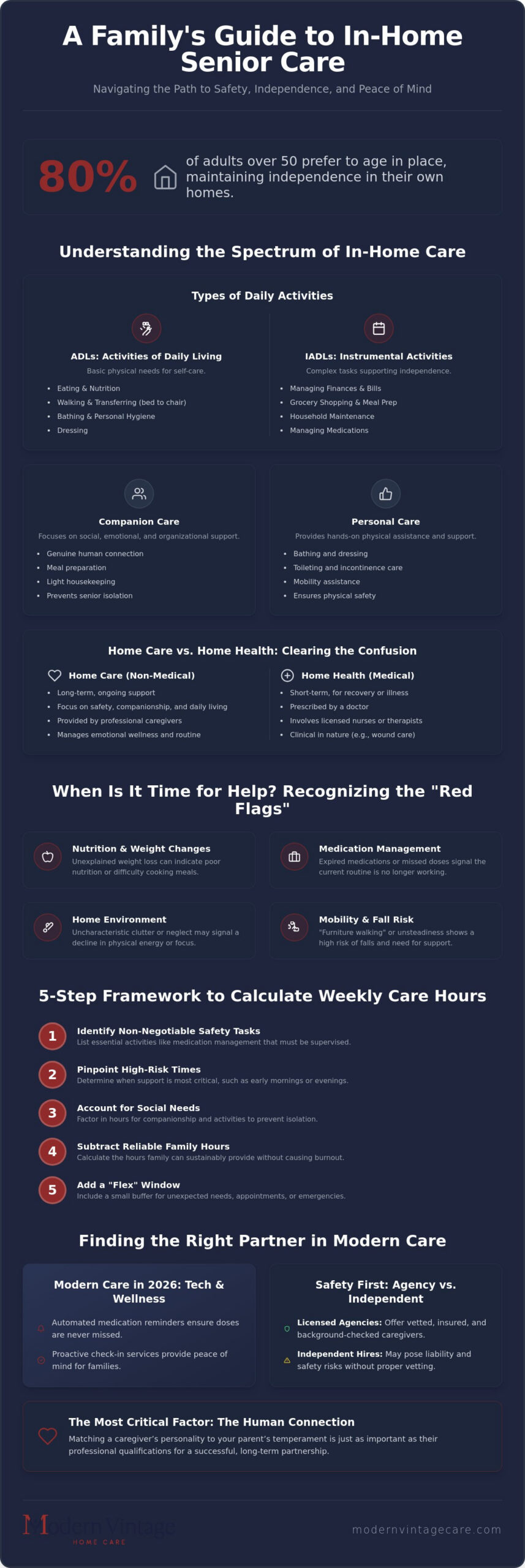
Last Tuesday, Sarah sat at her kitchen table with a stack of notes and a heavy heart, wondering if she was failing her father because she couldn’t be there every hour of the day. You likely feel that same weight of responsibility, mixed with a nagging fear about inviting a stranger into your loved one’s sanctuary. It’s common to feel overwhelmed by the difference between medical and non-medical terms or to worry about the safety of your parent when you aren’t around. With 80% of adults over 50 preferring to age in their own homes, your desire to find the right support is a deeply compassionate goal.
We believe that seeking in home help for elderly family members shouldn’t be a source of guilt, but rather a bridge to a safer and more vibrant life. You want a clear plan that keeps your parent independent while reducing the daily stress that currently rests on your shoulders. This guide offers a reliable framework for identifying specific needs and evaluating caregivers with total confidence. We will walk through how to assess safety, understand modern care technology, and ultimately find a professional partner who respects your family’s unique spirit.
Key Takeaways
- Learn the essential differences between basic daily activities and instrumental support to pinpoint exactly where your loved one needs a helping hand.
- Discover how to perform a home safety audit and recognize the subtle red flags that indicate it’s time to consider in home help for elderly family members.
- Navigate the financial landscape of senior care while understanding the vital safety differences between independent caregivers and licensed agencies.
- Explore how proactive tools like automated medication reminders and check-in services are redefining safety and independence in 2026.
- Understand why matching a caregiver’s personality to your parent’s temperament is just as important as their professional qualifications for a long-term partnership.
Understanding the Spectrum of In-Home Help for Seniors
In-home help for elderly loved ones is often misunderstood as a purely clinical or medical service. In reality, it’s a comprehensive non-medical support system designed to help seniors maintain their independence within the comfort of their own four walls. As we move through 2026, the modern care model has shifted significantly toward “aging in place.” This philosophy prioritizes keeping individuals in their familiar surroundings rather than transitioning to facilities, as research consistently shows that seniors thrive when they remain in their own communities and routines.
To understand what level of support your parent needs, it helps to look at two specific categories of daily life. Activities of Daily Living (ADLs) involve basic physical needs like eating, walking, or moving from a bed to a chair. Instrumental Activities of Daily Living (IADLs) are more complex tasks that support independent living, such as managing bills, grocery shopping, or keeping up with household maintenance. Identifying exactly where these gaps exist allows you to build a care plan that provides support without stripping away a senior’s autonomy.
Companion Care vs. Personal Care
Choosing between these two depends on your loved one’s physical health and cognitive requirements. Companion care is primarily social and organizational. It includes meal preparation, light housekeeping, and genuine human connection. Personal care is more intensive; it involves “hands-on” assistance with bathing, dressing, and toileting. If your parent is physically mobile but forgets to eat or feels lonely, companionship might be the answer. If they struggle with mobility or hygiene, personal care provides the necessary physical safety they need to stay at home.
Home Care vs. Home Health: Clearing the Confusion
The terms “home care” and “home health” are often used interchangeably, but they serve very different purposes. Home health is medical in nature, involving licensed nurses or physical therapists, and is usually prescribed by a doctor for short-term recovery. In contrast, home care is non-medical and focuses on long-term consistency and safety. While understanding home care services is vital for long-term planning, many families find that a hybrid approach works best. This ensures that medical needs are met by clinicians while daily safety and emotional wellness are managed by a dedicated care partner.
Beyond the physical tasks, the emotional value of a consistent care partner is vital. Senior isolation is a quiet crisis that often leads to depression and declining physical health. A caregiver doesn’t just watch over a senior; they become a friend who listens to stories, shares meals, and keeps the mind engaged. This social interaction is often the most critical element in preserving a senior’s spirit and overall quality of life.
How to Assess Your Loved One’s Need for Assistance
Recognizing the need for in home help for elderly parents often begins with quiet observation during a routine visit. You might notice subtle shifts in their environment or behavior that suggest daily tasks are becoming a burden. Conducting a baseline “Home Safety and Independence” audit is the first step toward clarity. This isn’t about judging their abilities, but rather identifying where a supportive partner can step in to preserve their dignity and safety. Look for specific “Red Flag” behaviors that indicate a change in status. Unexplained weight loss often points to poor nutrition or difficulty cooking; uncharacteristic clutter may signal a decline in physical energy or cognitive focus. If you find expired medications or missed doses, it’s a clear sign that the current routine is no longer working.
Determining the right amount of support doesn’t require jumping into a 24-hour schedule immediately. We recommend a 5-step framework to calculate weekly hours. First, list non-negotiable safety tasks like medication management. Second, identify high-risk times, such as early morning dressing or evening meal prep. Third, account for social needs to prevent isolation. Fourth, subtract the hours family members can reliably and healthily provide. Finally, add a small “flex” window for unexpected needs. Starting with Quick Care or short, targeted visits often feels less intrusive for a senior than a full-day presence. It allows them to build trust at their own pace.
The ‘ADL’ Checklist for Families
- Walking and transferring: Observe how they move from a chair to a standing position. Are they “furniture walking” or showing a high fall risk?
- Nutrition: Check the pantry. Are they eating fresh, balanced meals, or are they relying on processed snacks because cooking has become too difficult?
- Hygiene: Notice any changes in personal grooming, laundry habits, or a lingering scent in the home that suggests bathing has become a challenge.
Overcoming Resistance: Having the ‘Care Conversation’
It’s natural for seniors to feel defensive when the topic of assistance arises. They often fear that accepting help is the first step toward losing their home. To ease this transition, use “I” statements to express your feelings. Instead of saying “You aren’t cleaning the house,” try “I feel worried about your safety when I see the stairs are cluttered.” Framing in home help for elderly loved ones as a way to maintain independence is vital. It’s about offloading the chores so they can focus on the activities they actually enjoy. A “Trial Period” strategy is also highly effective. Suggest introducing a caregiver for just two hours a week to help with a specific task, like grocery shopping or a deep clean. This low-pressure approach often leads to a natural, comfortable bond. If you’re unsure where to start, considering Quick Care Services for these brief sessions can provide a gentle introduction to professional support.
The Cost and Safety Framework: Evaluating Your Options
Financing in home help for elderly parents often feels like a complex puzzle, but several paths exist to make quality care sustainable. Most families start with private pay, yet it’s vital to review any existing long-term care insurance policies that may have been tucked away years ago. These policies are designed specifically for non-medical assistance. If your loved one is a wartime veteran or a surviving spouse, they may qualify for the Department of Veterans Affairs “Aid and Attendance” benefit. This provides a monthly stipend to help cover the costs of personal care and companionship. Whether you are using insurance or personal savings, the goal is to create a stable environment that prevents expensive emergencies.
When comparing options, you might find that 24-hour care in the comfort of home is actually more cost-effective than a high-end assisted living facility. In a facility, your parent is one of many; at home, they receive dedicated, one-on-one attention. This personalized focus often prevents the “revolving door” of hospital visits. To further protect your budget and your loved one, a professional in-home safety assessment for seniors Sugar Land is a wise first step. Identifying simple environmental risks early prevents the physical and financial trauma of a fall, which is a leading cause of long-term healthcare spending.
Agency vs. Independent Caregivers: A Risk Analysis
Choosing between a licensed agency and an independent “registry” caregiver involves more than just the hourly rate. You must consider the hidden liabilities that come with being a direct employer.
- Liability and Insurance: If an independent caregiver is injured while lifting your parent, you as the homeowner may be legally responsible for their medical bills and lost wages. Licensed agencies carry workers’ compensation and liability insurance to protect your family.
- Vetting and Safety: Agencies perform rigorous background checks and verify references before a caregiver ever enters a home. This provides a layer of security that is difficult for a busy family to replicate on their own.
- Reliable Back-up Care: If an independent caregiver gets sick or has a family emergency, you are suddenly left without support. An agency maintains a team of professionals, ensuring that a qualified partner is always available to step in.
Maximizing Veterans Home Care Benefits
For those who served, Veterans Care benefits can be a lifeline. The Aid and Attendance benefit is specifically for veterans who need help with daily activities like bathing or dressing. Local agencies in Sugar Land often have established relationships with the VA to help streamline the paperwork and ensure care begins as quickly as possible. These benefits also extend to the spouses of veterans, acknowledging the sacrifices made by the entire family unit. Whether your loved one needs help with medication management or simple companionship, these earned benefits ensure they receive the respect and support they deserve without exhausting the family’s resources.
Modern Care in 2026: Integrating Technology and Wellness
Modern support in 2026 has moved beyond simple presence; it’s now about proactive wellness. Digital care logs allow families to see real-time updates, which is a massive relief for those living out of state. If a daughter in Chicago wants to know if her father in Houston enjoyed his lunch, she can check the secure log instantly. This transparency builds a circle of trust between the family and the professional team providing in home help for elderly relatives. It turns care into a shared journey rather than a series of disconnected updates.
For many families, full-day support isn’t necessary yet. Quick Care services bridge this gap by offering targeted 1-2 hour visits. These short sessions focus on high-impact tasks like meal prep or a safety walkthrough. This ensures that a senior remains independent without feeling overwhelmed by a constant presence in their home. It’s a flexible way to introduce support as needs naturally evolve.
The Safety Power of Automated Check-ins
Automated wellness calls act as a vital safety net between scheduled caregiver visits. These calls ensure that if a senior doesn’t answer or needs help, an alert is triggered immediately. This technology significantly reduces caregiver fatigue for family members by outsourcing the constant “just checking in” calls to a reliable system. Whether a parent is recovering from surgery or simply needs a morning greeting, these check-ins are a cornerstone of a home care for elderly living alone plan.
Medication Management: Beyond the Pill Box
Polypharmacy, or the use of multiple medications, is a significant risk for the elderly. Mistakes with dosage or timing often lead to adverse reactions that could have been avoided with professional oversight. Utilizing automated medication reminders for seniors Sugar Land ensures that the right dose is taken at the right time. Medication management is the #1 factor in preventing ER visits. This proactive approach keeps your loved one safe while giving you peace of mind that their health is being monitored with precision. To see how these safety tools can support your family’s routine, consider learning more about our personalized technology services.
Finding the Right Partner in Sugar Land and Houston
Choosing a provider for in home help for elderly family members in the Sugar Land area requires a team that understands the local landscape of Fort Bend County. A provider with deep roots in neighborhoods like Greatwood, First Colony, and Sienna can better manage logistics and tap into community-specific resources. Beyond the zip code, the connection between the caregiver and your parent is the most important element. A senior who thrives on quiet routine needs a different temperament than one who enjoys active storytelling. This personality matching is what transforms a professional service into a trusted companionship that respects the individual’s spirit.
For families facing more complex health journeys, dementia home care services Sugar Land provide the specific expertise needed to manage memory loss with patience and dignity. A professional intake process should feel thorough but never rushed. It’s a time for the agency to listen to your family’s story, understand your parent’s unique requirements, and map out a plan that respects their established routine. When the right in home help for elderly relatives is in place, the entire family unit feels a sense of relief, knowing that safety and emotional wellness are being prioritized by experts who truly care.
Vetting a Local Sugar Land Agency
When you interview a local agency, ask about their specific training programs for Alzheimer’s and Parkinson’s care. Inquire about their caregiver retention rates; high turnover often disrupts the stability your parent needs to feel secure. You should also verify their Texas licensing and look for a strong reputation within the local community. The support tools we discussed earlier, such as digital logs and automated check-ins, should be a standard part of their offering to ensure transparency and peace of mind for out-of-town relatives.
The Modern Vintage Home Care Approach to Personalized Care
At Modern Vintage Home Care, we believe in a philosophy that combines “Vintage” compassion with “Modern” safety technology. Our roots are firmly planted in the Sugar Land and Missouri City communities, and we treat every family with the same gentleness and respect we would show our own. We understand that this transition is sensitive, and we’re here to act as your steady advocate and compassionate guide. To begin this journey with a team that prioritizes your loved one’s dignity and independence, schedule your complimentary in-home assessment today.
Empowering Your Loved One’s Independence
Finding the right path for your parent doesn’t have to be a journey you take alone. By understanding the spectrum of care and utilizing modern safety tools like automated check-ins, you can ensure their dignity remains intact while your stress is reduced. Whether you are navigating a new diagnosis or simply noticing a need for more companionship, the right support system makes aging in place a vibrant reality. Choosing professional in home help for elderly family members is a proactive step that prioritizes long-term safety over reactive crisis management.
As a provider licensed by the State of Texas, we specialize in Alzheimer’s and dementia care for families throughout Sugar Land and Greater Houston. We are here to act as your steady advocate, combining heartfelt compassion with the reliability of modern technology. You deserve a partner who respects your loved one’s unique spirit and your family’s peace of mind. To begin building your personalized plan, Book Your Free In-Home Consultation in Sugar Land. Take heart in knowing that with the right support, your loved one can continue to thrive in the home they love.
Frequently Asked Questions
What is the difference between home care and home health?
Home health provides medical services like wound care or physical therapy prescribed by a doctor, whereas home care focuses on non-medical support for daily living. Home care includes personal care, meal preparation, and companionship to help seniors stay safe in their own homes. While home health is often short-term for recovery, home care offers the consistent, long-term support many families need for their loved ones.
How much does in-home help for the elderly cost in Sugar Land?
The cost of care depends on the specific level of support required and the number of hours requested each week. Factors such as specialized dementia care or 24-hour monitoring will influence the final plan. Because every family’s needs are unique, we provide a personalized assessment to determine a sustainable schedule. This ensures you only pay for the exact in home help for elderly relatives that your loved one needs to remain independent.
Can we get in-home help for just a few hours a week?
Yes, you can schedule support for as little as one or two hours through our Quick Care Services. These short visits are ideal for specific tasks like grocery shopping, light housekeeping, or providing a safety check-in. This flexible approach allows families to ease into professional support without the commitment of a full day. It’s an excellent way to build trust between your parent and their new care partner.
Does Medicare pay for non-medical in-home help?
Medicare typically does not cover non-medical custodial care, such as help with bathing, dressing, or meal preparation. It’s designed to pay for short-term, skilled medical services provided by home health agencies following a hospital stay. Most families utilize private pay, long-term care insurance, or Veterans benefits to cover the costs of in home help for elderly family members. We can help you review these options during your initial consultation.
How do I convince my parent to accept a caregiver?
Start by framing the conversation around your own peace of mind rather than their limitations. Use “I” statements to explain that having a little extra help around the house would make you feel much better about their safety. Suggesting a trial period for just a few hours a week often feels less threatening than a permanent change. This allows them to see the caregiver as a helpful assistant rather than a loss of autonomy.
What happens if our assigned caregiver is a poor fit?
We prioritize a strong personality match from the beginning, but we’ll immediately facilitate a change if the connection isn’t right. Your loved one’s comfort and dignity are our highest priorities, so we listen closely to your feedback. If a senior’s temperament doesn’t align with a specific caregiver, we’ll introduce a new partner who better suits their lifestyle. This ensures the relationship remains a source of joy and support.
Are your caregivers trained specifically for dementia and Alzheimer’s?
Yes, our team receives specialized training to handle the unique challenges associated with memory loss and cognitive decline. This includes learning techniques for redirection, managing repetitive behaviors, and ensuring a calm, safe environment. We understand that dementia care requires a high level of patience and empathy. Our goal is to provide a sense of routine and security that helps seniors with these conditions feel grounded and respected.
How do you ensure my loved one’s safety when I’m not there?
We utilize a combination of professional presence and modern safety technology to provide a continuous safety net. This includes automated medication reminders and wellness check-ins that trigger alerts if a senior doesn’t answer. Digital care logs also keep you updated in real-time, so you always know what happened during a visit. These layers of protection ensure your parent is never truly alone, even when a caregiver isn’t physically in the room.