

What if changing home care providers could protect your loved one’s routines rather than unsettle them? If you’re wondering how to switch home care providers Missouri City families can rely on, it’s natural to feel unsure about when to give notice, what care details to pass along, and how your loved one will respond to unfamiliar caregivers.
A provider change affects more than a schedule. Familiar routines, personal preferences, and trust all matter in daily care. With a thoughtful plan, your family can coordinate the transition, reduce the chance of a gap in support, and help your loved one feel heard and included.
This guide walks through the process, from reviewing your current agreement to preparing a care handoff and introducing new support. You’ll learn what to share about routines, safety, and medication reminders, so the next care arrangement can better fit your family in Missouri City, Texas, and the surrounding Sugar Land and southwest Houston area.
Key Takeaways
- Look for recurring changes in care needs, communication, or caregiver fit that may signal it’s time to reassess the arrangement.
- Separate essential daily support from comfort preferences, then map routines, schedules, and family communication roles.
- Use a handoff checklist to capture routines, safety considerations, communication preferences, and relevant care-plan details.
- To plan how to switch home care providers Missouri City families can use a clear sequence: identify needs, review current agreement terms, organize information, plan timing, and communicate.
- Explore in-home support that fits current needs, including dementia care, personal care, companionship, medication reminders, or 24-hour care.
When should a family consider switching home care providers in Missouri City?
Considering a change can feel personal when your loved one relies on familiar caregivers and daily rhythms. A missed visit or difficult interaction can be upsetting, but one hard day alone doesn’t necessarily mean the arrangement needs to end. Look for patterns over time, and consider whether the support respects the older adult’s dignity, preferences, and independence.
Start with what has changed. Your loved one may need more help with dressing or personal routines, or memory changes may make steady routines and familiar cues more important. If their needs have grown beyond what the current arrangement can comfortably address, reassess whether the care is still a good fit.
Notice recurring practical concerns, too: schedule changes that disrupt important routines, unanswered questions about care, or difficulty adapting support to your loved one’s preferences. These are useful signs to evaluate the overall arrangement, not reasons to blame an individual caregiver.
Home care and hospice encompass a broad professional landscape. The National Association for Home Care & Hospice (NAHC) offers general context on the industry. For your family, the central question is whether daily support meets your loved one’s current needs and helps them feel comfortable at home.
What may signal that the current care arrangement no longer fits?
Consider what happens throughout the day, not just what appears on the schedule. Are essential tasks supported as needs change? Are visits and communication predictable enough for the household? Does the caregiver’s approach work with established routines, such as a preferred time to get dressed or a quiet period after lunch? Include the older adult’s perspective, since their comfort and preferences are central to a good fit.
Keep a brief record of recurring concerns. Note what happened, when it happened, and how it affected the day. This can help distinguish an isolated mix-up from a pattern that needs attention. If the person has Alzheimer’s or dementia, changes in how they respond to routines or support may also be helpful to discuss with family and care professionals.
How can families discuss a possible change with compassion?
Choose a calm moment rather than raising the subject during a stressful visit. Describe what you’ve observed without criticizing an individual caregiver. For example, “The schedule has been hard to plan around” is more constructive than a personal accusation. Ask what your loved one values most about the current support, whether that’s a familiar routine, companionship, or help with a particular daily task.
Keep the conversation focused on improving fit, comfort, and continuity, rather than treating a change as a failure. If your loved one can take part, give them time to share concerns and preferences. Families learning how to switch home care providers Missouri City can use these observations to guide the next planning conversation while keeping the older adult’s voice at the center.
What to clarify before changing home care in Missouri City
Before planning a transition, make a clear picture of what your loved one needs today, not only what the original care arrangement was designed to provide. Separate essential support, such as help with dressing or meals, from preferences that make the day more comfortable, like a familiar greeting or a quiet rest after lunch. Both matter, but distinguishing them helps your family explain priorities and identify what has changed.
For families researching “how to switch home care providers Missouri City,” this needs assessment is a useful starting point. Write down the schedule, household rhythms, communication expectations, and who in the family usually shares updates or makes decisions. A short summary gives everyone a common reference and helps prevent important details from getting lost in conversation.
How to describe the support your loved one needs now
Describe specific tasks and timing instead of relying on broad labels such as “needs more help.” For example, note whether support is useful with getting dressed in the morning, preparing for bed, or staying engaged during the day. Include how your loved one prefers assistance to be offered and what helps them feel at ease. Record differences between weekdays, evenings, overnight hours, and family visits.
- Essential support: List daily activities where assistance is needed and the usual time of day.
- Comfort and routine: Record preferred communication styles, familiar habits, and calming activities.
- Schedule variations: Note when family members are present and how needs change at different times.
- Family coordination: Identify who shares updates and the best way to communicate them.
This overview can clarify what type of in-home support may fit, such as companionship, personal care, memory support, or more frequent supervision. Modern Vintage Home Care provides non-medical in-home care. Skilled nursing and home health are distinct services, so keep those needs separate when describing the support your family is seeking.
How changing memory or medication needs affect the handoff
If memory needs have changed, write down approaches that help your loved one feel safe and oriented. This might include familiar words, a gentle reminder before a routine task, or keeping daily activities in a predictable order. Families looking for more context on memory-support approaches can read about specialized dementia home care in Sugar Land.
For medication coordination, organize the current schedule and note how reminders are preferred, such as a verbal cue at a familiar point in the routine. Keep the information clear and current, and distinguish reminder preferences from instructions provided by the person’s health professional. A summary of needs and routines can also help your family discuss in-home senior care in Missouri City.
How to hand off care details without losing important routines
A useful handoff gives the incoming care team a practical picture of daily life, not just a task list. It transfers important support information while preserving the routines that help someone feel at home. Prepare the details in writing, then share what is relevant through an agreed communication channel. Limit personal information to what’s needed to coordinate care.
Which care details should families organize for the transition?
Gather the current schedule, your loved one’s preferences, and notes about what makes familiar routines easier. Include relevant medication instructions and reminder preferences for appropriate coordination, along with emergency contacts and household guidance. For example, explain how the person prefers to be approached in the morning, where commonly used items are kept, and whom the family wants contacted with updates.
Organize the handoff around three questions: what information matters, why it matters, and who should receive it. Share relevant details with the incoming care contact and family members involved in coordinating support. Use the agreed channel rather than distributing sensitive information broadly.
- Daily routine and schedule: Note usual visit times, the preferred order of activities, and what helps the day go smoothly. This gives the caregiver practical guidance for supporting the routine.
- Communication preferences: Describe how the older adult likes to be spoken to and how family members prefer to receive updates. Share this with the care contact and relevant family point person.
- Safety and household guidance: Record important considerations about moving through the home, commonly used items, or household routines. Share only details relevant to the person’s support with the appropriate care contact.
- Care-plan and medication details: Gather relevant support instructions, medication schedule information, and reminder preferences. Share through an agreed channel with those coordinating care, keeping medication directions consistent with guidance from the person’s health professional.
- Emergency contacts: Provide current names and contact information for people to reach if a concern arises, and clarify which family member should be contacted first.
How can families preserve familiarity during a provider change?
Keep valued routines steady where possible as new support begins. Familiar activities, preferred conversation topics, and a calm approach can help a caregiver learn what feels comfortable to the older adult. If the person has memory changes, share the words or gentle cues that help them feel oriented, as well as approaches that tend to cause confusion or distress.
For medication-safety context, families can review this guide to medication management for elderly seniors. When considering how to switch home care providers Missouri City families can use a written handoff to carry forward helpful routines and preferences while adapting support to current needs.
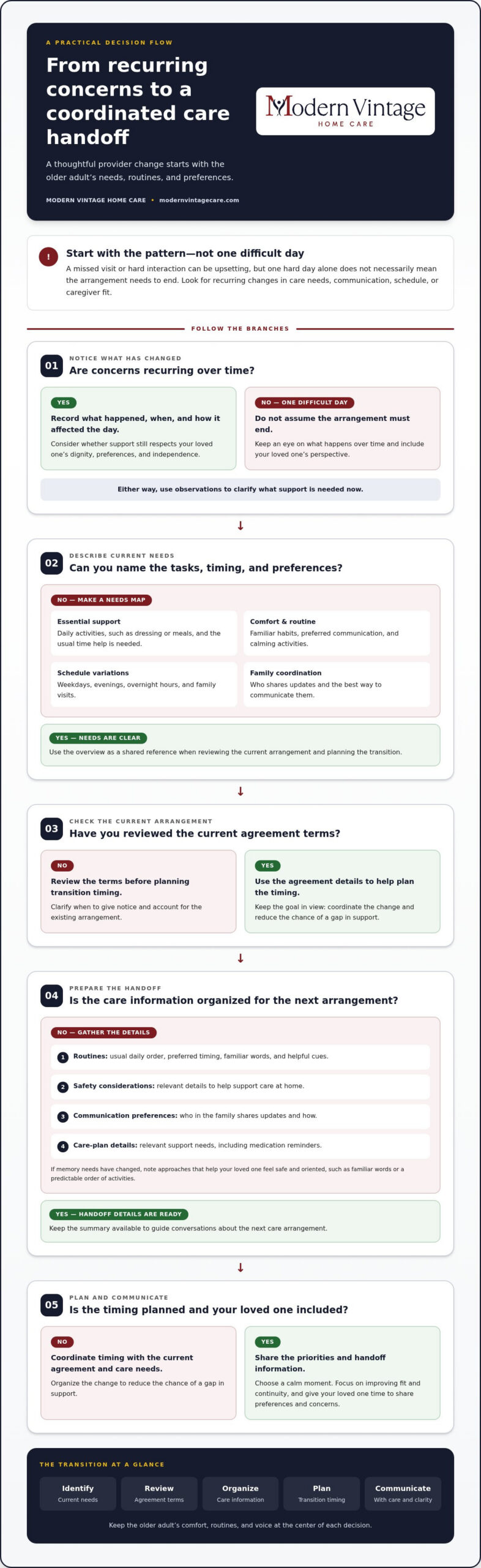
A practical step-by-step plan for switching home care in Missouri City
A provider transition is easier to coordinate when your family knows what needs to happen first, who will handle each conversation, and which details must carry forward. Identify needs, review the agreement, prepare the handoff, set a realistic date, and communicate clearly. The right timing depends on your family’s situation. Use these steps as a guide and adjust the pace to your loved one’s needs and comfort.
- Identify current needs. Write down the support your loved one needs now, including which parts of the day require assistance and what routines help them feel settled. Note priorities that have changed since care began, so your next discussions focus on current needs rather than assumptions.
- Review the current agreement. Read the home care agreement for notice provisions, transition details, and terms about ending services. This helps you understand the communication and timing required by the existing arrangement. Keep relevant information with your transition notes.
- Organize the handoff information. Bring together the schedule, household routines, communication preferences, relevant care-plan details, medication reminders, and emergency contacts. Keep the summary clear and share appropriate information through an agreed channel with those coordinating care.
- Plan a realistic transition date. Consider the current schedule, the older adult’s emotional comfort, and the time needed to prepare for a new routine. Where possible, coordinate the intended start date before ending the current arrangement to reduce the chance of an unplanned gap in support. A gradual introduction or brief overlap may be worth discussing if it would help preserve familiarity.
- Communicate with the right people. Decide who will speak with the current provider and who will keep family members informed. Share the planned transition date and essential care details with the people involved, and make sure everyone understands who is responsible for follow-up.
How to coordinate timing and communication
Keep communication calm and specific. One family member can serve as the main contact while another updates relatives who need to know about schedule changes. Use the agreement to guide notice and transition conversations, then share the date and key handoff information with the relevant people. If plans change, update those affected promptly so the older adult knows who is coming and when.
What to do if care needs include dementia or round-the-clock support
For a person living with dementia, carry forward familiar cues, preferred language, and the order of daily activities wherever practical. If support is needed throughout the day, map when supervision is required, including overnight periods and changes in family coverage, before setting transition timing. Families considering continuous support can explore 24-hour home care in Houston while planning around these needs.
Families wondering how to switch home care providers Missouri City can use this sequence to turn a stressful decision into manageable conversations and tasks. If you’re planning a change, talk with Modern Vintage Home Care about in-home support that reflects your family’s needs.
Explore in-home care options in Missouri City
Once your family has clarified which support matters most, consider care options that reflect your loved one’s daily needs and preferred routines. Modern Vintage Home Care serves Missouri City, Sugar Land, and the greater Houston area with non-medical in-home senior care. Support can address practical needs such as personal routines, companionship, memory care, or more continuous assistance.
As you explore how to switch home care providers Missouri City families can use their needs summary to guide a conversation about suitable support. Explain what is working, what has changed, and which familiar routines matter to your loved one. Keep dignity and comfort at the center of the discussion rather than rushing a decision.
What support can Modern Vintage Home Care provide?
Different services can address different parts of the day. Alzheimer’s and dementia care supports older adults living with memory changes, with attention to routines, safety, and quality of life at home. Personal care helps with daily activities, while companionship provides social engagement. Medication management and automated medication reminders support medication-related routines; reminders are distinct from medication instructions provided by a health professional.
- Alzheimer’s and dementia care: Support for older adults living with memory changes, with attention to routines, comfort, and quality of life at home.
- Personal care and companionship: Assistance with personal routines and social engagement, based on the person’s needs and preferences.
- Medication reminders and automated check-ins: Automated reminders and check-ins that can be part of a family’s support plan.
- 24-hour care: In-home support for families seeking care throughout the day and night.
- Quick Care Services: Short-term care visits and specialized assistance for a range of lifestyle needs.
Other services may also suit particular circumstances. Respite care can give family caregivers a break, while hospice support, veterans care, and concierge services address other individual needs. Discussing daily routines and support priorities can help your family identify which services fit.
How to begin a conversation about changing care
You don’t need a perfect plan before starting a conversation. Describe what your loved one’s days look like, what has changed, and which kinds of assistance could make daily life more manageable. Mention preferences that help preserve familiarity, such as a calm approach, a preferred routine, or the way your loved one likes to receive reminders. These details keep the discussion focused on the person, not just a schedule of tasks.
If your family is considering a change, contact Modern Vintage Home Care to discuss your loved one’s needs and preferred routines. A calm conversation can help you consider the next step at your own pace.
Take the next step at your family’s pace
A change in care can be an opportunity to shape support around the person your loved one is today. You don’t need every detail settled before starting a conversation. Bring your questions, describe the routines that matter, and talk through what kind of help feels appropriate for your family.
For families considering how to switch home care providers Missouri City, Modern Vintage Home Care is an independent local agency licensed in Texas. Its in-home services include specialized Alzheimer’s and dementia care, automated check-ins, and medication reminders, which can support a conversation about changing needs and familiar routines.
Start with a conversation focused on your loved one’s comfort, preferences, and day-to-day support. Talk with Modern Vintage Home Care about support in Missouri City and discuss a thoughtful next step for your family.
Frequently Asked Questions
How much notice should I give before switching home care providers?
Give the notice described in your current home care agreement, since timing and transition terms can differ. Read the section about ending services and note any steps or dates it specifies before making a change. If the wording is unclear, ask the current provider to explain its process in writing. Families learning how to switch home care providers Missouri City can use that information to plan a start date and discuss scheduling without assuming one notice period applies to everyone.
Can I switch home care providers if my loved one has dementia?
Yes, a dementia diagnosis doesn’t prevent a family from considering a provider change. To make the transition more comfortable, involve your loved one as much as they’re able and explain the change in simple, reassuring terms. Keep familiar objects and activities in place, and share cues that help them feel oriented. If confusion or distress increases, pause and consider what adjustment could make the transition gentler.
What should I do if I am unhappy with a caregiver but not the whole agency?
Start by explaining the specific concern to the agency’s appropriate contact and describing what would help, such as clearer arrival updates or a different approach to a daily task. You can discuss a caregiver change or another adjustment without immediately deciding to end the overall arrangement. Keep notes on what you’ve raised and any response so you can assess whether the change addresses your concern.
Can home care continue while a new provider is being arranged?
It may be possible to continue current care while coordinating a new arrangement, depending on the existing agreement and scheduling. Before ending current services, discuss the transition date with the current provider and coordinate the intended start date for the new arrangement. If a gap seems possible, identify which family members can help with essential tasks during that period. Don’t assume an overlap is automatic; make the timing clear with everyone involved.
What information should I share when changing home care providers?
Share information that helps the incoming care team understand your loved one’s daily support, including preferred ways to offer assistance, household routines, communication needs, and relevant safety considerations. Clarify who in the family is the main contact and how updates should be shared. For medication-related support, provide current reminder preferences and appropriate instructions through an agreed channel. Limit sensitive details to people involved in coordinating care.
Does Medicare pay for non-medical home care in Missouri City, Texas?
Original Medicare generally doesn’t cover ongoing non-medical personal care or companionship when that’s the only care needed. Coverage can depend on the type of service and the person’s circumstances, so review current plan information or contact Medicare or the health plan directly for guidance. Keep non-medical in-home support distinct from other kinds of care when discussing coverage, and don’t assume a service is covered based only on its location in Missouri City.
What if my loved one refuses to change home care providers?
Take the refusal seriously and ask what feels uncomfortable about the idea. Your loved one may worry about losing a trusted caregiver, changing a routine, or meeting someone unfamiliar. If the situation allows, discuss concerns without pressure and consider whether a smaller adjustment could help. Give your loved one a voice in preferences such as visit routines or introductions. If safety or decision-making concerns are part of the situation, seek guidance from an appropriate health professional.