
When you live far away, brief calls and scattered family messages can leave important details uncertain. Learning how to monitor a parent’s care from afar starts with noticing meaningful changes and agreeing on how to follow up. It also means respecting your parent’s independence: constant tracking can feel intrusive and may not provide the context you need.
You can seek dependable information while giving your parent a say in how support works. Start by agreeing on how to share updates, who can check in locally, and what changes call for a conversation or additional help.
This guide walks through a practical plan, from discussing consent and organizing family updates to choosing appropriate check-in methods. You’ll also learn how local in-home support, companionship, automated check-ins, and medication reminders can complement family involvement, and how to respond thoughtfully when needs change.
Key Takeaways
- Learn how to monitor a parent’s care from afar by tracking meaningful changes and following up, while respecting your parent’s independence.
- Agree on roles for family and trusted local contacts, and organize updates into observations, questions, and next steps.
- Choose check-in methods that suit your parent, from regular calls and visits to appropriate technology-assisted tools.
- Use a repeatable review routine to spot patterns, discuss concerns, and decide what to do next without trying to diagnose a condition.
- Consider how local in-home support in Sugar Land, including companionship, personal care, and dementia care, can complement family involvement from a distance.
How to Monitor a Parent’s Care From Afar Without Losing Sight of Their Independence
It can be unsettling to hear a change in your parent’s voice or learn that a routine has shifted when you can’t be there to understand why. Distance doesn’t prevent you from offering thoughtful support. A useful approach to how to monitor a parent’s care from afar is to notice patterns, share relevant updates with the right people, and arrange appropriate follow-up, rather than trying to oversee every moment.
A missed call or difficult day is a reason to gather context, not jump to a conclusion. Your parent may have been busy, tired, or simply having an off day. Ask gently what happened and compare it with what you’ve noticed before. A recurring change may call for a conversation or follow-up; one isolated moment may not.
During calls and visits, pay attention to changes in:
- Daily routines, such as getting dressed, preparing meals, or keeping up with household tasks
- Mood, energy, or interest in activities and social connection
- Meals and whether your parent says they are eating as usual
- Medication routines, including whether reminders are helpful or becoming harder to manage
These are observations, not diagnoses. Note what you noticed and when, then share it respectfully with your parent or an appropriate care professional if follow-up is needed. Caregiving can involve practical and emotional challenges; Understanding Caregiving offers a general overview of the role.
Respectful monitoring notices meaningful changes and supports informed choices. Surveillance tracks someone without regard for privacy or consent. Keeping that distinction in mind can help you stay attentive while honoring your parent’s preferences and autonomy.
What can you reasonably notice from a distance?
Learn what’s typical for your parent before deciding what is different. Look at routines over time rather than relying on one conversation: are meals, household tasks, or plans with friends repeatedly being missed? Ask how everyday tasks feel, what your parent enjoys, and whether staying connected with others has become harder. Their perspective matters alongside what you observe.
How can you make check-ins feel supportive?
Agree on a phone or video-call schedule that works for both of you, then make the conversation about connection, not inspection. Try open questions such as, “What’s been going well this week?” or “Is there anything you’d like a hand with?” Ask who your parent wants involved in updates and what information they’re comfortable sharing. Revisit the agreement if their preferences change.
Build a Shared Care Plan With Family and Trusted Local Support
A shared care plan turns separate check-ins into coordinated support. It can be a simple record of who does what, what your parent prefers, and how the family will share updates. Clear roles can prevent duplicated calls and missed follow-up. Keep your parent involved in decisions about who participates and what information is shared. The plan should support their choices, not make them feel that others are taking control.
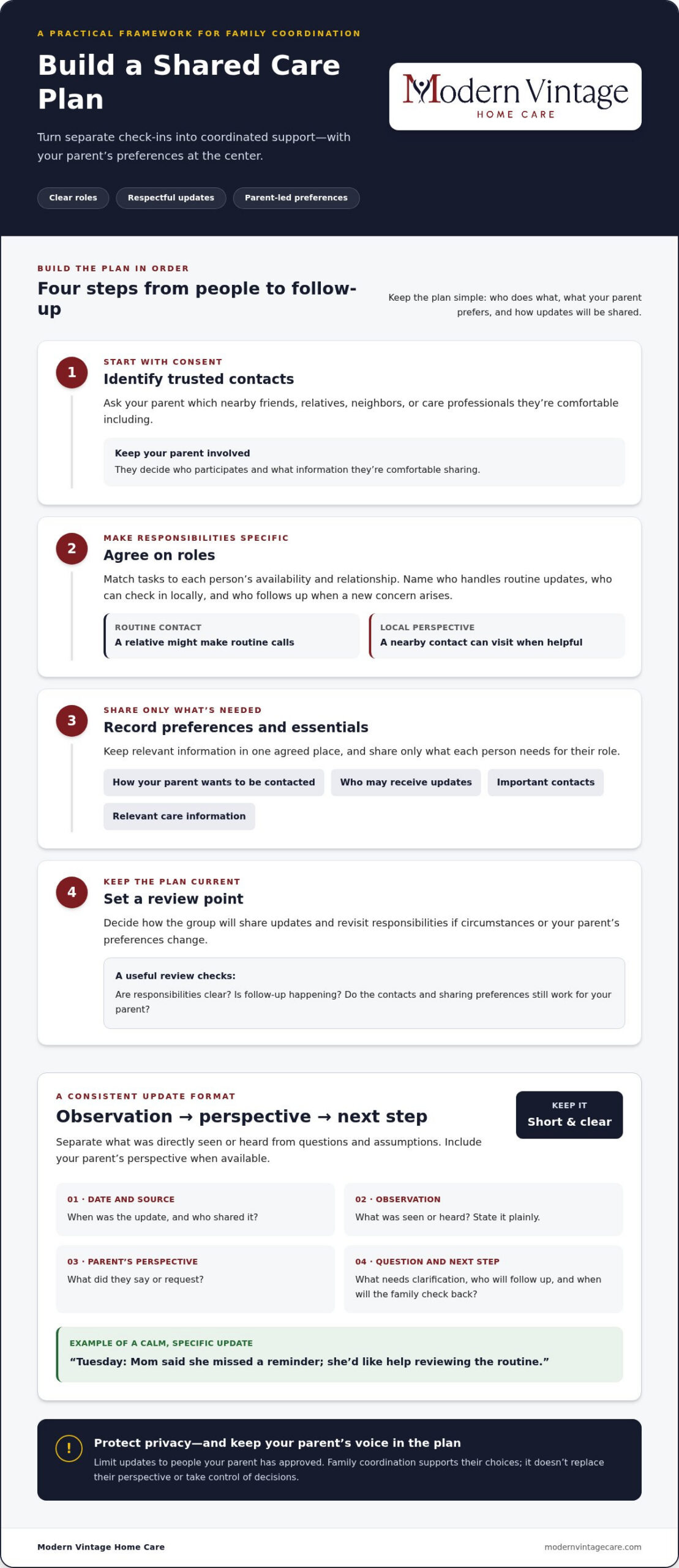
Build the plan in order:
- Identify trusted contacts. Ask your parent which nearby friends, relatives, neighbors, or care professionals they’re comfortable including.
- Agree on roles. Match tasks to each person’s availability and relationship. One relative might make routine calls, while a nearby contact can visit when an in-person perspective would help.
- Record preferences and essentials. Note how your parent wants to be contacted, who may receive updates, important contacts, and relevant care information. Share only what each person needs for their role.
- Set a review point. Decide how the group will share updates and revisit responsibilities if circumstances or your parent’s preferences change.
Who belongs in a long-distance support network?
Start with your parent, then include relatives who are actively involved, trusted nearby contacts, and relevant care professionals. Make responsibilities specific rather than assuming someone will step in. Name who handles routine updates, who can check in locally, and who will follow up when a new concern arises. Direct professional questions to the appropriate care professional, and make sure family updates don’t replace your parent’s own voice.
What should a shared care update include?
Use a short, consistent format so relatives can understand what happened and what comes next. Separate direct observations from questions, and include your parent’s perspective when available. For example, “Tuesday: Mom said she missed a reminder; she’d like help reviewing the routine” is clearer and calmer than “Mom isn’t managing.” If medication routines need closer attention, medication management for elderly seniors can help families focus their questions.
- Date and source: When was the update, and who shared it?
- Observation: What was seen or heard, stated plainly?
- Parent’s perspective: What did they say or request?
- Question and next step: What needs clarification, who will follow up, and when will the family check back?
Keep essential contact and care information in one agreed place that authorized family members can access. Limit sharing to people your parent has approved, and update the record when a contact, preference, or responsibility changes. A local support plan can also include in-home care and companionship to complement family coordination when practical, day-to-day help would be useful.
Compare Remote Check-In Methods and Monitoring Technology Respectfully
There isn’t one best way to stay informed. A phone call lets you hear how your parent is doing and what they want to share; a visit can offer more context about daily routines. A digital check-in or medication reminder may support a specific task, but it doesn’t offer the same understanding as a conversation. The best approach to how to monitor a parent’s care from afar is to match each method to a clear purpose and your parent’s comfort.
Quick comparison
Scheduled phone calls: Offer personal conversation and routine updates. They can help you notice changes in tone or engagement, but don’t show what’s happening at home.
Video chats: Add face-to-face connection when both people welcome it. They offer a visual interaction, but shouldn’t feel like an inspection.
Agreed local visits: Make space for direct conversation and a fuller sense of daily routines. A trusted visitor can share relevant observations with your parent’s permission.
Technology-assisted check-ins: Automated check-ins and medication reminders can support agreed routines. They provide limited, task-specific information, not continuous health or safety supervision.
When are calls, video chats, and visits useful?
Choose the format for the conversation you hope to have. Phone calls work well for catching up and asking about the week. Video may feel warmer if seeing each other matters to your parent, but a regular call is just as useful if video feels uncomfortable. Plan an in-person visit when talking together or seeing how a routine is going would add helpful context. Keep the focus on connection, not a pass-or-fail check.
How should families evaluate monitoring tools?
Start with the concern: is the goal to support a routine, make check-ins easier, or share agreed updates? Then discuss the tool with your parent before setting it up. Explain what information it collects, who can see it, and how updates will be used. If your parent is uneasy, consider a simpler approach or revisit the conversation later.
Discuss privacy directly. Don’t assume family members should automatically have access to every update. Agree on who can view information, what gets shared, and whether the arrangement still feels comfortable. If a tool changes what it records or who can access it, talk through those details before continuing.
Keep the limits clear. A reminder can prompt a task, and an automated check-in can support an agreed routine, but neither should be treated as continuous medical monitoring or an emergency response. Digital tools don’t replace personal contact, professional care, or emergency services. Use them as one part of a broader support plan, with a clear understanding of what they can and can’t tell you.
Create a Repeatable Routine for Reviewing Concerns and Following Up
A predictable review turns scattered messages into decisions without treating every change as a crisis. Set a regular time to check what family and local contacts have noticed, compare it with earlier updates, and hear directly from your parent. This steady rhythm is a practical part of how to monitor a parent’s care from afar because it gives each concern a clear place to go.
- Gather updates. Review notes from relatives, trusted local contacts, and care professionals, while respecting your parent’s preferences about what is shared.
- Look for patterns. Ask whether a change is new, repeated, or different from your parent’s usual routine. Keep observations separate from assumptions.
- Talk with your parent. Ask how they see the situation and what support, if any, would feel helpful.
- Agree on next steps. Name one person to follow up, set a reasonable time to do it, and record the outcome in the shared plan.
How can you turn a concern into a clear next step?
Describe the change plainly, including when it happened and whether it has occurred more than once. Ask your parent what they think is going on and what help they would welcome. For a routine question, agree who will raise it with the relevant healthcare professional. If there’s immediate danger or an urgent emergency, contact emergency services rather than waiting for the next family review.
Different concerns call for different responses. A question about a recurring routine may be suitable to discuss with your parent and their healthcare professional. A sudden, serious change or immediate threat to safety needs urgent attention. Family members should share observations, not attempt to diagnose a condition, and follow guidance from the appropriate professionals.
How can long-distance caregivers protect their own capacity?
Make responsibilities realistic and shared. If one relative handles every call, appointment update, and follow-up, the arrangement may become hard to sustain. Assign backup roles, plan breaks, and discuss additional support when caregiving demands grow. Respite care for family caregivers can be one option when family members need relief while care continues.
Revisit the plan when your parent’s routines or support needs change, or when a family member’s availability shifts. Update contact details, responsibilities, and the agreed way to raise concerns so the plan stays useful. If local in-home support could help your family share responsibilities, explore in-home care options with Modern Vintage Home Care.
Local In-Home Care Enhances Remote Support in Sugar Land
Family calls and shared updates help relatives stay involved, but they can’t provide practical help with everyday routines from a distance. Local in-home care can complement that connection: a caregiver provides support at home, while family members remain involved in planning and communication. Together, this can give everyone a clearer understanding of what support is useful without asking relatives to manage every task remotely.
Modern Vintage Home Care provides in-home care in Sugar Land, Missouri City, and SW Houston. Services include Alzheimer’s and dementia care, companionship, personal care, and 24-hour care. The right support depends on the person’s needs and preferences, and in-home care works alongside, not in place of, the parent’s healthcare professionals.
What kinds of in-home support may complement family check-ins?
For a parent living with memory changes, specialized Alzheimer’s and dementia care focuses on support shaped around daily routines and individual needs. Companionship offers social connection, while personal care can assist with everyday activities. Family members can share relevant preferences and observations, then use regular conversations to understand how the support fits. Families considering memory-care support can explore specialized dementia home care in Sugar Land.
Specific tools may also support parts of a routine. Automated check-ins and medication reminders can complement personal contact and family coordination. They are support options, not guaranteed alerts, emergency response, or continuous medical supervision. Families can discuss whether these tools suit the parent’s preferences and how updates should be shared.
When might families explore more regular support?
If shared updates point to recurring difficulty with daily routines, it may be time to discuss whether more consistent in-home support would help. Bring the observations to your parent, ask what they would welcome, and include relevant care professionals in questions about their needs. Modern Vintage Home Care also provides 24-hour care for seniors who need round-the-clock support. Families can learn more about 24-hour home care in Houston.
Adding local support doesn’t mean stepping away. Relatives can continue agreed check-ins, take part in care planning, and share meaningful updates with the people involved. This balance can make how to monitor a parent’s care from afar more manageable: local help addresses practical needs at home, while family stays connected to the parent’s preferences and changing priorities.
If you’re considering how in-home support could fit your family’s routine, explore the care options available through Modern Vintage Home Care and consider which type of help best matches your parent’s needs.
Take the Next Step Toward Steady, Respectful Support
Your care plan doesn’t have to solve every future question today. Start with one conversation: ask your parent what would make support feel helpful, then choose a small next step together. As routines and needs shift, you can adjust who checks in, what information is shared, and when to bring in additional help.
Learning how to monitor a parent’s care from afar is less about having eyes on everything and more about building trust, staying attentive, and knowing how to respond when something changes. A clear agreement and a dependable source of support can make the next conversation easier for everyone.
For families considering a local partner, Modern Vintage Home Care provides in-home support tailored to individual needs. Explore in-home care options with Modern Vintage Home Care and take a thoughtful step toward support that respects your parent’s independence.
With a shared plan and the right help around you, distance doesn’t have to prevent your family from staying connected and caring well.
Frequently Asked Questions
Can I monitor my parent’s care without using technology?
Yes. A reliable phone call, an agreed family contact, and a written note of anything that needs follow-up can help you stay informed without devices. For example, after a call, record a question your parent wants raised at an upcoming appointment. Ask what kind of check-in feels welcome, and involve a trusted nearby person only with your parent’s agreement. The goal is useful communication, not constant observation.
How often should I check in with a parent who lives far away?
Choose a schedule together based on your parent’s preferences and the support already around them. Some families set regular calls, then add a conversation when plans or circumstances change. Keep the rhythm flexible: if calls start to feel like a chore, discuss a different time or format. If a new concern comes up, address it directly rather than waiting for the next scheduled check-in.
What should I do if my parent refuses monitoring or help?
Ask what’s behind the refusal and listen before offering alternatives. Your parent may want more privacy, worry about losing independence, or find a new routine unsettling. You could suggest a simple call or ask whether they’d prefer a particular relative to check in. If they live in Sugar Land, Missouri City, or SW Houston, they may also want to discuss local in-home support on their own terms. For immediate danger, seek urgent help.
Is a video call enough to know whether my parent is doing well?
No. A video call can offer connection and a brief view, but it can’t show the full picture of daily life or establish a diagnosis. A parent may look well during a short conversation while still finding a particular task difficult. Ask about specific parts of the week, such as errands or preparing meals, and compare what you hear over time. If a change concerns you, discuss it with your parent and their healthcare professional.
What information should family members share about a parent’s care?
Share only details that help coordinate support: what happened, when it happened, what your parent said, and whether someone agreed to follow up. For example, “Thursday, Dad said the ride was missed; he’d like help arranging another one” is more useful than a guess about why it happened. In a family group, keep sensitive details limited to people your parent has agreed to involve.
When should I seek urgent help for a parent from another city?
If you have reason to believe your parent is in immediate danger, contact emergency services where they are instead of waiting for a routine call or relying on an app. For a worrying change that isn’t an emergency, speak with your parent and contact their healthcare professional or a trusted local person for appropriate follow-up. Keep key phone numbers and the parent’s address easy to find so you can act without searching through old messages.