

Sustainable Alzheimer’s care is a marathon, not a sprint, and trying to “do it all” is often the fastest path to failing your parent. When you’re managing chronic exhaustion and the constant anxiety of wandering, it’s easy to feel like you’re drowning in a sea of guilt. Finding the right support for caregiver of parent with Alzheimer’s isn’t just a luxury; it’s a necessity for your own survival. You likely feel that if you just work harder or sleep less, you can keep everything under control.
We understand that you want to preserve your parent’s dignity while keeping them safe in the home they love. This guide offers the practical strategies and emotional resources you need to sustain your well-being. We will explore daily behavior management tools, the vital role of respite care, and how to build a long-term plan that balances professional support with familial warmth. Whether you need a simple safety net like automated check-ins or the security of 24-hour care in Sugar Land or Houston, you’ll discover a path forward that honors both your parent’s spirit and your own health.
Key Takeaways
- Acknowledge the weight of the “long goodbye” and learn how to manage the physical exhaustion that often accompanies memory care.
- Find targeted support for caregiver of parent with Alzheimer’s by connecting with local resources and understanding the progression of the disease.
- Gain clarity on when to transition from family-led care to professional assistance to ensure both safety and your own well-being.
- Use structured routines and modern safety tools to create a calm environment that reduces anxiety for your loved one.
- Explore local respite care and 24-hour support options in Sugar Land that help you maintain a sustainable, long-term care plan.
The Emotional and Physical Reality of Caring for a Parent with Alzheimer’s
Caring for a parent with memory loss is a profound act of devotion, but it is also one of the most taxing roles a person can undertake. Many adult children in Sugar Land and Houston describe the experience as a “long goodbye.” It’s a unique form of grief where you mourn the person your parent used to be while they are still physically present. Finding support for caregiver of parent with Alzheimer’s begins with validating these complex emotions. You aren’t failing because you feel guilty or frustrated; you’re responding to an incredibly difficult situation.
The physical toll is often just as significant as the emotional weight. Chronic stress and sleep disturbances are common, especially if your parent tends to wander or becomes restless at night. Research into Dementia caregiving shows that informal caregivers often neglect their own health, leading to a state of constant hyper-vigilance. In 2026, the challenge for the “sandwich generation” is even more acute. You’re likely balancing a career and your own family while trying to manage your parent’s safety, which can quickly lead to exhaustion.
Identifying Caregiver Burnout Signs
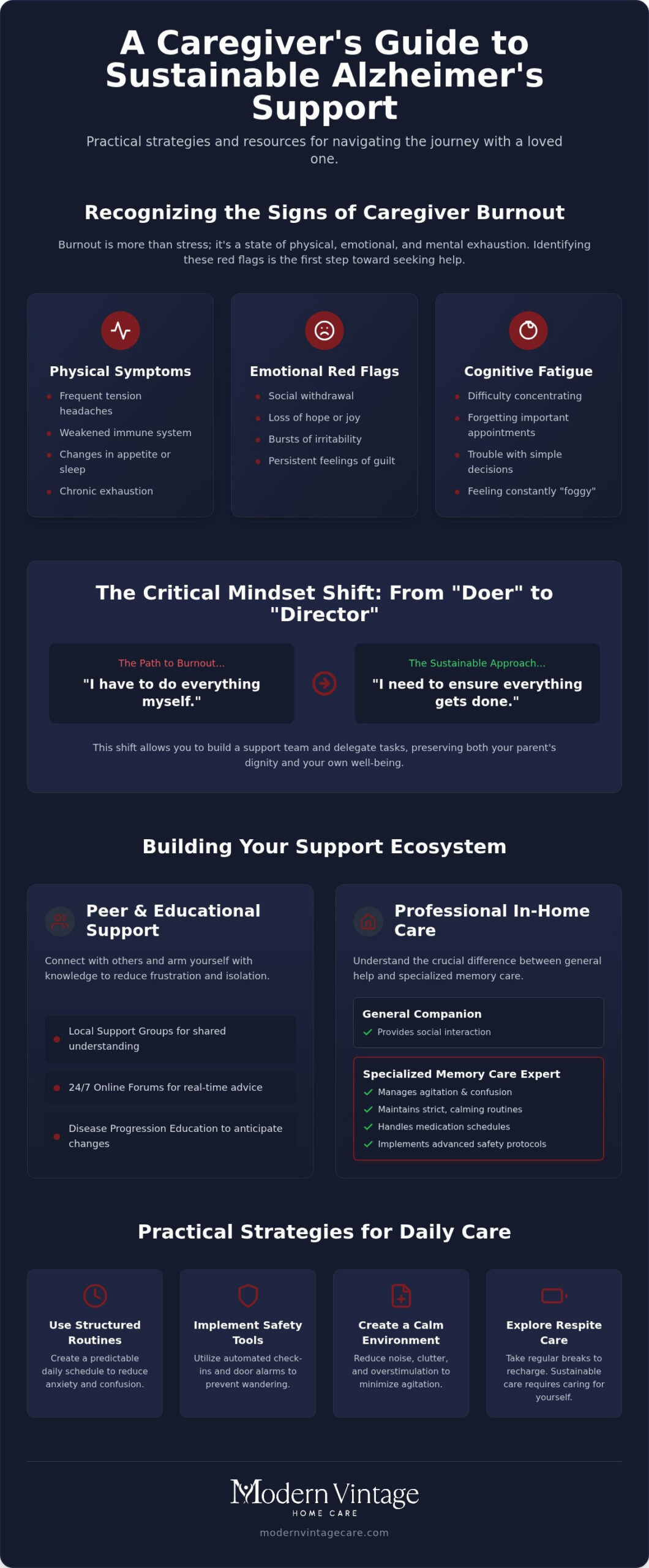
Caregiver burnout is a clinical state of physical, emotional, and mental exhaustion that requires professional intervention to resolve. It’s more than just a bad day; it’s a persistent feeling that you’ve reached the end of your rope. If you notice these red flags, it’s time to seek help:
- Physical symptoms: You might experience frequent tension headaches, a weakened immune system, or changes in appetite.
- Emotional red flags: Social withdrawal, a loss of hope, or feeling sudden bursts of irritability toward your parent.
- Cognitive fatigue: Difficulty concentrating at work or forgetting your own important appointments.
The Shift from Child to Caregiver
The transition from being a child to becoming a caregiver for your parent is a delicate role reversal. It requires navigating a new dynamic where you must make safety decisions for the person who once protected you. Maintaining their dignity is paramount, even when personality changes or agitation make it difficult. It’s okay to feel overwhelmed by these changes. You can honor your parent’s spirit by setting healthy boundaries and moving from the mindset of “doing everything” to “ensuring everything is done.” This shift allows you to focus on your emotional connection with your parent while letting professional partners manage the daily logistical challenges.
Essential Types of Support for Alzheimer’s Caregivers
Building a robust ecosystem of support for caregiver of parent with Alzheimer’s involves more than just finding an extra pair of hands. It requires a multi-layered approach that addresses your emotional, educational, and logistical needs. When you have the right tools and a reliable team behind you, the journey becomes more manageable and less isolating. You don’t have to carry the entire weight of this transition alone; in fact, the most successful care plans are those that lean on a variety of resources.
Educational Resources and Support Groups
Peer-led groups in Houston and Fort Bend County offer a unique space for shared understanding. These groups allow you to connect with others who truly understand the nuances of memory loss in our local community. In 2026, many families balance these in-person connections with online forums that provide 24/7 access to advice and real-time troubleshooting. Educational resources are equally vital, as understanding disease progression helps reduce the daily frustration that comes from unexpected behavior changes. You can find comprehensive guidance through Getting Help With Alzheimer’s Caregiving, which provides a roadmap for building your personal support system.
Professional In-Home Memory Care
There is a distinct difference between a general companion and a memory care expert. While a companion provides social interaction, specialized dementia home care services in Sugar Land focus on maintaining strict routines and cognitive engagement. These professionals are trained to handle the specific challenges of Alzheimer’s, such as agitation, confusion, or sundowning, with gentleness and expertise. They don’t just supervise; they actively work to preserve your parent’s spirit while managing medication schedules and safety protocols. This specialized approach ensures that your parent remains safe and comfortable in their own home while you receive the vital respite you deserve.
Logistical support also plays a crucial role in modern caregiving. Utilizing technology, such as automated medication reminders and check-ins, acts as a silent partner in your daily life. These tools reduce your mental load, allowing you to focus on meaningful quality time with your parent rather than just managing a checklist. Integrating professional home care into your routine isn’t a sign of giving up. It’s a proactive choice that ensures a sustainable path for your entire family, allowing you to remain a loving child while experts handle the complex logistics of memory care.
Navigating the Choice: Family-Led Care vs. Professional Assistance
Deciding whether to maintain family-led care or introduce professional help is rarely a single moment. It’s usually a series of realizations that the complexity of your parent’s needs is growing. Many people worry that bringing in support for caregiver of parent with Alzheimer’s means they are “giving up” on their parent. In reality, it’s the opposite. It is a strategic choice to ensure your parent receives the highest quality of care while you preserve your ability to be a loving daughter or son rather than just a task manager.
We often talk about “caregiver math,” which is the practice of weighing the financial cost of assistance against the physical and mental cost to your health. If you are sleep-deprived and chronically stressed, the risk of an accident for both you and your parent increases significantly. The National Institute on Aging caregiver guide emphasizes that finding help early is essential for preventing burnout and ensuring a safe home environment. Assessing your own capacity isn’t an admission of weakness; it is a vital part of being a responsible advocate for your parent.
When 24-Hour Support Becomes Necessary
Certain behaviors, such as frequent wandering or intense sundowning, signal that one person can no longer provide safe supervision alone. If your parent is awake and confused during the night, your own sleep suffers, creating a dangerous cycle of exhaustion. Utilizing 24-hour home care in Houston provides a safety net that allows you to rest with confidence. It ensures that a trained professional is awake and attentive to your parent’s needs, preventing falls and managing agitation while you recover your energy.
The Benefits of Hybrid Care Models
You don’t have to choose between doing everything yourself or nothing at all. A hybrid model allows you to stay deeply involved while professional attendants handle specific shifts or high-stress tasks. For instance, using Quick Care Services for doctor appointments or personal errands provides short-term relief without a long-term commitment. These professionals can also teach you better care techniques, such as how to safely assist with mobility or manage behavioral triggers. This collaborative approach creates a sustainable rhythm that honors your parent’s desire to stay at home while protecting your well-being.
Practical Strategies to Manage Daily Caregiving Challenges
Managing the daily nuances of memory loss requires a shift from reactive to proactive care. One of the most effective ways to provide support for caregiver of parent with Alzheimer’s is through the creation of a structured daily routine. When activities like meals, dressing, and gentle exercise happen at the same time every day, it reduces the environmental “noise” that often triggers anxiety in those with cognitive decline. Simple home adaptations also play a vital role. Using contrasting colors for dinnerware or labeling drawers with both words and pictures can help your parent maintain their independence for a longer period.
Medication Management and Safety Tech
Safety often hinges on the small details of health maintenance. Proper medication management for elderly seniors is critical in preventing adverse reactions and unnecessary hospitalizations. By utilizing automated medication reminders, you can step away from the role of the “enforcer,” which often strains the parent-child relationship. These tools, alongside automated check-in services, provide a reliable safety net for busy families. Whether you are at work or simply in another room, these technologies offer peace of mind that your parent is following their prescribed routine safely without constant supervision.
Communication Techniques for Cognitive Decline
As verbal communication becomes more challenging, your non-verbal cues take on a greater significance. It’s often more helpful to use the “Validation Method” rather than “Reality Orientation.” If your parent is insisting on an impossible reality, then validating the emotion behind their words is more comforting than correcting the facts. For example, if they are asking for their own parents, acknowledging that they must miss them is more soothing than reminding them they’ve passed away. This approach preserves their dignity and prevents the escalation of difficult behaviors. When faced with repetitive questions, try to respond with the same calm tone each time, or redirect their attention to a comforting activity like listening to familiar music. Your body language, including a gentle touch or a warm smile, often communicates more safety and love than words ever could.
Implementing these strategies can transform a chaotic day into a manageable one, allowing you to focus on the connection you share with your parent. If you find that managing these daily logistics is becoming a barrier to your relationship, consider how a professional partner can help. You can explore our specialized memory care services to see how we can support your family’s unique needs and restore balance to your home.
Sustainable Care Solutions in Sugar Land and Houston
Building a long-term plan requires moving beyond day-to-day survival toward a model that is sustainable for years. In Fort Bend County, families have access to specialized local resources that bridge the gap between struggling alone and the high cost of facility placement. Finding the right support for caregiver of parent with Alzheimer’s often means looking for a licensed agency that understands the specific regulatory environment in Texas. This ensures that your parent receives care from attendants who meet the state’s rigorous standards for dementia-specific training and safety protocols. Choosing a local partner allows for a more personalized level of advocacy that a national directory simply cannot provide.
Respite Care: Reclaiming Your Personal Time
Taking a break isn’t a sign of weakness; it is a medical necessity for anyone in a high-intensity caregiving role. Utilizing respite care for family caregivers in Sugar Land allows you to step away with the confidence that your parent is in safe, professional hands. Whether you choose a short-term visit for a single afternoon or recurring weekly support, this relief is vital for preventing the physical health decline associated with chronic stress. If you allow yourself this time, you can return to your parent as a refreshed son or daughter rather than an exhausted nurse. This shift in perspective preserves the emotional bond that is so often strained by the repetitive tasks of daily care.
Specialized Memory Care with Modern Vintage Home Care
At Modern Vintage Home Care, we believe that specialized memory care should improve the quality of life for the entire family unit. Our approach centers on personalized, compassionate support that honors your parent’s unique history while addressing their current safety needs. We serve families throughout Sugar Land, Missouri City, and the Greater Houston area, focusing on the preservation of dignity through structured routines and social engagement. Whether your family requires Quick Care Services for short-term relief or more intensive 24-hour support, we act as a steady, reliable presence in your home.
Getting started is a straightforward process focused on understanding your family’s specific requirements. By scheduling a consultation, you can begin to build a support ecosystem that includes medication management, companionship, and automated safety nets. This proactive step ensures that you aren’t making difficult decisions in the middle of a crisis. Instead, you are creating a thoughtful path forward that prioritizes your parent’s spirit and your own well-being. When you have the right support for caregiver of parent with Alzheimer’s, you can focus on making meaningful memories during this sensitive life transition.
Building a Sustainable Path Forward for Your Family
You’ve learned that managing memory loss is about creating a delicate balance between safety, routine, and your own well-being. By moving from a mindset of “doing everything” to one of “ensuring everything is done,” you protect your health while honoring your parent’s dignity. Finding reliable support for caregiver of parent with Alzheimer’s is the most important step you can take toward a sustainable future. Whether you need a few hours of respite or round-the-clock supervision, you don’t have to navigate this transition alone. It’s okay to ask for help; it’s a proactive choice that keeps your family unit strong.
As a licensed Texas home care agency, our specialized memory care experts are dedicated to serving Sugar Land and Houston families with heartfelt empathy. We’re here to act as your trusted partner, providing the professional guidance and nurturing presence your family deserves. Request a Compassionate Care Consultation for Your Loved One to explore how we can help manage daily behaviors and medication schedules. You’ve already taken the first step by seeking information; now, let’s build a care plan that brings peace and stability back to your daily life.
Frequently Asked Questions
What are the first signs that I need help caring for my parent with Alzheimer’s?
Signs you need support for caregiver of parent with Alzheimer’s include feeling constant exhaustion, noticing your parent’s hygiene is declining, or experiencing “sundowning” episodes that keep you awake. If you are missing your own appointments or feeling resentful, it’s a signal that the current situation isn’t sustainable. In Sugar Land, families often realize help is needed when wandering becomes a safety risk. Early intervention helps maintain a calm, safe home environment for everyone involved.
Does Medicare cover in-home support for caregivers of Alzheimer’s patients?
Medicare typically doesn’t cover non-medical in-home services like companionship or personal care. While it may cover short-term clinical needs, most families in Missouri City use long-term care insurance, veterans benefits, or private funds for Alzheimer’s support. It’s important to review your specific policy to understand what is included. We can help you navigate these options during a consultation to ensure your parent receives the consistent, high-quality care they need without unnecessary financial stress.
How can I convince my parent to accept help from a professional caregiver?
Start by introducing a professional as a “friend” or “assistant” rather than a caregiver. Focus on a specific task they can help with, like light meal prep or organizing a hobby. Using our Quick Care Services for short visits is an excellent way to build trust gradually. When your parent sees the added companionship as a positive social outlet, they are more likely to accept a regular routine that includes professional assistance and safety monitoring.
What is the difference between respite care and permanent home care?
Respite care provides temporary relief for family members, ranging from a few hours to a few days, so you can rest or handle personal business. Permanent home care, such as our 24-hour support, offers a consistent, long-term solution for seniors with advanced needs. Both options focus on safety and routine, but respite is specifically designed to prevent caregiver burnout, while permanent care ensures round-the-clock supervision and engagement for your parent in a familiar environment.
How do I handle “caregiver guilt” when I feel I can’t do it all anymore?
Guilt often stems from the unrealistic expectation that you should be able to handle everything alone. Reframe your perspective by recognizing that seeking support for caregiver of parent with Alzheimer’s is an act of advocacy, not a failure. When you step back from being a task manager, you have the emotional energy to be a loving son or daughter again. Professional help ensures your parent is safe, which is the ultimate goal of any dedicated family member.
What local resources are available for Alzheimer’s caregivers in Sugar Land, TX?
Sugar Land and Missouri City offer several local resources, including peer-led support groups through the Alzheimer’s Association and community centers in Fort Bend County. You can also find specialized guidance through licensed agencies like Modern Vintage Home Care. These local connections provide a safety net of people who understand the specific challenges of aging in the Houston area. Combining community resources with professional in-home support creates a comprehensive, reliable ecosystem for your family.
How can automated medication reminders help reduce my caregiving burden?
Automated medication reminders act as a silent partner in your home, ensuring your parent follows their health plan without constant prompting from you. This technology reduces the mental load of caregiving and prevents the “nagging” dynamic that can strain your relationship. By removing the stress of medication schedules, you can focus on meaningful quality time. It’s a simple, proactive tool that significantly enhances safety while preserving your parent’s sense of independence and dignity.
Is 24-hour in-home care a realistic alternative to a memory care facility?
Yes, 24-hour in-home care is a highly effective alternative that allows your parent to age in a familiar, comfortable setting. Many families in the Houston area find that one-on-one attention from a specialized memory care expert reduces the confusion and agitation often caused by moving to a facility. This approach prioritizes structured routines and personal dignity, providing the same level of safety and supervision as a memory care unit without the emotional stress of relocation.