

What if the most reassuring website isn’t the best guide to whether an agency will provide dependable, respectful care? When provider promises sound alike, evaluating the quality of in-home care services can feel difficult, especially when you’re unsure what to ask about caregiver screening, training, supervision, or communication. It’s reasonable to want more than polished descriptions. You need to understand what care will look like in your loved one’s home and how the agency will respond when needs change.
This checklist offers practical questions and signs to look for as you compare providers. Ask how the agency assesses needs, builds and updates a care plan, matches caregivers, and keeps families informed. Consider whether the plan reflects your loved one’s routines, preferences, dignity, and independence. Whether you’re arranging companionship, personal care, or memory-related support in Sugar Land or Missouri City, a thoughtful evaluation can help you compare options and make a more informed choice.
Key Takeaways
- Define quality by how well care reflects your loved one’s needs, routines, preferences, and independence, not by provider promises alone.
- When evaluating the quality of in-home care services, ask each agency the same questions about caregiver screening, training, supervision, backup coverage, and complaints.
- Compare providers side by side on services, schedules, care-plan reviews, communication, and what happens if a caregiver can’t make a visit.
- After care begins, check whether visits and support match the written plan, and raise concerns early without judging the whole arrangement by one incident.
- Involve your loved one in decisions wherever possible, and revisit the care arrangement as needs or preferences change.
What Does Quality In-Home Care Look Like? Start With the Person, Not the Provider
Quality care isn’t defined by a provider’s promises or a long list of services. It’s support that fits the older adult’s needs, respects their choices, and is delivered consistently. The goal is to help the person feel safe and comfortable at home while preserving as much dignity and independence as possible. For a neutral overview of supportive care provided in the home, consider whether the type and scope of support match the person’s situation.
Families evaluating the quality of in-home care services can look for evidence in everyday details. Does the caregiver follow the person’s preferred routine? Are changes or concerns communicated clearly? Does the provider explain which needs its services can support and which fall outside its scope? These questions help you distinguish reassuring language from practices you can discuss, observe, and document.
What should a good in-home care plan include?
A useful plan should reflect the individual, not just list tasks. Look for documented preferences, daily routines, support needs, and goals that matter to the older adult, such as keeping a familiar morning routine or making time for companionship. The plan should also clarify the agreed services, schedule, responsibilities, and how the family will receive updates.
Ask who reviews the plan and how to request an update. Changes in mobility, health, or memory may affect what support is appropriate. A clear review process gives the family a way to discuss those changes instead of assuming the original arrangement will always fit. For memory-related needs, ask how the provider can support familiar routines and comfort at home.
How do you distinguish a care promise from a quality indicator?
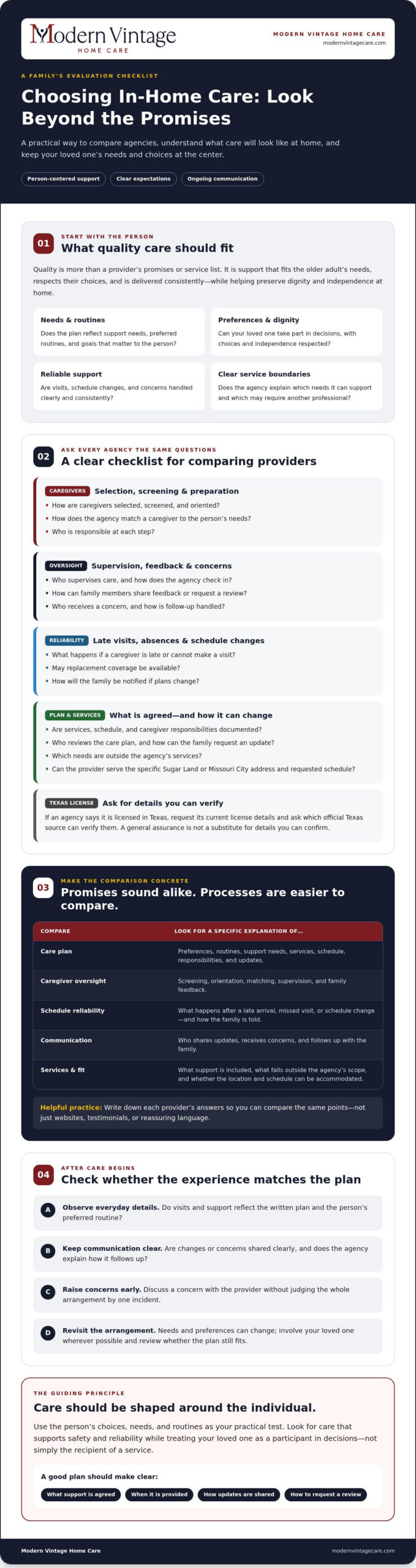
Promises such as “dependable care” sound reassuring, but ask what the provider does to put them into practice. What happens if a visit is missed or the schedule changes? Who receives a concern, and how is follow-up handled? Ask for a clear explanation of caregiver supervision, family feedback, and how care-plan updates are shared. Write down the answers so you can compare providers on the same points.
Person-centered care means support shaped around an individual’s choices, needs, and routines, with their dignity and independence at the center. Use that as a practical test: Can the provider explain how the older adult’s preferences shape the plan, and how the family can raise concerns if the experience doesn’t match it? Quality includes safety and reliability, but it also means treating the person as a participant in decisions, not simply the recipient of a service.
Use This Checklist to Evaluate an In-Home Care Agency
Ask every provider the same questions so you can compare their answers, not just their websites or testimonials. Specific explanations make it easier to understand what to expect and identify anything that needs clarification. As you evaluate agencies, note whether the proposed support matches the older adult’s needs, preferred routine, location, and requested schedule in Sugar Land or Missouri City.
What should families ask about caregivers and agency oversight?
Ask how caregivers are selected, screened, oriented, and matched to a person’s needs. Don’t assume every provider follows the same process. Listen for an answer that explains what the agency does and who is responsible at each step.
Next, ask who supervises care, how the agency checks in, and how a family can share feedback or request a review. Find out how the agency handles a late arrival or absence, whether replacement coverage may be available, and how the family will be notified if plans change. A useful answer explains the process without promising coverage the provider can’t confirm.
How can you check service scope and local credentials?
Before care begins, ask the agency to document the agreed services, schedule, and caregiver responsibilities. Confirm that the provider can serve the specific Sugar Land or Missouri City address and accommodate the requested schedule. Ask which needs fall outside its services and may require another professional. Clear boundaries help everyone understand what to expect.
If an agency says it’s licensed in Texas, request its current license details and ask which official Texas source you can use to verify them. Check the information before relying on it. A general assurance is not a substitute for details you can confirm.
If memory support is part of your family’s evaluation, review this Sugar Land dementia home care guide for additional considerations around routines, safety, and quality of life.
Use this question set for each provider:
- How do you select, screen, orient, and match caregivers?
- Who supervises the care, and how can we raise a concern?
- What happens if a caregiver is late or can’t attend a scheduled visit?
- What services and responsibilities will be documented before care starts?
- Can you support this location and requested schedule, and how can we verify your current Texas license details?
Keep the answers together so it’s easier to compare providers later. To compare a provider’s stated service options with your family’s needs, you can review in-home care services as one step in your research.
Compare Care Plans, Communication, and Reliability Before You Decide
After gathering answers from each agency, put them side by side. A simple comparison can reveal differences that were easy to miss during conversations. Use one row for each practical detail:
- Services: What support is included, and what falls outside the provider’s scope?
- Schedule: Which days and times can the agency support, and how are changes handled?
- Care-plan review: Who reviews the plan, and how can the older adult or family request an update?
- Communication: Who is the primary contact, and how are routine updates and urgent concerns shared?
- Backup arrangements: How will the family learn about an absence or a change in coverage?
Compare the answers against the older adult’s actual priorities, not an idealized list of services. If a familiar breakfast routine matters, ask how it would appear in the schedule and plan. If companionship is important, clarify what that support would involve during a visit. A provider may offer many services, but the key question is whether it can support this person’s needs and requested schedule.
Which questions reveal whether a care plan fits?
Ask how the agency learns about the person’s routines, preferences, communication style, and goals. Find out who contributes to planning and how the older adult’s choices are included, especially if a family member is coordinating care. For medication support, clarify exactly what the provider offers and how it fits into the individual plan. This elderly medication management safety guide can help families prepare questions about medication-related support.
How should families assess reliability and communication?
Ask how completed visits, schedule changes, and care concerns are recorded and shared. Confirm the family’s primary contact and what to do if that person is unavailable. Discuss how urgent concerns are escalated, but don’t assume a specific response time unless the provider explains and documents one.
Predictable communication is an observable sign of quality because families can check whether updates arrive through the agreed channel and whether concerns receive clear follow-up.
The easiest arrangement to start isn’t always the best fit. If caregiver responsibilities, scheduling expectations, or communication paths remain unclear, ask for clarification before deciding. Families evaluating the quality of in-home care services should understand who does what, how the plan will be carried out, and how to raise a concern. To review one local provider’s stated options as part of your comparison, explore Modern Vintage Home Care services.
After Care Begins, Track These Signs and Address Concerns Early
Choosing a provider is only the beginning. Agree on a check-in after care starts, then compare what happens during visits with the written plan. This gives the older adult and family an opportunity to share what feels comfortable, identify gaps, and adjust expectations before small issues become ongoing frustrations.
What should families monitor during the first weeks?
Notice whether your loved one feels respected, comfortable, and included in everyday decisions. Check whether visits happen as scheduled and whether agreed tasks support the person’s usual routines. One missed detail may not indicate a pattern, so consider the overall experience and invite the older adult to share how the care feels to them.
Automated check-ins or medication reminders may support an agreed care plan, but they don’t replace individualized attention or personal care. Ask what the technology is intended to do, who receives its information, and how it fits alongside support during visits.
A simple record can make check-ins more useful. Note:
- Whether scheduled visits took place and any changes communicated
- Whether the older adult seemed at ease and involved in decisions
- Whether the agreed routine and responsibilities were followed
- Any questions or concerns still waiting for follow-up
What should you do if care does not meet expectations?
Describe concerns with specific observations rather than general impressions. Record the date, what happened, and how it affected your loved one’s routine or comfort. Contact the agency representative you were told to reach, ask for a review, and agree on next steps. Note who will follow up and what changes, if any, are made to the plan.
If needs change, ask whether the current service and plan remain appropriate. A new concern related to health, mobility, or memory may call for a plan review or assessment by a qualified professional. Clarify which needs the provider can support and which require another professional. For families considering continuous or overnight support, this 24-hour home care guide offers additional questions to consider.
Evaluating the quality of in-home care services continues after care begins. Use check-ins to look for patterns, recognize what’s working, and address unresolved concerns calmly and directly. If you’re reviewing ongoing support options, discuss your family’s in-home care needs with Modern Vintage Home Care.
Choose In-Home Care That Fits Your Family and Your Loved One
A thoughtful choice depends on more than the number of services an agency lists. Look for a provider whose support fits the older adult’s needs and preferences, whose service boundaries are clear, and whose communication, oversight, and care-plan review process your family understands. Involving your loved one wherever possible helps keep their routines, dignity, and independence central to the decision.
Before contacting an agency, gather a few notes to guide the conversation:
- The support needed, such as personal care, companionship, or help related to memory needs
- Preferred routines, the location, and the schedule you’re looking for
- Communication preferences, including who in the family should receive updates
- Questions about caregiver matching, care-plan reviews, backup arrangements, and service boundaries
What should families prepare before contacting an agency?
Write down what a typical day looks like and what the older adult hopes to maintain or make easier. Include concerns that could affect the care arrangement, then ask how the provider would discuss and document those needs. If a family caregiver needs temporary support, this respite care resource guide can help you prepare questions for the conversation.
How can Modern Vintage Home Care help families explore options?
Modern Vintage Home Care serves Sugar Land, Missouri City, and the greater Houston area. Its offerings include Alzheimer’s and dementia care, personal care, respite support, and other home care services. Service fit and availability depend on the individual situation, so confirm whether the agency can support your location, needs, and requested schedule. Families can also ask about automated check-ins and medication reminders, which are supplementary supports, not replacements for individualized care.
Use your notes to discuss what matters most, whether that’s support with daily personal care, familiar routines for a loved one with memory needs, or temporary respite for a family caregiver. A clear conversation can help you understand which options may fit and what questions still need answers. The decision remains yours, guided by your loved one’s preferences and the details each provider can confirm.
For families in Sugar Land or Missouri City, a practical next step is to discuss your family’s in-home care needs, including schedules, service questions, and the support you’re considering.
Choose Care With Confidence, One Clear Question at a Time
Evaluating the quality of in-home care services means looking beyond promises to see whether the plan fits your loved one’s preferences, daily routines, and support needs. Compare providers using the same questions, clarify responsibilities and communication before care begins, and check in after visits start. Above all, involve the older adult in decisions wherever possible.
Modern Vintage Home Care is an independent agency licensed in Texas. Families should verify current license details and confirm service availability for their location and schedule. Offerings include Alzheimer’s and dementia care, personal care, companionship, respite, and 24-hour support. Automated check-ins and medication reminders are also available as supplementary supports, not replacements for individualized care.
If you’re considering support in Sugar Land, Missouri City, or the greater Houston area, take the next step at a pace that feels right for your family. Discuss your family’s in-home care needs and share your questions about services, schedules, and care preferences. A thoughtful conversation can help you explore options while keeping your loved one’s dignity and independence at the center.
Frequently Asked Questions
How do I evaluate the quality of an in-home care agency?
Evaluate an agency by checking whether its services, care plan, communication, and oversight fit the older adult’s needs and preferences. Ask how caregivers are selected and matched, how concerns are handled, and what happens if a visit changes. Compare providers using the same questions, then check whether their answers are clear and consistent. After care begins, review whether the actual experience reflects the agreed plan.
What questions should I ask an in-home care provider?
Ask what services the provider can support, how it learns about the person’s routines, and how caregiver screening, orientation, and supervision work. Clarify who coordinates the care plan, how updates are shared, and how families can raise concerns. Also ask how absences or schedule changes are communicated, what backup arrangements may be available, and whether the agency serves the person’s specific location and requested schedule in Sugar Land or Missouri City.
How can I tell if an in-home caregiver is a good fit?
A good fit respects the older adult’s preferences, communicates comfortably, and follows the agreed routine and responsibilities. Notice whether your loved one feels at ease, is included in everyday choices, and can express concerns. Discuss caregiver matching with the agency and ask how it responds if the relationship or support needs aren’t working well. One visit may not tell the whole story, so look for patterns and invite your loved one’s feedback.
What should I do if home care services are not meeting expectations?
Write down specific observations, including dates, what happened, and how it affected your loved one or their routine. Contact the agency representative identified for concerns, explain the issue, and ask for a review and clear follow-up steps. Keep a record of what the agency agrees to do. If needs have changed or the current service no longer seems appropriate, request a care-plan review and ask whether another qualified professional should assess the situation.
How do I verify whether a home care agency is licensed in Texas?
Ask the agency for its current Texas license details and which official state source can verify them. Use the verification method provided by the appropriate Texas licensing authority, and check that the agency’s details match the record. Don’t rely only on a website statement or verbal assurance. If you’re unsure which state office or database applies, confirm the correct method with the agency or the state before making a decision.
Can in-home care help someone with Alzheimer’s or dementia?
Yes, some in-home care providers offer support for people living with Alzheimer’s or dementia. Ask how the agency approaches familiar routines, safety, communication, and changes in memory-related needs, and confirm which services are included. Modern Vintage Home Care offers Alzheimer’s and dementia care focused on safety, routines, and quality of life at home. The right plan depends on the person’s needs, preferences, and the support the provider can offer.
How often should a home care plan be reviewed?
Agree with the provider on when to check in, and request a review whenever the older adult’s needs, preferences, or daily routine change. A review can confirm that scheduled visits, responsibilities, and communication still match the plan. Families should also raise concerns rather than waiting for a routine check-in if something important is not working. There isn’t one review schedule that fits every person, so clarify the process with the agency.