

What if the most important difference when hiring a private caregiver vs an agency is not who provides care, but who keeps the plan dependable when schedules change? The hiring a private caregiver vs agency pros and cons come down to more than personal preference. A private hire may offer more direct control, while also leaving your family to manage screening, payroll, scheduling, and backup coverage.
It’s understandable to want a caregiver who feels like a natural fit and support you can count on. But if a caregiver is unavailable or your loved one’s needs change, the responsibilities behind the arrangement matter just as much as the day-to-day connection.
This guide compares control, continuity, coordination, and family responsibilities so you can weigh each option. You’ll also learn what to ask before choosing support in Sugar Land, Missouri City, or the greater Houston area, including when care needs involve dementia. The right arrangement is one that supports your loved one’s well-being and feels sustainable for your family.
Key Takeaways
- Compare the hiring a private caregiver vs agency pros and cons by looking beyond caregiver fit to who manages coordination and backup coverage.
- Before hiring directly, clarify who will handle recruitment, screening, scheduling, supervision, and payment.
- Use your loved one’s care needs, preferred schedule, and your family’s capacity to guide the choice, especially if support needs may change.
- Ask providers which services they offer, what tasks are included, and whether your needs involve skilled medical services.
- Prepare a short list of routines, preferences, and questions, and include your loved one in the decision wherever possible.
Private Caregiver vs. Home Care Agency: What Is the Difference?
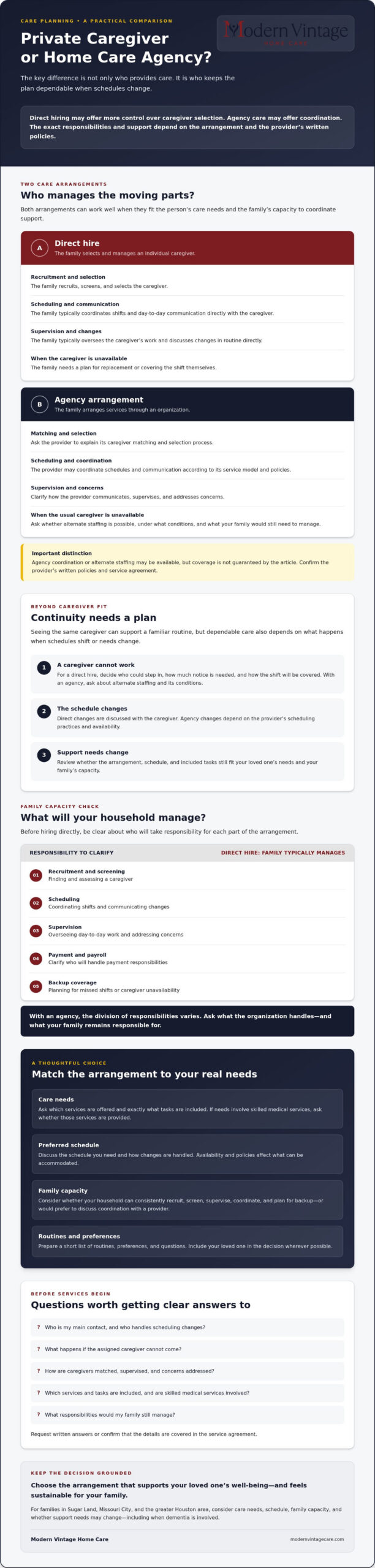
Both arrangements can work well when they fit the person’s care needs and the family’s capacity to coordinate support. With direct hiring, the family selects and manages an individual caregiver. With agency care, the family arranges services through an organization, which may coordinate caregiver matching, scheduling, and communication according to its service model. The broad term Home care can include different kinds of support, so ask exactly which tasks are included rather than assuming every provider offers the same services.
| Area | Direct hire | Agency arrangement |
|---|---|---|
| Hiring | Family recruits and selects a caregiver. | Provider explains its matching and selection process. |
| Scheduling | Family coordinates shifts with the caregiver. | Provider may coordinate schedules under its policies. |
| Backup | Family needs a plan if the caregiver is unavailable. | Ask whether alternate staffing is possible and under what conditions. |
| Supervision | Family typically oversees the caregiver’s work. | Clarify how the provider communicates, supervises, or addresses concerns. |
| Flexibility | Changes are discussed directly with the caregiver. | Changes depend on the provider’s scheduling practices and availability. |
Who hires, supervises, and coordinates the caregiver?
In a direct arrangement, families typically handle recruitment, screening, scheduling, and day-to-day communication. They may also need to address missed shifts and changes in routine. Through an agency, some coordination may be handled by the organization, but the exact division of responsibilities varies. Before services begin, ask who your main contact will be, how schedule changes are handled, and what happens if the assigned caregiver can’t come. Request written answers or check that these details are covered in the service agreement.
Which arrangement gives families more choice or support?
Hiring directly may give a family more say in choosing one caregiver and building a consistent relationship. That choice also means taking on the work of finding someone who fits and arranging coverage if plans change. An agency may offer coordination or alternate staffing, depending on availability and policy. Ask what is included and what your family would still need to manage rather than assuming coverage is guaranteed.
Direct hiring can give families more control over caregiver selection; agency care may provide more coordination, while the provider’s written policies define the support available.
For families in Sugar Land, Missouri City, and the greater Houston area, comparing the hiring a private caregiver vs agency pros and cons starts with a practical question: which responsibilities can your household manage consistently, and which would you rather discuss with a provider?
Private Caregiver vs. Agency Pros and Cons: Control, Continuity, and Backup
Both options can support a familiar routine, but continuity depends on more than seeing the same caregiver. It also depends on what happens when schedules shift, support needs change, or a caregiver can’t work. As you weigh the hiring a private caregiver vs agency pros and cons, consider who will manage each coordination task, not just who provides care during a scheduled visit.
When direct hiring may suit a family
Direct hiring may fit families who have the time and capacity to recruit, screen, supervise, and coordinate an individual caregiver. It can also suit a senior who prefers direct communication and the chance to build a relationship with a carefully selected person. A consistent caregiver may learn familiar routines and preferences, but finding the right match takes time and is not automatic.
Continuity also requires a plan. If the caregiver is ill, needs time off, or can no longer work, the family may need to arrange a replacement or cover the shift themselves. Before hiring, decide who could step in, how much notice is needed, and how schedule changes will be communicated. Flexibility may be easier to discuss directly, but it still depends on the caregiver’s availability and the agreed arrangement.
When an agency may offer useful coordination
An agency may be worth considering if your family would prefer support coordinating schedules or exploring coverage options. Ask how caregivers are matched, whether the provider can accommodate changes to the schedule, and what happens when the usual caregiver is unavailable. These details matter for a senior who values familiar routines, including someone living with dementia. Share preferred communication styles, daily patterns, and comfort needs, then ask how that information guides care.
Agency coordination can help organize care, but matching, continuity, and backup depend on the provider’s policies and availability. Confirm the details before services begin.
Whichever arrangement you choose, communication remains essential. With a direct hire, the family typically coordinates changes with the caregiver. With an agency, clarify which tasks the provider handles and which remain yours. Put expectations in writing, including who to contact, how routine updates are shared, and how concerns are addressed.
If you’re comparing services in Sugar Land, Missouri City, or greater Houston, explore local home care services and ask how the provider approaches caregiver matching and schedule coordination. For a separate need involving Medicare-certified home health agencies, Medicare’s Home Health Compare tool can help with comparisons; it is not a directory for non-medical caregiver arrangements.
What Does Each Care Arrangement Ask of the Family?
The day-to-day care is only part of the arrangement. The hiring a private caregiver vs agency pros and cons also include the administrative work that keeps support clear and consistent. Before choosing, list who will handle recruitment, screening, scheduling, supervision, payment, and communication. Compare the full workload and coverage plan, not just the quoted rate.
- Recruitment and screening: Who finds candidates, checks references, and assesses experience?
- Scheduling and supervision: Who confirms hours, communicates changes, and follows up on concerns?
- Payment and paperwork: Who processes payment, maintains records, and confirms any insurance arrangements?
- Service terms and urgent communication: What are the cancellation terms, who should be contacted with an urgent concern, and what is the plan if a caregiver can’t attend?
What should families verify before hiring directly?
Use a consistent screening process for every candidate. Check references, relevant experience, and qualifications suited to the agreed role. Then document the practical details: duties, hours, communication expectations, privacy, payment, schedule changes, and what happens during absences. A written agreement helps everyone understand the arrangement and provides a shared reference if expectations shift.
Worker classification, payroll, tax, and insurance responsibilities depend on the circumstances. Don’t assume the caregiver’s title alone determines who is responsible. Ask a qualified tax or employment professional, and an insurance professional where appropriate, to review your situation before work begins.
What should families ask a home care agency?
Ask how caregivers are screened and matched, how the care plan is shared, and how supervision or family updates work. Confirm who handles schedule changes, absences, complaints, and urgent communication. Request the service agreement and review its cancellation terms, included tasks, and any insurance information relevant to your arrangement. Policies differ, so specific answers matter more than general assurances.
Also clarify the scope of support. Ask which services are non-medical and which tasks are included in the agreed plan. If your loved one needs assessment or treatment from a licensed medical professional, ask how the provider distinguishes that need from its services and whom your family should contact. Non-medical home care and skilled medical services are not interchangeable.
A clear arrangement makes it easier to focus on your loved one rather than untangling responsibilities later. Before signing or setting a start date, make sure you know who handles each task, how concerns are raised, and what happens when the plan needs to change.
How to Choose Based on Care Needs, Schedule, and Family Capacity
Start with the care your loved one needs today, then consider how reliably your family can coordinate it. The hiring a private caregiver vs agency pros and cons become clearer when you compare the actual tasks, schedule, and backup plan instead of choosing based on one preference alone.
- Define the support needed. Note whether the priority is companionship, help with personal care, medication reminders, or support with dementia-related routines. Separate these needs from medical assessment or treatment.
- Map the schedule. List preferred days and times, and consider whether support is occasional, recurring, overnight, or around the clock.
- Assess family capacity. Decide who can recruit, communicate, coordinate changes, and follow up on care.
- Plan for gaps. Identify who could step in if a caregiver is ill, takes leave, or leaves the arrangement.
- Compare providers. Ask about caregiver matching, scheduling, coverage, services, and availability in your location.
Does the care schedule require reliable backup?
An occasional visit may be easier for a family to rearrange than recurring or overnight support. If you hire directly, decide who can cover a shift during illness, leave, or a sudden departure, and how quickly you could arrange a replacement. If you speak with an agency, ask what coverage it can arrange for your requested schedule, how substitutions are communicated, and whether a replacement’s availability is confirmed in advance.
Does the care plan include memory or daily-living support?
For dementia-related needs, look for an approach that respects familiar routines, safety preferences, and clear communication with the family. Describe specific daily patterns and ask how a caregiver would be prepared to follow them. For companionship or personal care, clarify the tasks needed at home. These supports don’t replace clinical care or skilled nursing; ask a licensed medical professional about needs that require assessment or treatment.
Families in Sugar Land and Missouri City should verify that a provider serves their location and can accommodate the requested schedule and type of support. Ask how services may adapt if needs change, and make sure the proposed plan stays within the provider’s scope. Availability can vary by care option, so confirm it directly.
If you’re considering agency support, discuss your home care needs with Modern Vintage Home Care and ask which services and schedules may fit your family’s situation.
Next Steps: Compare Caregiver Options and Find a Thoughtful Fit
You don’t need to settle every detail before exploring support. A short preparation list can help you compare options clearly and make the conversation more useful. As you weigh the hiring a private caregiver vs agency pros and cons, focus on what would help your loved one feel comfortable and what your family can sustain.
- Care priorities: List the help needed, such as companionship, personal care, medication reminders, or support with familiar routines.
- Preferred schedule: Note the days, times, and frequency you’re seeking, including any anticipated changes.
- Personal preferences: Record communication style, activities, cultural or household routines, and other details that matter to your loved one.
- Questions and concerns: Write down what you want to understand about matching, updates, schedule changes, backup options, and service terms.
Include the senior in these conversations wherever possible. Their preferences can guide the caregiver match and help shape routines that feel familiar, respectful, and comfortable. If they have memory-care needs, describe familiar cues and daily patterns that may help support a calmer experience at home.
Questions to ask during a care consultation
Ask how the provider learns about care needs, shares updates, and reviews support if circumstances change. Confirm how caregiver matching works, which schedule options may be available, how absences are handled, and what the service agreement says. For dementia support, ask how caregivers learn the person’s routines and preferences, and how the family can share updates over time.
Also clarify which services are included and where the provider’s scope ends. If a need requires medical assessment or treatment, ask which licensed professional your family should contact.
Explore local support without committing prematurely
A conversation can help you decide whether an agency’s services and approach fit your family. Modern Vintage Home Care is a local agency serving Sugar Land, Missouri City, and the greater Houston area. Its offerings include Alzheimer’s and dementia care, companionship, personal care, medication management, automated check-ins, automated medication reminders, and Quick Care Services. Ask which options may fit your situation and confirm service availability for your location and preferred schedule.
There’s no need to decide before you understand the details. Talk with Modern Vintage Home Care about your family’s needs to discuss possible support and whether its services may be a thoughtful fit.
Choose Care That Fits Your Family’s Next Chapter
The right choice isn’t simply about who provides care. It’s about matching your loved one’s needs and preferred routines with a plan your family can manage, including who coordinates communication and what happens if schedules change. The hiring a private caregiver vs agency pros and cons become easier to weigh when you look at the full care arrangement, not just the caregiver relationship.
If you’re exploring agency support, Modern Vintage Home Care serves families in Sugar Land, Missouri City, and the greater Houston area. Its offerings include specialized Alzheimer’s and dementia care, as well as automated check-ins and medication reminders. Ask which services may fit your loved one’s needs and confirm availability for your location and schedule.
Talk with Modern Vintage Home Care about your family’s needs to discuss possible support and ask your questions. You can take this decision one step at a time, with your loved one’s comfort and preferences guiding the way.
Frequently Asked Questions
Is it cheaper to hire a private caregiver than use a home care agency?
Direct hiring may have a lower advertised hourly rate, but it isn’t automatically less expensive overall. Families may also need to account for screening, payroll, taxes, insurance, scheduling, and arranging backup coverage, depending on their situation. Agency pricing may include coordination or other services, but providers differ. To compare the hiring a private caregiver vs agency pros and cons fairly, ask for a written breakdown of services and consider the time your family will spend managing care.
What are the disadvantages of hiring a private caregiver?
With a direct hire, families may need to find and screen candidates, coordinate schedules, supervise the arrangement, manage payment, and plan for absences. If the caregiver becomes unavailable, your household may need to find replacement coverage. Direct hiring can offer more choice and communication with one person, but that relationship still requires clear expectations and a backup plan. Consider whether your family has the time and capacity to manage these responsibilities consistently.
Can a home care agency provide a replacement caregiver if someone is unavailable?
Possibly, but replacement coverage depends on the agency’s policies, staffing, schedule, and availability. Ask what happens if a caregiver is ill or otherwise can’t attend, whether another caregiver may be assigned, and how your family will be notified. Confirm whether coverage applies to the particular days, times, and services you need. Don’t assume a replacement is guaranteed; review the written service agreement and ask how changes or gaps are handled.
Who is responsible for taxes when hiring a caregiver privately?
Tax responsibilities depend on the working arrangement and how the caregiver is classified. A family that directly hires and controls a caregiver may have household-employer responsibilities, but the answer can vary with the circumstances. Don’t rely on a contract label or informal understanding alone to determine what applies. Before hiring, describe the arrangement to a qualified tax professional or employment adviser and ask what payroll, reporting, and recordkeeping steps your family may need to take.
How do I check a private caregiver’s references and qualifications?
Use the same careful process for each candidate. Ask for references from people familiar with their caregiving work, contact those references, and discuss reliability, communication, and experience with similar needs. Verify relevant training or qualifications for the role, and ask scenario-based questions about routines, privacy, and safety. Agree in writing on duties and expectations. If a task may require medical expertise, confirm with a qualified professional who is authorized to provide it.
What is the difference between a private caregiver and an independent contractor?
A private caregiver describes how a family arranges care directly, while “independent contractor” describes a possible work classification. The terms aren’t automatically interchangeable: classification depends on the actual working relationship and applicable rules, not just the name used in an agreement. Factors can include how the work is arranged and managed. Because the distinction can affect tax and employment responsibilities, ask a qualified tax or employment professional to review your specific situation.
When should a family consider an agency for dementia care at home?
Consider speaking with an agency if your loved one may benefit from structured routines, dementia-focused support, or coordinated communication with family. Ask how caregivers learn the person’s preferences, how familiar routines are supported, and what happens if the schedule changes. Modern Vintage Home Care offers Alzheimer’s and dementia care for families in Sugar Land, Missouri City, and the greater Houston area. Confirm that the requested services and schedule are available and fit your loved one’s needs.