
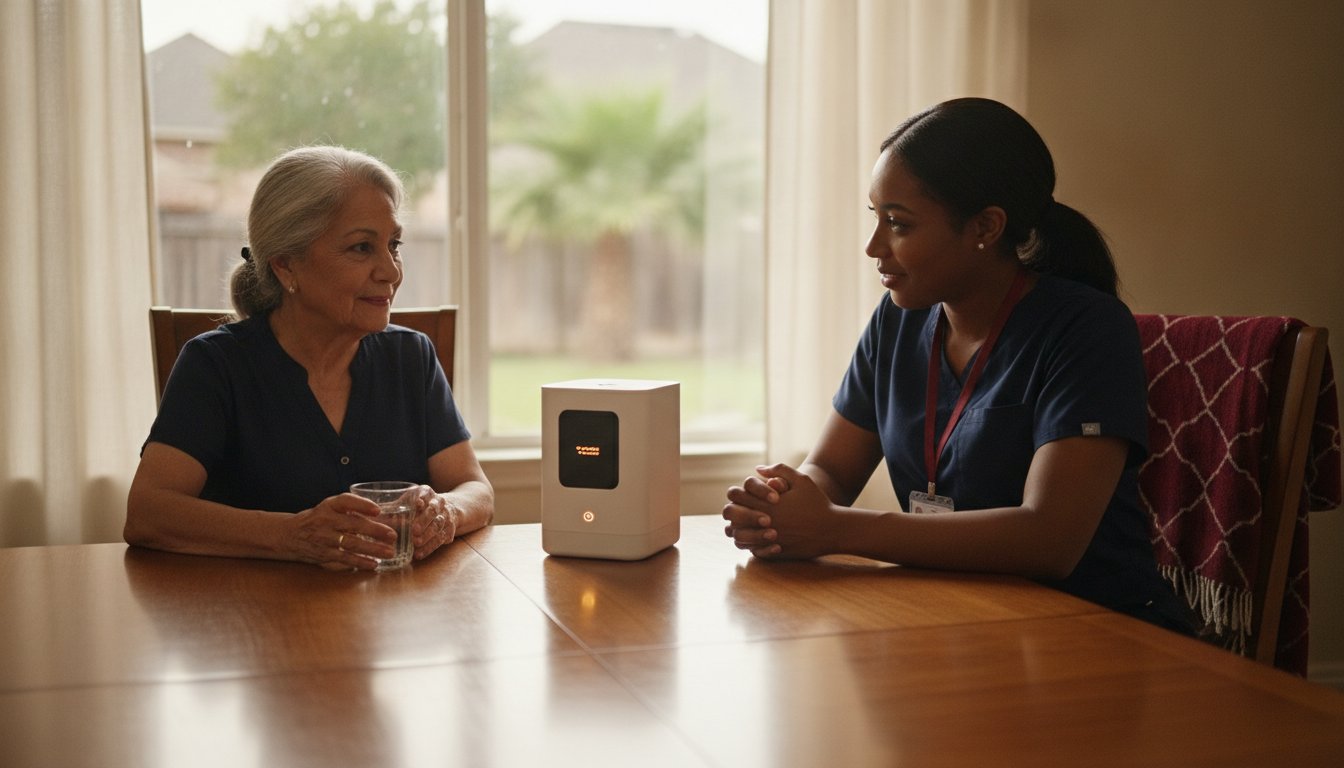
What if the biggest threat to your parent’s health isn’t a serious diagnosis, but a missed pill on a Tuesday afternoon? It’s a quieter risk than most families expect, yet for many seniors managing multiple prescriptions, inconsistent medication routines can quietly undermine even the best treatment plans. If you’ve found yourself calling your mom or dad several times a day just to confirm they’ve taken their morning dose, you already know how exhausting and unsustainable that cycle becomes.
You’re not alone in feeling that tension between wanting to protect your loved one and respecting their independence. Automated medication reminders for seniors have become a meaningful solution for families in Sugar Land navigating exactly this challenge, but technology alone only tells part of the story. The real question isn’t just which device or app to choose; it’s how to ensure that when a reminder goes off, someone is there to follow through.
This article walks you through the most effective reminder options available today, cuts through the confusion of high-tech versus low-tech choices, and explains how professional home care from a licensed agency like Modern Vintage Home Care can turn a simple alert into a genuine safety net for your family.
Key Takeaways
- Medication non-adherence is far more common than most families realize, and understanding why seniors miss doses is the first step toward choosing a solution that actually works.
- Automated medication reminders for seniors range from simple timed alarms to sophisticated smart dispensers, and matching the right system to your loved one’s abilities matters more than choosing the most advanced option.
- Technology alone is rarely enough — without human follow-through, even the best reminder system can be ignored, a phenomenon known as alarm fatigue that quietly defeats the purpose of the device.
- Professional home care can bridge the gap between a reminder going off and a dose actually being taken, turning a passive alert into an active safety net for your family.
- Families in Sugar Land have a practical path forward that combines the right reminder tools with compassionate caregiver support — and this article shows you exactly how to build it.
The Vital Role of Automated Medication Reminders in Senior Safety
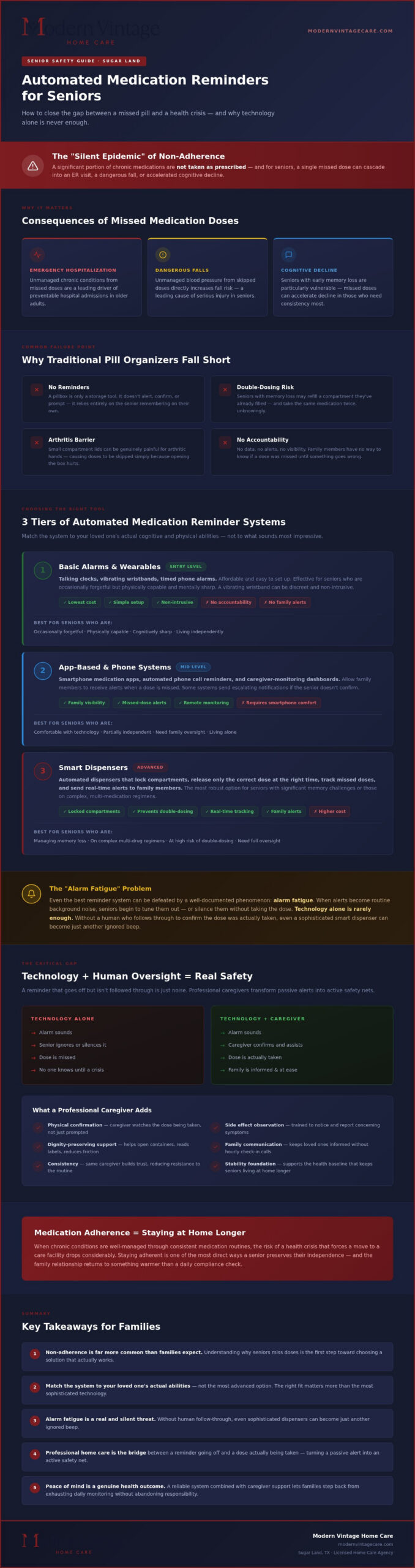
At their core, automated medication reminders for seniors are systems designed to prompt a person to take their medication at the right time, in the right dose. They range from simple smartphone alarms and talking pill boxes to sophisticated smart dispensers that lock compartments, track missed doses, and send real-time alerts to family members. The technology varies widely, but the goal is always the same: closing the gap between a prescription’s intent and what actually happens at home.
That gap is larger than most families expect. Research on medication adherence consistently shows that a significant portion of chronic medications are not taken as prescribed, a pattern that has led some researchers to describe non-adherence as a silent epidemic in older adult populations. For seniors managing conditions like hypertension, diabetes, or heart failure, a missed dose isn’t a minor inconvenience. It can trigger a cascade of consequences, including emergency hospitalizations, dangerous falls caused by unmanaged blood pressure, and accelerated cognitive decline in those already showing early signs of memory loss.
For families in Sugar Land, these aren’t abstract statistics. They’re the 3 a.m. phone calls, the unexpected ER visits, and the quiet worry that settles in every time a loved one is home alone. Peace of mind isn’t a luxury in this situation; it’s a genuine health outcome. When a reliable reminder system is in place, families can step back from the exhausting role of daily medication monitor without feeling like they’re abandoning their responsibility.
Why Manual Pillboxes Often Fail
The traditional plastic pill organizer looks like a solution, but it’s really just a storage tool. It doesn’t remind, confirm, or protect. A senior with early memory loss may fill Monday’s compartment, forget they’ve done it, and fill it again, leading to accidental double-dosing. Arthritis makes those small compartment lids genuinely painful to open, so doses get skipped simply because the physical act is too difficult. The “set it and forget it” assumption behind manual boxes ignores the reality that memory and dexterity don’t stay constant as people age.
The Connection Between Medication and Independence
Staying adherent to a medication routine is one of the most direct ways a senior preserves their ability to live at home. When conditions are well-managed, the risk of a health crisis that forces a move to a facility drops considerably. This is why personal care for seniors in Houston works best when it’s built around a stable health foundation, and consistent medication routines are central to that stability. Reminders also reduce the friction between parents and adult children; when a system handles the prompting, the relationship can return to something warmer than a daily compliance check.
How Automated Medication Systems Work: Tech vs. Tradition
The landscape of automated medication reminders for seniors has matured considerably, and families today face a genuinely different decision than they did even a few years ago. Choosing the right system isn’t about finding the most sophisticated option; it’s about matching the technology to where your loved one actually is, both cognitively and physically. The safe use of medicines for older adults depends as much on the right support structure as it does on the prescription itself, and technology is only one part of that structure.
Systems today fall into three broad categories, each designed for a different level of need. Understanding those distinctions prevents the common mistake of over-engineering a solution for someone who doesn’t need it, or under-supporting someone who does.
Basic Alarm Systems and Wearables
Talking clocks, vibrating wristbands, and simple timed alarms represent the entry point. They’re affordable, easy to set up, and genuinely effective for seniors who are occasionally forgetful but otherwise physically capable and mentally sharp. A vibrating wristband, for instance, can prompt a dose without the social awkwardness of a loud alarm in a shared space. The core limitation is significant, though: these tools notify, but they don’t verify. If your loved one hears the alarm and ignores it, no one knows. There’s no confirmation, no locked compartment, and no safety net if the dose is skipped or doubled.
Smart Pill Dispensers: The Vault Approach
Smart dispensers take a fundamentally different approach. Rather than simply alerting a senior, they control access to the medication itself. Only the correct compartment unlocks at the scheduled time, which removes the risk of accidental over-medicating. If a dose is missed, the device logs it and sends a real-time notification to designated family members or caregivers. This makes them particularly well-suited for seniors managing moderate memory loss or those whose conditions carry serious risks if doses are doubled or skipped. The device becomes an active participant in the routine, not a passive bystander.
App-Based Reminders and Caregiver Portals
For tech-comfortable seniors, smartphone apps offer a flexible middle ground. Caregiver portals connected to these apps allow family members to review adherence trends across weeks or months, which transforms daily guesswork into genuine data. This kind of longitudinal visibility supports better conversations with physicians and is central to effective medication management for elderly loved ones. Many platforms now sync directly with pharmacy services, triggering automatic refill requests when supply runs low, which quietly eliminates one of the most common reasons doses get missed.
Automated check-in services add another layer to this ecosystem. Rather than waiting for a family member to notice a missed alert, a scheduled check-in call or digital prompt can confirm wellness without feeling intrusive. It’s a non-invasive way to bridge the gap between a reminder going off and someone actually following through. If you’re evaluating how these tools might work alongside professional support, exploring caregiver-assisted medication management is a practical next step.
Choosing the Right Reminder System for Your Loved One’s Needs
Before browsing dispensers or downloading apps, slow down and assess the person who’ll actually be using the system. The most common mistake families make is choosing a device based on its features rather than their loved one’s current abilities. A smart dispenser with a touchscreen interface is only useful if the person in front of it can understand what the screen is asking. Starting with an honest evaluation of two core factors will save you money, frustration, and the quiet defeat of a device that sits unused on the counter.
The first is the dexterity factor. Can your loved one press a small button reliably? Open a spring-loaded lid? Arthritis, tremors, and reduced grip strength are common in older adults and can make even “simple” devices genuinely inaccessible. Test this before purchasing by observing how they handle everyday objects like jar lids or pill bottles. If small mechanisms cause frustration, look for dispensers with large, clearly marked buttons or those that automatically present the dose without requiring the senior to manipulate any components themselves.
The second is the cognitive factor. Does your loved one understand what the alarm means and what they’re supposed to do when it sounds? For seniors managing early memory changes, a beep alone may not be enough. They may hear it, acknowledge it, and then forget its purpose within moments. This is where the medication safety for older adults guidance from the CDC becomes particularly relevant; environmental prompts and caregiver reinforcement consistently outperform technology-only approaches when cognitive decline is present.
Regimen complexity matters just as much. A senior taking two medications at the same time each day has very different needs from someone managing ten or more pills across four daily windows. The more complex the schedule, the stronger the case for a locked smart dispenser with caregiver alert capabilities rather than a basic alarm.
Matching Tech to Memory Loss Stages
In the early stages of memory loss, audio-visual cues and smartphone apps often work well. The senior retains enough awareness to respond to prompts and self-correct. As memory loss progresses to a moderate stage, locked dispensers become essential because they prevent the dangerous confusion of “did I take that already?” that leads to accidental double-dosing. In later stages, technology must take a clear backseat to hands-on human support. At this point, specialized dementia home care services in Sugar Land provide the structured, compassionate oversight that no device can replicate. Automated medication reminders for seniors work best as a complement to care, not a replacement for it.
Environmental Considerations at Home
Smart dispensers that rely on Wi-Fi are only as reliable as the connection supporting them. In larger Houston-area homes, a device placed in a back bedroom may sit outside the router’s stable range, which can interrupt dose-logging and caregiver alerts. Placement also matters for durability; kitchens and bathrooms expose devices to humidity and heat that can affect electronics over time. A bedside table or a consistent spot in the living room often works better. For seniors with hearing impairment, confirm the device’s alarm volume before purchasing, since some models offer adjustable tones or visual flash alerts that pair well with hearing aids.
The Critical Link: Why Technology Needs Human Oversight
Here’s the question every family eventually asks: what happens when the alarm goes off and nothing changes? The dispenser chimes, the light flashes, and your loved one simply goes back to watching television. No dose taken. No alert acknowledged. And if no one is physically present, no one knows.
This is alarm fatigue, and it’s one of the most underappreciated failure points in automated medication reminders for seniors. The concept is straightforward: when a person hears the same alert repeatedly, day after day, it loses its psychological urgency. The brain begins to tune it out the same way it tunes out a car alarm on a busy street. A device that once felt urgent becomes background noise. Compliance drops, not because the technology failed, but because repetition dulled its impact. No hardware upgrade solves this. Only a human presence can.
The most effective approach treats technology as the trigger and a person as the follow-through. When a dispenser logs a missed dose and sends an alert, that alert needs to reach someone who can actually act on it. That’s the safety net model: the device creates visibility, and a caregiver or family member converts that visibility into action. Without the human half of this equation, even the most sophisticated smart dispenser is just an expensive alarm clock.
The Role of the In-Home Caregiver
A caregiver who is physically present doesn’t just remind; they observe. They notice that a senior seems unusually drowsy after a new prescription, or that a dose was taken on an empty stomach despite instructions. They can spot the early signs of a side effect that no sensor can detect, and they can communicate those observations directly to a physician before a minor concern becomes a serious one. When adherence patterns shift, whether a senior is suddenly resistant to taking a particular medication or seems confused about the routine, a caregiver can flag that change and support a timely conversation with the care team. This kind of active, attentive oversight is what separates professional home care from a reminder system acting alone.
Automated Check-Ins: The Middle Ground
Not every family needs a caregiver present around the clock, and that’s where automated check-ins provide meaningful support. Modern Vintage Home Care offers automated check-in services that create a structured layer of accountability between scheduled visits. If a senior doesn’t respond to a check-in prompt, the escalation process begins: a designated family member is notified, and if needed, a Quick Care visit can be arranged to confirm the senior’s wellbeing in person. This kind of responsive structure supports families who are also considering 24-hour home care in Houston, giving them a flexible option that scales with their loved one’s needs rather than locking them into a fixed schedule from the start.
Automated medication reminders for seniors work best when they’re connected to a human response system. The technology surfaces the problem; the people solve it. If you’re ready to build that kind of layered safety net for your family, explore how Modern Vintage Home Care’s caregiver and check-in services work together.
Modern Vintage Home Care: Integrating Tech with Compassionate Support
Technology sets the stage. People make care real. Modern Vintage Home Care operates from exactly that understanding, functioning as the partner that manages both the person and the process rather than leaving families to coordinate the two on their own. For seniors in Sugar Land and the surrounding Fort Bend County communities, that distinction matters enormously. A dispenser that logs a missed dose is only as useful as the response it triggers, and Modern Vintage provides that response through caregivers, automated check-ins, and Quick Care visits that turn alerts into action.
What separates this approach is its refusal to treat seniors as problems to be monitored. Every interaction is shaped by a commitment to dignity. When a caregiver arrives to support a medication routine, the goal isn’t surveillance; it’s companionship with purpose. Seniors feel supported rather than managed, which makes them more receptive to the routine itself. That emotional dimension is something no device can replicate, and it’s central to why automated medication reminders for seniors work far more consistently when paired with human presence.
Customized Care Plans for Sugar Land Seniors
Every care plan begins with a thorough assessment of the senior’s medication needs, physical capabilities, and home environment. From there, the Modern Vintage team identifies which reminder tools align with the person’s daily reality, not just their diagnosis. The team also collaborates with local Fort Bend County pharmacies to support seamless refill coordination, reducing the supply gaps that quietly cause missed doses. Family members stay informed through consistent communication, so no one is left guessing about how their loved one’s routine is holding together.
The Quick Care service deserves particular attention here. When a smart dispenser alert goes unanswered or an automated check-in doesn’t receive a response, Quick Care provides a short-notice in-person visit to confirm the senior’s wellbeing. It’s a flexible, responsive option that bridges the space between scheduled visits without requiring families to commit to a full-time care schedule before they’re ready.
Getting Started with a Safety Assessment
The gap between living independently and needing full-time support is wider than most families realize, and Modern Vintage is built to occupy that middle ground. Families in Sugar Land and Missouri City are welcome to connect with the team to discuss a personalized medication safety plan that reflects their loved one’s actual situation today, with room to grow as needs change over time.
If you’re ready to move from daily worry to genuine peace of mind, contact Modern Vintage Home Care for a personalized medication safety plan and take the first step toward a safer, steadier routine for your family.
Your Loved One’s Safety Routine Starts Here
Keeping a senior safe at home isn’t a single decision; it’s a series of small, consistent choices that compound over time. Automated medication reminders for seniors create the structure those choices need, but as this article has shown, technology only carries your loved one so far. Without human follow-through, even the smartest dispenser becomes background noise.
The path forward is clearer than it might feel right now. Match the reminder system to your loved one’s actual abilities. Build in human oversight so alerts translate into action. And when memory loss is part of the picture, lean on specialized Alzheimer’s and dementia support from people who understand what that daily reality looks like.
Modern Vintage Home Care brings all of this together for families in Sugar Land, combining local expertise with an automated check-in safety net that keeps someone in your corner between scheduled visits.
You don’t have to keep carrying this alone. Secure your loved one’s health with a professional medication management plan today. A steadier, safer routine is closer than you think.
Frequently Asked Questions About Automated Medication Reminders for Seniors
Are Automated Medication Reminders Covered by Insurance or Medicare?
Medicare does not currently cover the cost of automated medication reminder devices or smart pill dispensers as standalone purchases. Some Medicare Advantage plans include supplemental benefits that may offset the cost, so it’s worth calling your plan directly to ask. Long-term care insurance policies vary widely, and a benefits coordinator can clarify whether medication management tools qualify under your loved one’s specific coverage.
Professional medication management services provided through a licensed home care agency may be covered differently than the devices themselves, so separating those two costs when you inquire is a practical first step.
What Is the Best Medication Reminder for Someone with Advanced Dementia?
For someone with advanced dementia, no device replaces a human caregiver. At this stage, a senior may not understand what an alarm means, may resist the dispenser, or may attempt to force open a locked compartment. Technology becomes a documentation tool rather than a primary intervention, helping caregivers and families track patterns rather than prompting the senior directly.
Specialized dementia care from a trained caregiver who understands behavioral approaches to medication support is the most effective solution at this stage. Automated medication reminders for seniors work best earlier in the progression, before awareness of routine has significantly declined.
How Do I Prevent My Parent from Unplugging Their Electronic Pill Dispenser?
Placement and routine are your strongest tools here. Positioning the dispenser in a less-trafficked area, away from visible power strips, reduces the likelihood of accidental or intentional unplugging. Some families use furniture or small enclosures to make the cord less accessible without restricting the device itself. A caregiver who visits regularly can also reinforce the routine so the device feels familiar rather than intrusive.
If unplugging becomes a consistent behavior, it’s often a signal that the senior feels a loss of control rather than a hardware problem to solve. Addressing that emotional dimension with compassionate conversation, or involving a care professional, tends to be more effective than any physical deterrent.
Can Automated Reminders Handle Liquid Medications or Injections?
Most smart dispensers and automated reminder systems are designed specifically for solid oral medications like tablets and capsules. They don’t accommodate liquid medications, patches, inhalers, or injectable medications such as insulin. For those medication types, the reminder function can still be useful, but the dispensing and verification components won’t apply.
In these situations, a caregiver’s presence becomes especially important. A trained home care professional can prompt and observe the administration of non-pill medications in a way that no device currently replicates, ensuring the dose is given correctly and at the right time.
What Happens If the Power Goes Out? Do These Devices Have Battery Backups?
Many smart dispensers include internal battery backups that maintain alarm and dispensing functions during a power outage, though the duration varies by model. Wi-Fi-dependent features like caregiver alerts and dose logging typically go offline until the connection is restored, which means a power outage can create a gap in remote monitoring even if the device itself keeps working.
Before purchasing, confirm the backup battery duration with the manufacturer and consider whether your loved one’s home is in an area prone to outages. For families who want consistent coverage regardless of connectivity, pairing a device with a caregiver visit or an automated check-in service provides a reliable fallback that doesn’t depend on a stable power supply.
Is There a Monthly Fee for Smart Medication Reminder Services?
Many smart dispenser brands operate on a subscription model that covers the caregiver alert portal, refill coordination, and cloud-based dose logging. These fees vary by provider and plan tier, so comparing the ongoing cost alongside the upfront device price gives you a more accurate picture of the total investment. Some devices function without a subscription but lose their remote monitoring capabilities as a result.
It’s worth separating the device cost from any professional home care services you add alongside it. Those are priced differently and reflect the caregiver time and oversight involved, not the technology itself.
How Can I Tell If My Senior Is Actually Taking the Pills After the Alarm Goes Off?
This is one of the most common frustrations families face, and it’s the core limitation of reminder-only systems. A locked smart dispenser addresses part of this by only releasing a dose when the compartment is opened, which creates a reasonable inference that the medication was accessed. Some devices include weight sensors that detect when pills are removed, adding another layer of confirmation.
Even so, opening a compartment doesn’t guarantee swallowing. The most reliable confirmation comes from a caregiver who is physically present to observe and gently verify. If full-time visits aren’t feasible, an automated check-in service can follow up shortly after a scheduled dose window to confirm the senior’s status and flag any concerns for the family.
Are These Devices Easy for Someone with Arthritis to Use?
Arthritis compatibility varies considerably between devices, and this is one specification worth testing before you buy if possible. Look for dispensers that present the medication automatically rather than requiring the senior to press small buttons, pry open compartments, or manipulate any fine mechanisms. Large, clearly labeled buttons and a wide dispensing tray make a meaningful difference for someone with reduced grip strength or joint pain.
Wearable vibrating reminders can also be a gentler option for seniors who struggle with device interaction, pairing the alert function with a caregiver or family member who handles the actual pill retrieval. Matching the physical design to your loved one’s current dexterity is just as important as matching the features to their cognitive needs.