

What if caregiver guilt isn’t proof that you’re letting your loved one down, but a signal that your expectations need adjusting? If you feel uneasy asking for help, taking time away, or getting frustrated during a hard day, you’re not alone. Dealing with caregiver guilt and stress starts with recognizing that difficult feelings don’t cancel out your care or commitment.
It’s understandable to want to be there for every need, especially when someone you love depends on you. But caring well doesn’t mean carrying everything by yourself or meeting standards that exceed your time and energy. Your well-being matters, too.
This guide will help you name guilt and stress without judging yourself, distinguish essential responsibilities from unrealistic expectations, and choose manageable next steps. You’ll also learn how family caregiver support and respite care can create breathing room while keeping your loved one’s dignity, preferences, and daily routines at the center.
Key Takeaways
- Recognize that guilt, fatigue, or frustration can coexist with love and commitment; a difficult feeling isn’t a verdict on your caregiving.
- Separate a specific responsibility from a harsh judgment about your worth, then focus on what was within your control.
- For dealing with caregiver guilt and stress, pause, name the pressure, identify one need, and choose a manageable next step.
- Adjust expectations to fit your available time and energy instead of measuring yourself against an impossible standard.
- Explore tailored caregiver support and respite in Sugar Land, Missouri City, and SW Houston to make room for your well-being while respecting your loved one’s routines and preferences.
What Caregiver Guilt and Stress Can Feel Like in Everyday Care
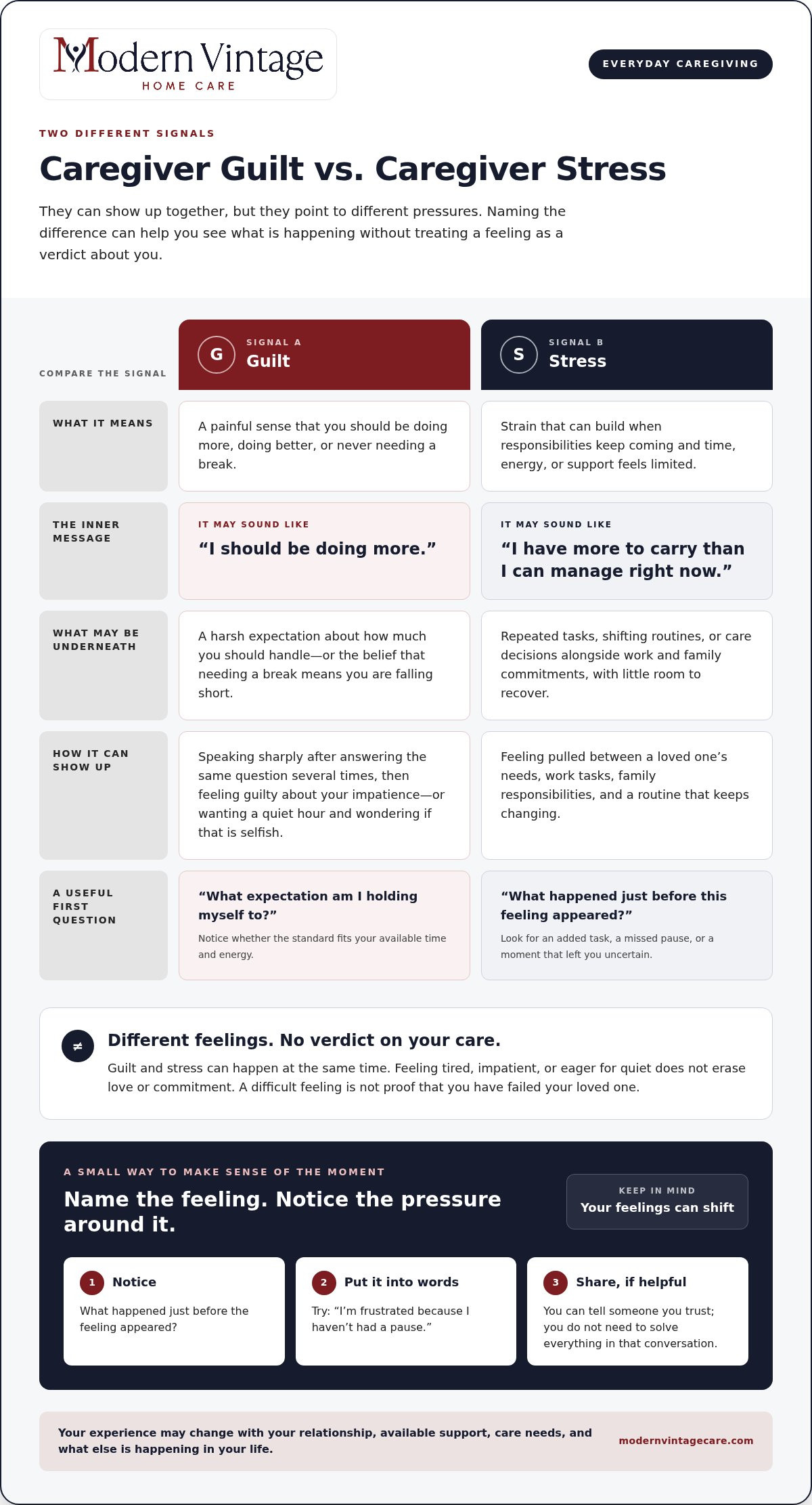
You can love someone deeply and still feel tired, impatient, or eager for a little quiet. Those feelings don’t erase your commitment. Caregiver guilt is the painful sense that you should be doing more, doing better, or never needing a break. It’s a feeling, not proof that you’ve failed your loved one.
Caregiver stress is the strain that can build when responsibilities keep coming and time, energy, or support feels limited. A shifting routine, repeated tasks, and decisions made alongside work or family commitments can leave little room to recover. Guilt says, “I should be doing more”; stress says, “I have more to carry than I can manage right now.” They can show up together, but they aren’t the same thing.
Caregiving burden can describe the broader impact of ongoing responsibilities on a caregiver’s daily life. The overview of Caregiver burden discusses related impacts, risk factors, and forms of support. It can offer context, but it can’t define what your experience means for you or your relationship.
How Guilt and Stress May Show Up During Caregiving
Maybe you’re trying to finish a work task while arranging a loved one’s appointments, then helping your child with homework before the evening routine begins. You may feel pulled in several directions, even when each responsibility matters to you. When plans change or tasks take longer than expected, the pressure can spill into the rest of the day.
You might hear yourself speaking sharply after answering the same question several times, then feel guilty about your impatience. Or perhaps you look forward to a quiet hour alone and immediately wonder whether wanting it makes you selfish. It doesn’t. Wanting rest is a human response to effort, not a measure of how much you care.
There’s no single emotional pattern that fits every caregiver. Your feelings may depend on your relationship, the support available, how care needs change, and what else is happening in your life. A sibling caring from a distance may face different worries than someone sharing a home with a parent. Even your own feelings can shift from one day to the next.
Why Naming the Feeling Can Be a Useful First Step
Before judging yourself, notice what happened just before the feeling appeared. Was a task added to an already full day? Did a conversation leave you uncertain? Were you hoping for a break that didn’t happen? Naming the moment can help you see the pressure around the emotion, rather than treating the emotion as a verdict about your character.
Try describing it privately in a few words: “I’m frustrated because I haven’t had a pause,” or “I feel guilty because I want someone else to take over for a while.” You can also share the feeling with someone you trust. You don’t need to solve everything in that conversation. Putting the experience into words may help you identify the kind of support or adjustment that could be useful as you continue dealing with caregiver guilt and stress.
Why Caregiver Guilt and Stress Arise Even When You Care Deeply
Caregiving asks you to make decisions, adapt to changing routines, and stay attentive to another person’s needs. Love can motivate that care, but it can’t prevent fatigue, frustration, or uncertainty. Caring deeply doesn’t give you unlimited time, energy, or control. Feeling stretched is not evidence that your commitment is lacking.
Guilt often grows when responsibility gets confused with total control. You may be responsible for helping arrange support, for example, but you can’t control every change in a loved one’s health or how quickly a difficult situation improves. Recognizing that difference can make dealing with caregiver guilt and stress more grounded: focus on your choices, not on blaming yourself for circumstances you can’t direct.
The Pressure to Be Available for Everything
A caregiver may be balancing work deadlines, family needs, household tasks, and a loved one’s care. If one responsibility takes longer than planned, the rest of the day can feel like a series of compromises. It’s understandable to wish you could give each person your full attention, but constant availability isn’t a fair measure of care or commitment.
Expectations can come from several places. Some are self-imposed, such as believing you should handle every task without asking for help. Others may come from relatives who assume you’re available because you live nearby, or from family members who have different ideas about what “enough” care looks like. Try asking: Which expectation did I choose, and which one needs a family conversation? Naming the source can help you decide whether to adjust your own standard, clarify responsibilities, or explain what you can realistically manage.
When a Loved One’s Needs Change
Care needs don’t always stay predictable. A change in memory, mobility, or daily routine may prompt new decisions and leave family members unsure about the next step. Different relatives may disagree about what support is appropriate, while the person receiving care may have preferences that deserve careful consideration. These tensions can bring sadness or doubt without making anyone the cause of the underlying change.
Separate what you can influence from what you can’t. You might be able to share observations, talk with family, learn about support options, or make a routine more manageable. You can’t will away a health change or guarantee that every decision will feel simple. If dementia is part of your family’s experience, consider the specific routines and kinds of support that help your loved one feel comfortable as needs change.
Accepting help can be one way to sustain a caring relationship, not a sign that you’ve failed. Family caregiver support may include education, training, and emotional support, while respite care can create time away as your loved one receives tailored, non-medical support. If added help could ease the pressure, explore personalized in-home support as one possible part of your family’s care plan.
How to Separate Reasonable Responsibility From Unfair Self-Blame
A hard caregiving moment can call for a practical response without becoming a judgment about who you are. To make that distinction, describe what happened in specific terms, then separate the action you might take from the story you’re telling yourself about your worth. This is a useful step in dealing with caregiver guilt and stress because it directs attention toward what can be addressed, not toward punishing yourself.
A specific responsibility
“I missed the time we planned to call the clinic. I can call back and ask about the next available time.”
A judgment about personal worth
“I missed one call, so I’m a terrible caregiver and can’t be trusted.”
The first statement identifies an event and a possible next step. The second turns one moment into a sweeping verdict. Reframing doesn’t mean pretending the missed call doesn’t matter. If it affects your loved one’s needs, follow up and make a plan. It means responding to the actual concern without adding blame that doesn’t help resolve it.
A Simple Check for Guilt-Driven Thoughts
When a self-critical thought shows up, ask whether it describes a particular action or labels your whole character. Then consider what you knew at the time, what you could reasonably do, and what support was available. Replace words like “always,” “never,” or “I’m no good” with a fair account of the moment, such as, “I was tired, I responded impatiently, and I can try again more calmly.”
For a quick reflection, pause and ask:
- What happened? Describe the moment without assigning motives or blame.
- What was within my control? Separate your choices from another person’s response, changing needs, or circumstances you couldn’t predict.
- What would help now? Consider a follow-up, a clearer routine, a conversation, or support with the task.
This isn’t a test you have to pass. It’s a way to notice whether guilt is pointing to a repairable action or repeating a harsh judgment. If there is a practical concern, address it with care. If the thought only attacks your worth, it doesn’t offer a useful plan.
When Family Expectations Do Not Match Reality
Family members may have different views about who should do which tasks, how often to visit, or what kind of help feels appropriate. Choose a calm time to discuss your loved one’s current needs, preferences, and routines, then name what each person can realistically contribute. A shared plan might divide tasks, rotate them, or include outside support. There’s no single arrangement that suits every household.
Keep the conversation concrete: “Which tasks need coverage this week?” can lead to a more useful discussion than “Why don’t you help enough?” If expectations still feel unclear, write down responsibilities and revisit them as circumstances change. Accepting help can be one way to protect the relationship and provide thoughtful care, not a measure of failure. Explore tailored in-home support as one possible part of a plan that respects your loved one’s needs and your capacity.
Managing Caregiver Stress Without Ignoring Your Needs
Your needs don’t have to wait until every caregiving task is finished. In a demanding moment, try a brief sequence that helps you respond without expecting yourself to fix everything at once:
- Pause. If it’s safe and practical, take a slow breath or step away from the immediate task for a moment.
- Name the pressure. Be specific: “I’m trying to manage two appointments and dinner,” or “I haven’t had a quiet moment today.”
- Identify one need. Decide whether you need information, a few minutes of rest, help with a task, or a clearer boundary.
- Choose one next action. Make a call, ask someone to take on one responsibility, or postpone a non-urgent task.
This small reset won’t remove every source of strain, and it doesn’t need to. Its purpose is to help you find a manageable response when the whole situation feels too large. If you have little time or support, naming the pressure and choosing what can wait may be a useful first step in dealing with caregiver guilt and stress.
Build a Small, Repeatable Reset Into the Day
Choose a brief activity that fits your real circumstances, not an ideal schedule. You might sit with a cup of tea before starting the next task, stretch while something warms, or step outside for a few breaths if your loved one is safely supported. Notice your own early signs of overwhelm, such as rushing, tension, or difficulty concentrating, and pause where practical. A short reset can offer a moment of care, but it isn’t a cure for ongoing demands.
Boundaries can be small and flexible, too. You might set a time to return a non-urgent call, let a relative know when you’re available to discuss plans, or protect a brief period for rest. If plans change, adjust rather than treating the boundary as a failure. The goal is to make room for your capacity while still attending to your loved one’s needs.
Ask for Help With One Clear, Specific Need
“I need more help” can be hard for others to act on. A concrete request gives family or friends a clearer way to respond: “Could you prepare dinner on Thursday?” or “Can you check in with Dad while I attend an appointment?” You might also ask for a family check-in to divide tasks or arrange a respite visit so you can have time away while your loved one receives support.
Accepting help isn’t abandonment. Thoughtful support can protect your energy and make care more sustainable, while routines and preferences remain central to your loved one’s day. If a respite break could help, explore respite care support tailored to your family’s needs. Starting with one specific request is enough; you can adjust the plan as circumstances change.
Finding Caregiver Support in Sugar Land and Greater Houston
Support can be more than a break from daily tasks. Family caregiver support may include education, training, and emotional support shaped around your family’s needs. It can help you think through routines, communicate about responsibilities, and consider what kind of help feels respectful to the person receiving care. You don’t have to wait until you feel completely overwhelmed to explore what might make caregiving more manageable.
Respite care may give you time away while your loved one receives support at home. That time might let you attend an appointment, focus on work, or simply rest. Accepting help doesn’t mean stepping away from your relationship. It can be one way to sustain it while making room for your own well-being, too.
Discuss What Support Should Look Like for Your Family
Before considering a care plan, think about what a helpful day looks like for your loved one. Note familiar routines, personal preferences, and the specific tasks where another person’s help could ease pressure. For example, you might want support with companionship, personal care, or maintaining a daily routine, while keeping other family roles unchanged.
Care should be tailored, not treated as a one-size-fits-all arrangement. Families can discuss the individual’s needs and preferences, and clients may select caregivers based on compatibility, skills, and preferences. Sharing these details helps shape support around the person’s dignity and familiar ways of doing things, while giving family caregivers a clearer picture of what help can look like.
Explore Flexible In-Home Support With Modern Vintage Home Care
For families in Sugar Land, Missouri City, SW Houston, and nearby Greater Houston communities, Modern Vintage Home Care provides non-medical in-home support, including respite care and family caregiver support. Family support includes education, training, and emotional support, while respite care can create time away for a family caregiver. Support is personalized around the individual and their routines.
After an initial assessment, care typically begins within a few days. This is a typical timeframe, not a guaranteed start date, and the assessment helps inform a plan that reflects the person’s needs and daily life. In-home support is non-medical and doesn’t replace medical care from qualified professionals when that is needed.
If you’re dealing with caregiver guilt and stress, talking through the practical pressures can be a gentle first step toward finding a support plan that respects everyone involved. You can discuss personalized in-home care and the kind of respite or family caregiver support that may fit your family’s situation.
Let Support Grow With Your Family’s Needs
You don’t have to solve every caregiving challenge before you take a next step. Choose one conversation that could make the coming days feel clearer: what matters most to your loved one, what support would feel comfortable, and what you can realistically manage. Needs and preferences can change, so it’s okay for the plan to change with them.
Dealing with caregiver guilt and stress can include learning to accept support without treating it as a verdict on your love or commitment. Family caregiver support can offer education, training, and emotional support, while caregiver compatibility, skills, and preferences can help shape an arrangement around the person receiving care.
If you’re ready to talk through what respectful in-home support could look like for your family, talk with Modern Vintage Home Care about supportive in-home care. You deserve care and consideration, too. Reach out to discuss a personalized support plan for your family in Sugar Land, Missouri City, or SW Houston.
Frequently Asked Questions
Is caregiver guilt normal?
Yes, caregiver guilt is a common response to competing needs and difficult decisions. It may surface after you miss a social event, change a routine, or decide to ask someone else to help. Rather than treating guilt as a command to do more, consider what it’s asking you to examine: is there a practical issue to address, or are you holding yourself to an impossible standard? That distinction can guide your next step.
Can I feel resentful or frustrated and still be a good caregiver?
Yes. Resentment or frustration can reflect a demanding situation, not a lack of love. If you notice these feelings, look for the pressure beneath them: perhaps a responsibility has grown, or you haven’t had a chance to rest. You can still act with respect while acknowledging your emotions. If frustration is affecting how you interact, pause when it’s safe, then consider what support or adjustment could make the moment easier.
How do I stop feeling guilty when my loved one refuses help?
You may not be able to stop the guilt immediately, but you can respond without turning the refusal into a personal failure. Ask what concerns your loved one most, then offer choices that preserve their sense of control, such as trying one task together or revisiting the conversation later. If the concern involves safety or health, discuss it with an appropriate qualified professional. Respectful conversation can keep trust intact even when you disagree.
What can I do when family members disagree about caregiving?
Start with the shared goal of supporting your loved one, then make the discussion specific. List the tasks that need attention, ask what the person receiving care prefers, and invite each relative to say what they can realistically take on. For example, one person might handle calls while another helps coordinate meals. If conversation becomes tense, pause and return to the plan later, or seek a neutral facilitator who can help the family communicate.
When should a caregiver seek professional help for stress?
Consider speaking with a health or mental health professional if stress feels persistent, disrupts sleep or daily functioning, or leaves you feeling unable to cope. You don’t need to wait for a crisis to ask for guidance. A professional can help you explore coping strategies and whether additional support may be useful. If you’re worried you might harm yourself or someone else, seek immediate help through emergency services or a crisis resource.
Can respite care help if I feel guilty about taking a break?
Yes, respite care can provide a planned period away while your loved one receives support, giving you room to rest or attend to another responsibility. If guilt comes up, remind yourself that a break is a way to care for your capacity, not a withdrawal of love. You can begin by identifying what would make the time away feel comfortable for your loved one, such as keeping familiar routines or sharing useful preferences with the caregiver.