
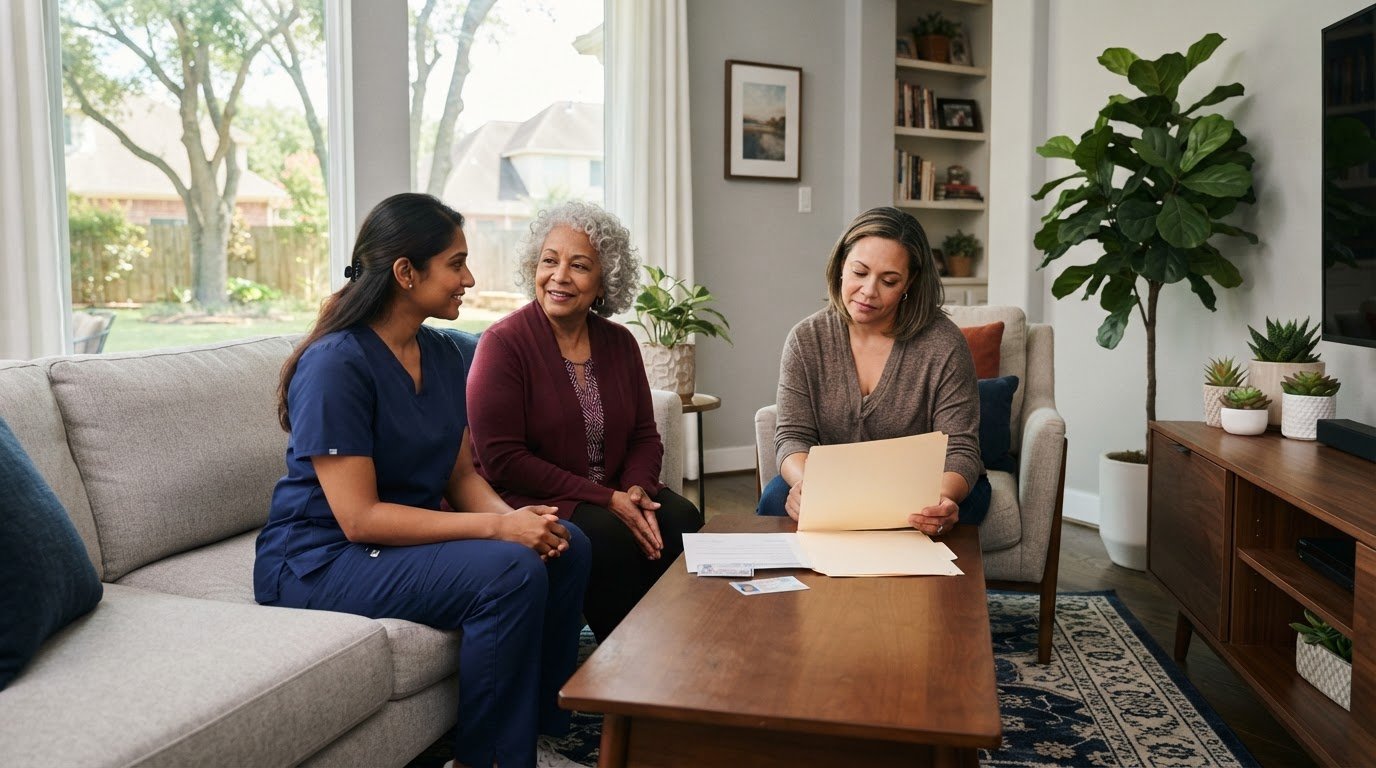
A background check can help you make a more informed choice, but it can’t tell you whether a caregiver will feel like the right person in your loved one’s home. That distinction matters when you’re weighing background checks for in-home caregivers alongside the trust, comfort, and routines that shape daily life.
It’s natural to want clear answers before welcoming someone into a family member’s home. Screening can identify certain information, depending on what was checked, but it can’t guarantee future behavior or measure personal compatibility. Requirements and screening practices can differ by care arrangement, so understanding the process for your situation helps prevent assumptions.
This 2026 guide explains what caregiver background checks can and can’t tell you, how to approach Texas-specific questions, and what to consider when comparing care arrangements. You’ll also find a practical checklist for discussing screening, skills, and personal fit. At Modern Vintage Home Care, all caregivers undergo rigorous background checks, and clients can choose caregivers based on compatibility, skills, and preferences. For families in Sugar Land, Missouri City, and southwest Houston, a thoughtful decision considers both screening and the person receiving care.
Key Takeaways
- Use background checks for in-home caregivers as one source of screening information, not a prediction of future conduct or personal character.
- Screening can vary by role, employer, location, and applicable rules; Wisconsin and Washington examples are not Texas guidance.
- Compare agency-arranged care with direct hiring by considering who handles screening, coordination, and caregiver matching.
- Use the family checklist to clarify what you know about screening and assess whether a caregiver’s skills and approach suit your loved one.
- Modern Vintage Home Care caregivers undergo rigorous background checks, and clients can choose based on compatibility, skills, and preferences.
What Background Checks for In-Home Caregivers Can Tell Families
Inviting someone into a loved one’s home is a personal decision. Families naturally want reassurance, especially when a caregiver will support daily routines and spend one-on-one time with a senior. Background checks for in-home caregivers can provide useful screening information, but they can’t answer every question that matters in a care relationship.
A caregiver background check reviews selected information; it is not a complete assessment of someone’s character, care skills, or future conduct. Its scope depends on the screening process and the rules that apply. A check can inform a decision, but no check alone can guarantee safety or show exactly how someone will behave in a home.
What a caregiver background check is designed to do
A background check is a screening tool used to review information under a particular process and its requirements. The term can refer to different types of searches, and the information considered may vary with the caregiver’s role, employer, location, and applicable law. For a general overview, see What is a Background Check?
That variation matters for Texas families. Screening practices described in another state may reflect that state’s rules, not the rules for a care arrangement in Sugar Land. Avoid assuming that every employer uses the same process or that a broad label tells you exactly what was reviewed. Start by asking what the process is described as covering and who is responsible for it. Screening has a defined scope; it is not an all-purpose judgment of a person.
Why a check is only one part of choosing care
Screening information and everyday caregiving answer different questions. A check can provide information considered during a hiring or care decision. It can’t show whether a caregiver listens patiently, communicates clearly, respects privacy, or responds thoughtfully when a routine changes. Those qualities become clearer through interactions and through how support is shaped around the individual.
Consider a senior who enjoys a quiet breakfast, prefers familiar conversation, and wants help with personal care at an unhurried pace. A screening process can’t determine whether a caregiver’s manner will put that person at ease. Families also need to consider preferences, household routines, communication needs, and the senior’s comfort with the person providing support. Wherever possible, keep the older adult involved in the decision.
Careful screening is a meaningful part of a responsible care decision, but it isn’t the whole decision. Consider it alongside skills, communication, and compatibility. A fuller assessment looks at what screening can establish within its scope and how the caregiver and senior interact as support begins. This balanced approach helps families seek reassurance without treating a check as a guarantee.
What Caregiver Screening May Cover, and Why Texas Rules Need Careful Checking
Families researching background checks for in-home caregivers may find detailed screening instructions online, including references to registries, fingerprints, or repeat checks. Those details are useful only when they apply to the specific care arrangement. Screening scope can vary by role, employer, jurisdiction, and governing requirements, so a process described on one website shouldn’t automatically be treated as the rule for a Texas family.
Screening components are not identical in every setting
There is no single list of screening steps that applies universally to every caregiver or employer. The process for agency-arranged care may differ from the process a family uses when hiring directly. Requirements can depend on the person’s role and the rules that govern the employer. A practice an employer chooses to use is not necessarily a legal requirement.
For example, Wisconsin’s Department of Health Services describes screening practices for Wisconsin-regulated entities. Washington’s Department of Social and Health Services explains a process specific to that state, including its own forms and procedures. These are out-of-state examples, not Texas guidance. A fingerprint step, database search, or schedule described for those settings does not establish that the same step applies in Sugar Land.
An out-of-state screening rule cannot establish a Texas requirement; only applicable Texas authority can clarify what the law requires for a particular care arrangement. This distinction helps families avoid relying on a familiar-sounding process that may not fit their situation.
How to handle Texas-specific legal information responsibly
Before treating a screening step as mandatory in Texas, verify it through an authoritative Texas source, such as Texas Health and Human Services or the relevant state law or regulation. Then consider whether the requirement applies to the specific agency or caregiver arrangement. A rule may apply to one category of employer or worker without applying to every person providing support in a private home.
If a source doesn’t clearly answer those questions, don’t present the point as settled law. This is especially important for claims about which records are searched, how far back a search goes, whether fingerprints are required, or when checks must be repeated. If your family needs a legal interpretation for a particular hiring arrangement, an appropriate Texas legal resource can help clarify the issue.
The U.S. Equal Employment Opportunity Commission also explains employer responsibilities and fair practices in its EEOC Guidelines for Background Checks. That federal guidance offers useful context for employment screening, but it doesn’t replace checking Texas-specific requirements or determine which rules govern an individual care arrangement.
For families, the practical takeaway is to distinguish what a screening process includes from what the law requires, and to distinguish both from what a check can tell you about day-to-day care. Modern Vintage Home Care brings screening together with individualized caregiver matching, so families in Sugar Land, Missouri City, and southwest Houston can explore person-centered in-home support with compatibility, skills, and preferences in view.
Agency vs. Direct Hire: Comparing Care Arrangements
Choosing between agency-arranged care and hiring a caregiver directly affects more than who handles screening. It also shapes who organizes the care relationship, communicates expectations, and helps find someone whose approach suits the senior. Neither arrangement is automatically safer or a better fit for every family. Compare how responsibilities are divided and whether the arrangement meets your loved one’s needs.
| Consideration | Agency-arranged care | Direct hire |
|---|---|---|
| Screening responsibility | The agency handles screening as part of its hiring and care-arrangement process. The exact scope depends on the agency and applicable requirements. | The family takes responsibility for arranging screening and understanding what it covers, subject to applicable requirements. |
| Coordination | The agency helps arrange the caregiver and communicate care expectations; families should understand how coordination works. | The family typically organizes caregiver selection, expectations, and communication directly. |
| Caregiver fit | Caregiver selection may include consideration of compatibility, skills, and preferences. | The family evaluates the caregiver’s experience, communication, and fit with the senior and household. |
Who coordinates screening and ongoing care
With agency-arranged support, the agency takes responsibility for its screening process and helps organize the care arrangement. Families should also understand how responsibilities are divided: who communicates the senior’s routines, how expectations are shared, and whom to contact about the arrangement. A Texas-specific resource such as the Texas Employee Misconduct Registry provides context about a state registry, but it doesn’t by itself explain every screening responsibility for every care arrangement.
With a direct hire, the family generally carries more of the organizing work, including deciding how to screen and how to set expectations. In either model, clarity matters. Before care begins, make sure the senior’s preferences, daily routines, and support needs are understood by the people involved. Don’t assume agency involvement means a particular level of ongoing monitoring or repeat screening; those details depend on the arrangement.
Why compatibility belongs in the comparison
A check can’t tell you whether a caregiver’s communication style will feel reassuring or whether their pace will suit a senior’s routine. A person who enjoys conversation may appreciate a warm, social companion, while someone who values quiet may feel more comfortable with a calmer approach. Experience and skills matter, too, but they complement screening rather than replace it. For memory-care needs, a specialized dementia care guide can help families consider support and routines that may suit their loved one.
Modern Vintage Home Care lets clients choose caregivers based on compatibility, skills, and preferences, alongside rigorous background checks. Families in Sugar Land, Missouri City, and southwest Houston exploring person-centered in-home care can weigh screening and personal fit together, rather than expecting either one to answer every question.
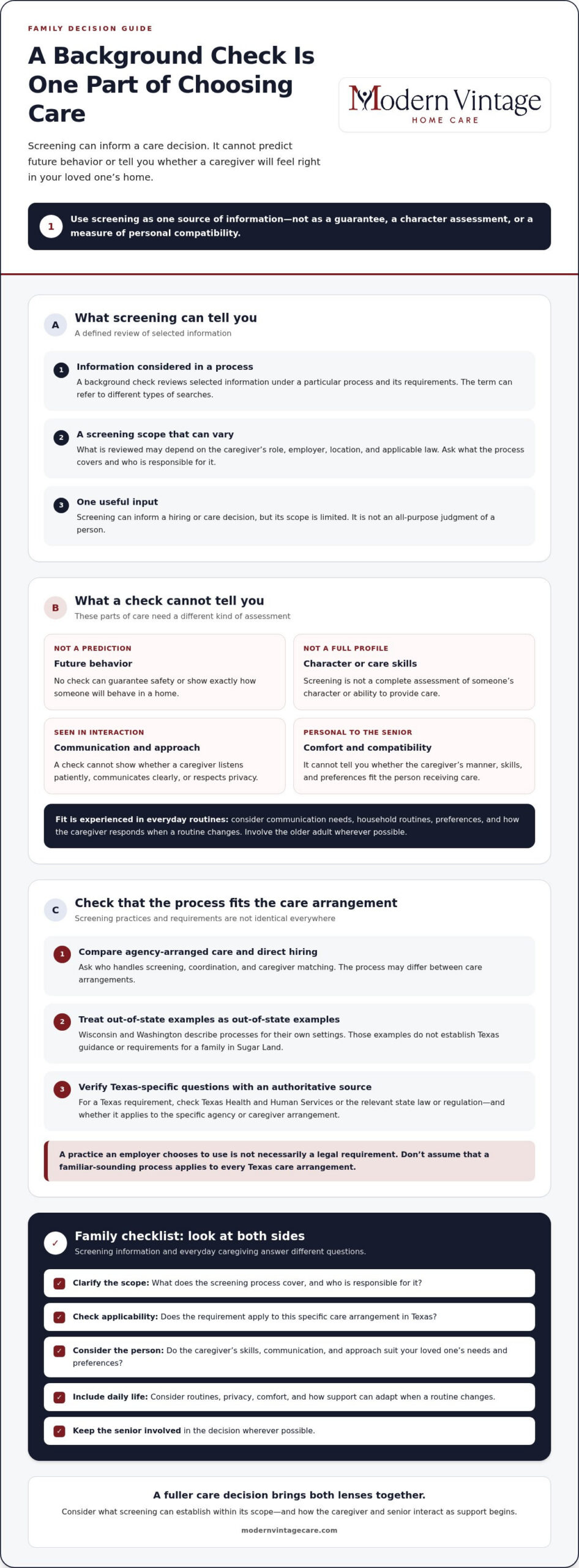
A Family Checklist for Evaluating In-Home Caregiver Screening
A useful checklist makes room for both clear information and the senior’s lived experience. Use these prompts to understand the screening process, set shared expectations, and consider whether a caregiver’s approach feels right. The answers can’t predict every future interaction, but they can help your family make a thoughtful decision about background checks for in-home caregivers and daily support.
Questions that clarify the screening process
Focus on what can be explained plainly. Clarifying responsibility and scope helps you understand what screening information contributes to the decision, without treating it as a guarantee or assuming one process applies everywhere.
- Who is responsible for conducting the screening? Identify whether an agency or the family arranges it, and who can explain the process.
- What can be explained about the screening’s scope? Note what the process is described as covering, and distinguish that explanation from information that isn’t available to you.
- How is screening information handled? Understand who receives or discusses the information and how screening fits into the care decision, without assuming a particular record or procedure.
- Who is the caregiver, and what is their role? Make sure names, responsibilities, and the support expected in the home are clear to the family.
Questions that clarify day-to-day care fit
Next, consider the details that shape comfort at home. Share the senior’s preferences and routines with the people coordinating care, and include the older adult in decisions wherever possible. If support with daily living tasks such as bathing or dressing is needed, consider how the family’s needs align with the support described in a personal care guide.
- What routines and preferences should the caregiver know? Describe typical meal times, preferred activities, privacy needs, and the pace that feels comfortable.
- What communication style works best? Consider whether the senior prefers quiet companionship, conversation, reminders, or extra time to respond.
- How will the family share expectations? Agree on a practical way to communicate care preferences and changes to routines.
- Does the senior feel comfortable with this caregiver? Notice how the person responds during introductions and early interactions. Comfort and compatibility deserve attention alongside skills and screening.
Quick summary: Clarify who screens, understand the scope that can be explained, share the senior’s routines, and consider comfort and compatibility. At Modern Vintage Home Care, all caregivers undergo rigorous background checks, and clients may choose caregivers based on compatibility, skills, and preferences. Explore personalized in-home care for your family.
Modern Vintage Home Care: Screened, Person-Centered Care
For families considering support at home, screening can be an important part of choosing care, but it can’t show on its own whether a caregiver’s approach will suit a loved one. Modern Vintage Home Care brings these considerations together: all caregivers undergo rigorous background checks, and clients may choose caregivers based on compatibility, skills, and preferences.
This balance matters because care happens in the details of daily life. A senior may value quiet companionship, familiar routines, or a gentle pace when receiving personal care. Families can consider those preferences alongside the caregiver’s skills, rather than treating screening as the only measure of suitability. Background checks for in-home caregivers contribute information to a decision; the person receiving care and their comfort should remain central to it.
Screening alongside caregiver choice
Modern Vintage Home Care’s rigorous background checks form one part of its in-home support. They don’t guarantee future conduct, so families can also consider how a caregiver’s skills and personal manner align with the individual’s needs. Clients may choose caregivers based on compatibility, skills, and preferences, keeping the selection focused on the person who will receive care.
That choice can make the conversation more specific. A family might consider whether a caregiver’s communication style feels comfortable, whether their skills align with the support needed, and whether the senior’s preferences have been heard. These are practical parts of building a care arrangement around the individual, not questions a screening result can settle.
A supportive next step for local families
Modern Vintage Home Care is state-licensed in Texas under State License #020191. Its service area includes Sugar Land, Missouri City, Houston, Fort Bend County, and Harris County. Whether a family is exploring companionship, personal care, or support for a loved one living with Alzheimer’s or dementia, start by identifying what matters to that person and the family.
For example, a family in Sugar Land may be looking for help that respects a loved one’s familiar daily rhythm, while relatives in Houston may be weighing what kind of support would ease day-to-day responsibilities. Each family’s circumstances are different. Sharing the senior’s preferences, support needs, and priorities can help frame a thoughtful discussion about in-home care without expecting a background check to answer every question.
If you’re considering care in Sugar Land, Missouri City, or southwest Houston, you can discuss your family’s in-home care needs with Modern Vintage Home Care. A calm conversation can help you explore personalized support and the caregiver qualities that matter most to your family.
Take the Next Step Toward Care That Feels Right
Choosing support for someone you love doesn’t have to happen all at once. Start a thoughtful conversation with your family: what would make daily life easier, which routines should stay familiar, and what would help your loved one feel respected and at ease? Including the senior wherever possible can help keep their voice at the center of the decision.
As you consider background checks for in-home caregivers, remember that screening is a starting point for informed conversations, not a promise about what every day will look like. Weigh that information alongside the qualities that matter in your home, from communication and patience to compatibility with your loved one’s preferences.
Modern Vintage Home Care provides in-home support with rigorous caregiver screening and a choice process that considers compatibility, skills, and preferences. If you’re ready to explore what could work for your family, discuss your family’s in-home care needs. A calm, personal conversation can help you take the next step with greater confidence.
Frequently Asked Questions
What does a background check for an in-home caregiver usually include?
There isn’t one universal set of records or steps used in every caregiver screening. The scope can depend on the employer, role, location, and applicable requirements, so families should understand what applies to their particular care arrangement. At Modern Vintage Home Care, all caregivers undergo rigorous background checks. A check provides information to consider, not a guarantee of future conduct.
Do Texas law requirements for caregiver background checks apply to every in-home care arrangement?
Not necessarily. The rules that apply can depend on the care arrangement, caregiver role, and relevant Texas requirements. Before relying on a legal claim, verify it through an authoritative Texas source, such as Texas Health and Human Services, or consult a qualified legal professional. Don’t assume a rule described for another state applies in Texas. Focus on understanding the screening process used for the specific arrangement.
Does a caregiver background check guarantee that a caregiver is safe?
No. A screening result can’t guarantee how someone will act in every future situation. It’s one source of information; clear expectations, communication, family involvement, and the senior’s comfort also help shape the care experience. For example, discuss how the caregiver should communicate a change to a familiar routine and how the family prefers to stay informed. These steps complement screening without treating it as a prediction.
Can a family run its own background check on an in-home caregiver?
Families may find consumer screening services, but a personal search isn’t necessarily the same as an employer’s screening process. Rules about consent, permissible purpose, and using third-party reports may apply, depending on the situation. Before ordering or relying on a report to make a hiring decision, verify the requirements that apply to your circumstances. Avoid treating an online result as a complete picture of a person or their suitability for care.
How recent does an in-home caregiver background check need to be?
There’s no universal validity period that families can assume applies to every care arrangement. Timing and any repeat-check expectations depend on applicable rules and the employer’s process. An interval described for Wisconsin, for example, shouldn’t be treated as a Texas requirement. If timing matters to your decision, look for Texas-specific guidance and understand the screening process relevant to the arrangement rather than inferring a schedule.
What should a family do if a background check raises a concern?
Pause and seek clarification before drawing conclusions. Check whether the information is accurate and relevant, and use the proper process to raise questions or request corrections. A finding alone doesn’t explain the full circumstances, so avoid making assumptions about a caregiver’s conduct. If there’s an immediate safety or medical emergency, contact appropriate emergency services or qualified professionals. For other concerns, keep communication calm and focused on the senior’s needs.
Can families choose their in-home caregiver after screening?
Yes. Screening and personal fit serve different purposes, and Modern Vintage Home Care allows clients to select caregivers based on compatibility, skills, and preferences. A family might consider whether a caregiver’s communication style feels comfortable or fits the senior’s routines. Include the older adult in the conversation where possible, and treat their comfort as a meaningful consideration, not a promise that every match will be perfect.