

What if the way to get siblings to agree on parent care isn’t to win an argument, but to start with what your parent wants and needs? Learning how to get siblings to agree on parent care can feel especially difficult when one person sees an urgent need for support and another doesn’t. Distance, different assumptions, and long-standing family habits can make a practical conversation feel personal.
If you’re carrying most of the day-to-day work, it’s understandable to want a fairer plan without turning every discussion into a conflict. Siblings don’t have to contribute in identical ways. The goal is a realistic plan built around your parent’s preferences, each person’s capacity, and the support needed to maintain their well-being. This guide offers practical ways to prepare for a calmer conversation, share responsibilities clearly, and keep communication open as needs change. Family caregiver education and respite support can also help relatives feel less alone while care continues at home.
Key Takeaways
- Disagreement may stem from different information, worries, or capacity. Identify what each sibling’s concern is really about before trying to solve it.
- Prepare for a family conversation by separating firsthand observations from assumptions and setting a clear purpose and agenda.
- Compare care options using the same criteria, including daily needs, routines, safety, and what relatives can realistically provide.
- To learn how to get siblings to agree on parent care, turn general offers into specific tasks, with a named person responsible and a time to review the plan.
- When needs change or caregiver strain grows, family education, respite, or tailored non-medical home care can offer practical support.
Why siblings disagree about parent care, and what is really at stake
Disagreement about a parent’s care can feel like a painful judgment on the family, but it doesn’t mean anyone loves them less. Siblings may have different information, fears, and capacities. One person might notice missed meals during frequent visits, while another sees a parent managing comfortably during occasional calls. Each is responding to a different view of the same situation.
The disagreement may also be about what kind of help feels right, how much it could cost, or who should take responsibility. A sibling living nearby may gradually handle appointments and errands, while relatives farther away may not see how those small tasks add up. Family history can add another layer: an old sense of unfairness may shape how a request for help is received today. Identifying the source of tension makes it easier to discuss the practical issue without treating every difference as a personal attack.
A shared care decision reflects the parent’s needs and preferences while recognizing what each family member can realistically contribute. This shifts the goal from getting everyone to agree with one person to building a plan the family can explain and revisit.
Recognize the concern beneath each sibling’s position
One sibling may prioritize safety after noticing a change at home; another may worry that added help will disrupt a parent’s independence or familiar routine. Cost concerns, guilt about living far away, and fear of losing a parent’s trust can also come out as criticism or resistance. Before debating a proposed solution, ask what each person is most worried might happen. Curiosity can reveal shared hopes beneath different opinions.
Try asking, “What feels most important to protect?” or “What have you noticed that worries you?” Then separate what someone directly observed from what they infer. “Mom left the stove on twice this week” is a specific observation; “she can’t live alone” is a conclusion that needs a fuller conversation. This distinction gives siblings something concrete to discuss without dismissing anyone’s concern.
Keep the parent at the center of the disagreement
Ask your parent what they want, what matters in their daily life, and what kinds of support they would accept. If possible, include them in a calm conversation at a time and pace that suits their needs. Rather than presenting a decision that’s already been made, offer a clear choice or invite them to describe what would make daily life easier. Their preferences can guide the family toward support that feels respectful.
Needing help with some tasks doesn’t automatically mean a parent can’t express preferences or take part in decisions. If siblings are unsure about the parent’s ability to make a particular decision or who has authority to make it, seek guidance from a qualified professional rather than relying on family assumptions. The family caregiver role can bring emotional and practical pressures, so naming those pressures matters too. Understanding what is at stake is a useful first step in how to get siblings to agree on parent care.
How to prepare for a family conversation about your parent’s care
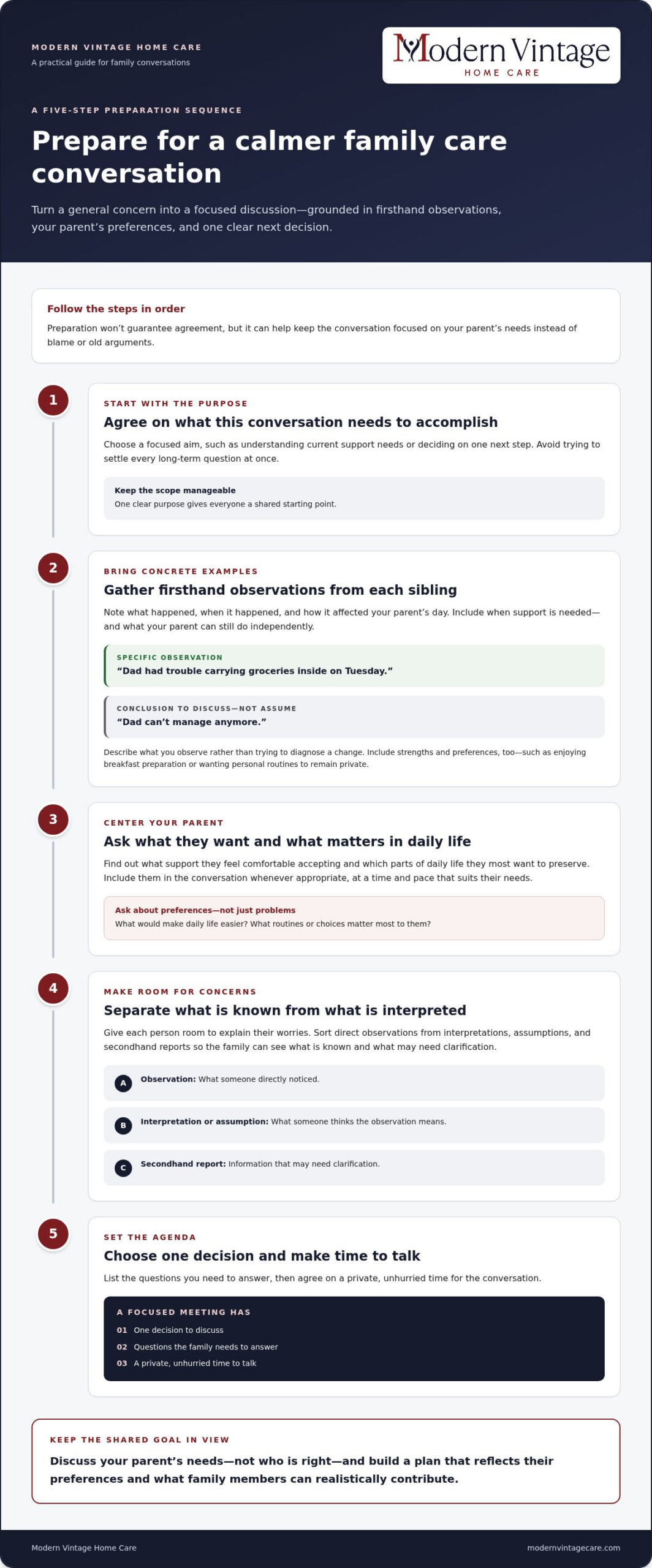
A calmer conversation starts before everyone sits down. Agree on what you hope to decide, gather clear examples, and give each sibling a way to contribute, including those who live far away. Preparation won’t guarantee agreement, but it can help the family discuss your parent’s needs instead of getting pulled into blame or old arguments.
Specific examples make care discussions more useful than blame because they give everyone something concrete to understand and respond to. Note what happened, when it happened, and how it affected your parent’s day. For example, “Dad had trouble carrying groceries inside on Tuesday” is more useful than “Dad can’t manage anymore.” Include strengths and preferences, too: perhaps your parent still enjoys preparing breakfast or prefers to handle personal routines privately. Describe what you observe rather than trying to diagnose a change; direct health questions to qualified professionals.
Use a five-step preparation sequence
Take these steps in order to turn a general concern into a focused family conversation:
- Agree on the purpose. Decide what the conversation needs to accomplish, such as understanding current support needs or choosing one next step. Avoid trying to settle every long-term question at once.
- Gather observations. Invite each sibling to share firsthand examples, including when support is needed and what your parent can still do independently.
- Ask your parent. Find out what they want, what they’re comfortable accepting, and what parts of daily life they most want to preserve. Include them in the conversation whenever appropriate.
- Share concerns. Give each person room to explain their worries. Separate direct observations from interpretations, assumptions, and secondhand reports so the family can see what’s known and what may need clarification.
- Set an agenda. Choose one decision to discuss, list the questions you need to answer, and agree on a private, unhurried time to talk.
Make the conversation workable for everyone
If siblings live in different places, ask them to send observations and questions before the meeting. A short written update helps a distant sibling contribute without relying on incomplete information, while giving the sibling who visits most a chance to describe everyday details. Keep notes factual and balanced. Treat a secondhand account as a prompt for more context, not as proof.
At the meeting, agree to listen without interrupting or blaming. Make space for each sibling and, if appropriate, your parent to speak. If emotions become overwhelming, pause and return to the discussion later. A respectful agenda keeps the group focused on one decision rather than reopening every family disagreement.
Preparing together is one practical step in how to get siblings to agree on parent care. If caregiver education or emotional support would help your family plan, family caregiver support can be part of the conversation.
How to compare care options and reach a decision together
Once the family has a clearer picture of what’s happening, compare possible support using the same criteria. Start with your parent’s preferences, then consider daily needs, safety, familiar routines, and what relatives can realistically provide. This keeps the discussion focused on how each option fits your parent’s life, rather than on which sibling has the most convincing argument.
Separate needs into practical tasks, companionship, and supervision. Help with errands, for example, is different from having someone nearby during a part of the day when your parent feels uncertain. Preserve routines and activities that matter to them wherever possible.
Match the care plan to needs and family capacity
Consider each sibling’s availability, distance, skills, and other responsibilities without treating those differences as a measure of devotion. One person might coordinate appointments, another might visit regularly, and a relative who lives farther away might arrange calls or handle planning tasks. If memory changes are part of the picture, specialized dementia home care services in Sugar Land can support a plan shaped around those needs.
Use a simple side-by-side comparison to make the plan more concrete:
Family can provide: regular visits, meal preparation, errands, transportation, companionship, or organizing appointments. Name who can take on each task and when.
Support to arrange: help with personal care, additional companionship, respite for a family caregiver, or support with daily routines that relatives can’t reliably cover. Match each need to an appropriate service or resource.
Parent’s preferences: note which tasks they accept help with, routines they want to keep, and any concerns they want the family to consider.
Non-medical home care can support daily living and companionship, but it doesn’t replace clinical care or emergency services. If a health question needs assessment, involve a qualified medical professional. For urgent medical needs, contact emergency services.
Know when a neutral facilitator may help
If repeated conversations stall, a qualified mediator, counselor, or care professional may help everyone clarify what they’ve heard and what they value. Their role is to support a more useful discussion, not to choose the family’s priorities or override the parent’s wishes. For questions about legal authority, consent, or formal decision-making, seek qualified legal guidance rather than relying on assumptions.
Agree on what would prompt a review, such as a new difficulty with a daily task, a change in the parent’s preferences, or a relative no longer being able to manage an agreed responsibility. A review point isn’t a prediction that something will go wrong; it gives the family a calm way to adjust the plan as needs change. A clear, flexible comparison can make how to get siblings to agree on parent care feel more manageable.
How to divide caregiving responsibilities fairly and revisit the plan
A workable care plan doesn’t require every sibling to do the same amount or the same kind of work. Fairness means matching responsibilities to each person’s time, distance, skills, and other commitments while keeping your parent’s needs covered. The sibling who lives nearby may be able to attend appointments, but that shouldn’t automatically make them responsible for every visit, errand, and update.
Replace broad promises like “I’ll help more” with tasks people can understand and agree to. For each responsibility, write down who owns it, what they’ll do, and when. For example, one sibling might coordinate appointments, another could plan grocery orders, and a third could call your parent at agreed times and share updates with the family.
Create a shared, practical responsibility plan
Choose one shared record, such as a family document or calendar, for responsibilities, decisions, questions, and changes. Keep entries brief and factual so everyone can see what’s covered without relying on scattered messages. Review the list together and ask whether the tasks are manageable. If an arrangement depends on one sibling being available every day, it may need another layer of support or a backup plan.
- Visits: Agree who will visit and what support or companionship they’ll provide.
- Appointments: Assign coordination, transportation, or follow-up communication as separate tasks.
- Meals and errands: Decide who will plan, shop, or help with practical needs.
- Family updates: Name the person who will share relevant changes and how the family will stay informed.
Set a check-in date while creating the plan, then choose a change that should bring the family back together. A new daily task, a change in your parent’s preferences, or a sibling’s shift in availability could all be reasons to review responsibilities. Revisit the arrangement before frustration builds, and adjust it without treating a change as a broken promise.
Use respite and family support without framing them as failure
Caregiving can be meaningful and still leave a family member needing time to rest. Respite care for family caregivers can provide planned relief while support continues at home. Asking for help doesn’t mean relatives have failed; it can make the shared plan more sustainable and give a caregiver space to attend to other parts of life.
Family caregiver support can include education, training, and emotional support, helping relatives feel better prepared and less alone. Non-medical home care can be tailored to a person’s routines and daily needs. If your family is considering added help, explore tailored non-medical home care as one way to support your parent and caregiving arrangement.
When family agreement needs support: a compassionate next step
Sometimes a thoughtful family conversation still doesn’t settle everything. Disagreement may keep returning, a caregiver may feel stretched thin, or your parent’s daily needs may change enough to call for a new plan. Those are reasons to seek additional support, not signs that your family has failed. Outside help can address practical care needs while relatives continue working through decisions together.
Modern Vintage Home Care provides family-centered, non-medical home care in Sugar Land, Missouri City, SW Houston, and surrounding Texas communities. Depending on a senior’s needs and preferences, support may include Companionship, Personal Care, Alzheimer’s & Dementia Care, or Respite Care. These services can support daily routines and give a family caregiver planned time away, but they don’t resolve family conflict by themselves or replace clinical care. The family remains involved in deciding what feels appropriate for their parent.
What to expect when exploring in-home support
An initial assessment helps shape a care plan around the senior’s needs, preferences, and routines. It also gives family members an opportunity to share observations and discuss the kind of help that may fit daily life. Clients may choose caregivers based on compatibility, skills, and preferences, so the senior’s comfort remains part of the process.
Care typically starts within a few days after the initial assessment. If siblings are still discussing options, they can use the assessment conversation to clarify practical questions without treating it as a commitment to a particular arrangement. The aim is to understand how non-medical support could fit alongside family involvement.
Choose a next step that keeps the family involved
Before a care conversation or consultation, invite each sibling to share their questions and priorities. One person may want to understand how support fits a familiar routine; another may want to discuss respite or help with personal tasks. Gathering those questions beforehand can make the conversation more focused and help relatives feel included, whether they live nearby or at a distance.
Keep your parent’s dignity, independence, and preferences at the center. Ask what support they’re comfortable accepting and what parts of daily life they want to continue doing themselves. If siblings disagree, distinguish the practical question of what help may be useful from the family’s separate work of reaching agreement. Learning how to get siblings to agree on parent care can take time, and a care plan can be explored while those conversations continue.
A no-obligation consultation is a gentle way to discuss home care in Sugar Land, Missouri City, and SW Houston and consider how support might fit your family’s needs. If you’re ready to explore that option, discuss home care with Modern Vintage Home Care.
Take one thoughtful step toward a shared plan
Agreement doesn’t have to arrive all at once. A useful next step might be asking your parent what would make the coming week feel easier, or inviting each sibling to name one manageable way they can contribute. Small, respectful actions can help your family keep the conversation moving without expecting every difference to disappear.
If added support could make the plan more sustainable, Modern Vintage Home Care offers non-medical care tailored to individual routines and needs. Families can discuss caregiver compatibility and preferences, along with education, training, and emotional support for relatives. That support can complement family involvement while keeping your parent’s dignity and choices at the center.
Learning how to get siblings to agree on parent care is ultimately about building a plan that can adapt as your parent’s needs and family capacity change. You don’t have to work out every detail before taking a first step. Talk with Modern Vintage Home Care about a supportive next step, and keep moving forward with care, patience, and your parent’s wishes in view.
Frequently Asked Questions
What should I do if my sibling refuses to discuss our parent’s care?
Invite your sibling to discuss one specific concern, rather than trying to resolve every family tension at once. You might say, “Could we talk for 15 minutes about Mom’s missed appointments?” Share what you directly observed, then ask what’s making the conversation difficult for them. Offering a choice of times can lower the pressure. If attempts keep stalling, a neutral counselor, mediator, or care professional may help everyone take part.
How can siblings make a care decision when they live in different places?
Siblings can coordinate from different locations by choosing one shared place to record updates and decisions, such as a family calendar or document. A relative who lives far away might arrange appointment reminders or keep other family members informed, while someone nearby handles an in-person task. Set a regular time to check whether the arrangement still fits. Include your parent’s preferences directly, rather than assuming distance tells you what they need.
Can siblings make care decisions without the parent’s agreement?
Start by involving your parent and asking what they want whenever possible. Being an adult child doesn’t automatically establish authority to decide for a parent. Consent and decision-making capacity depend on the circumstances, so avoid treating a sibling’s opinion as a legal answer. If the family is unsure who can make a particular decision, seek qualified legal or medical guidance. Keep conversations respectful, and explain concerns in a way that preserves your parent’s dignity.
What if one sibling is doing most of the caregiving?
Name the imbalance as a workload issue, not proof that one sibling cares more. Try tracking recurring tasks for a short period, including time spent on calls, errands, and follow-up. Then ask each person to choose a realistic contribution, such as handling a family update or coordinating an appointment. If someone can’t take on hands-on care, they may still help in another way. Revisit the arrangement if circumstances change.
How do you talk to siblings who disagree about whether a parent needs help?
Discuss what’s changed instead of arguing over broad labels like “fine” or “unsafe.” For instance, describe a specific task your parent now finds difficult and ask what each sibling has observed. Ask what additional information would help the family understand the situation. The question of how to get siblings to agree on parent care may become easier to approach when everyone is discussing the same evidence. Refer health or safety concerns to a qualified professional.
Can respite care help when siblings disagree about caregiving?
Respite care may give a family caregiver planned time away while their loved one continues receiving support at home. It won’t settle sibling disagreements by itself, but relief from caregiving duties can create space for a more considered conversation. Families in Sugar Land, Missouri City, and SW Houston can explore non-medical home care options based on the parent’s needs and preferences. For urgent medical needs, contact emergency services or a qualified medical professional.
