

Finding help with senior-care costs doesn’t have to start with guesswork. For financial assistance for senior care in Fort Bend County, call 211 for referrals to local community resources, including senior services, or text your ZIP code to 898211. Fort Bend organizations may also offer referrals or specific forms of support, such as need-based utility assistance when funding permits.
It’s understandable to feel unsure where to turn when care needs are changing and household costs are already stretched. Financial assistance can take different forms, and local referrals may help you identify resources that fit your family’s needs.
This article explains how to use 211 Texas, what local social-service organizations may offer, and what to consider as you explore care options. You’ll also learn how in-home support can help a senior maintain familiar routines and receive assistance with daily needs, so your next steps feel clearer and more manageable.
Key Takeaways
- Use local referral services to narrow down social-service resources that match your family’s needs.
- Learn which Fort Bend County organizations may offer practical help, including utility assistance when funding permits.
- Understand the difference between emergency financial help and support for ongoing senior care.
- Explore how Texas Medicaid pathways and eligibility factors relate to nursing home and in-home care.
- Consider what kind of day-to-day support may help a senior remain comfortable and supported at home.
211 Texas/United Way information and referrals
211 Texas connects Texans with local community resources, including senior services and social-service referrals. Fort Bend County families can use the helpline to identify where to ask about care costs, benefits, and application assistance.
Medicaid Eligibility and Income Limits
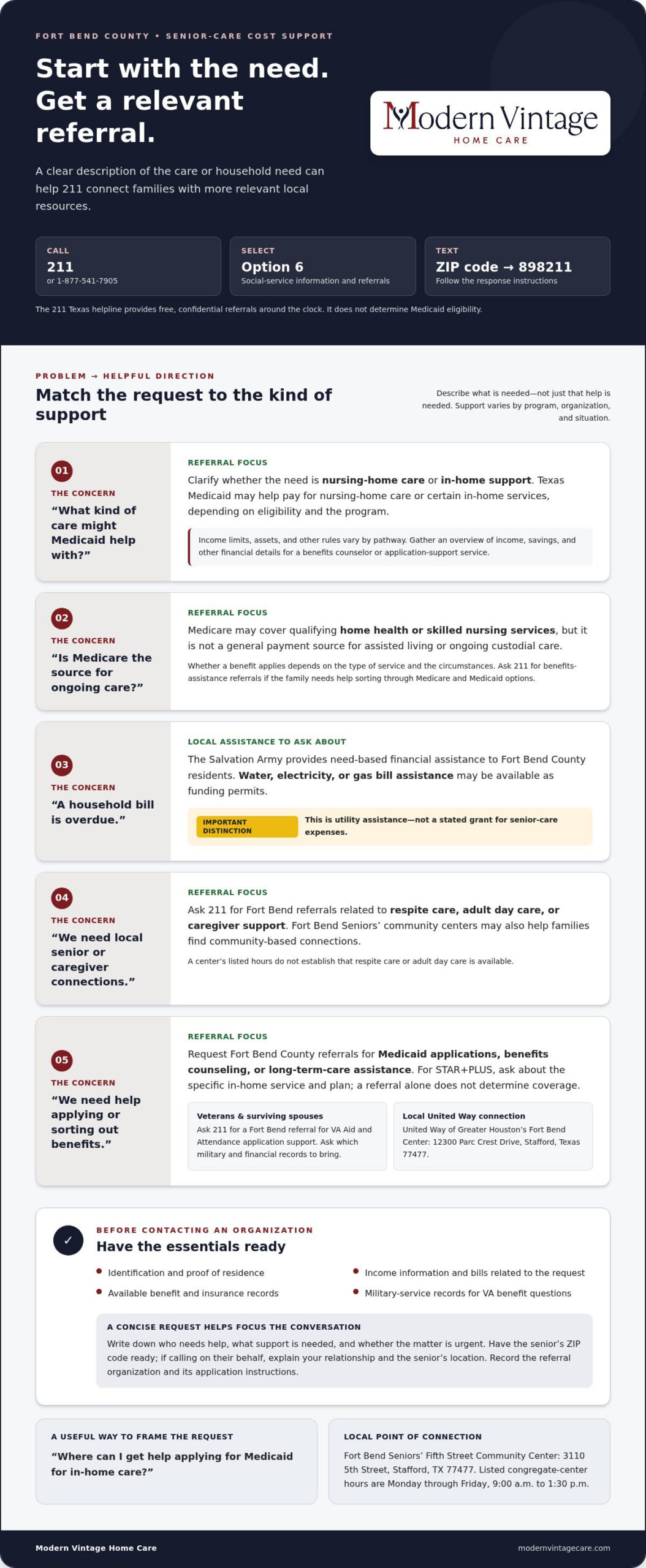
Texas Medicaid eligibility depends on the program and the type of long-term care someone needs. Income limits and other eligibility rules vary by pathway, so identify whether the need involves nursing home care or support at home. This helps make a referral more useful. 211 can direct callers toward community resources and benefit information, but it doesn’t determine Medicaid eligibility.
Income and Asset Effects
Income and assets can affect eligibility for Texas senior-care assistance, but the rules vary by program. Income, savings, and other financial details may be treated differently across benefit pathways. Gather an overview of these details before seeking application help so a benefits counselor or application support service has a clear starting point.
Medicare may cover qualifying home health or skilled nursing services, but it isn’t a general payment source for assisted living or ongoing custodial care. The type of service and the circumstances determine whether a Medicare benefit applies. Ask 211 for referrals to benefits assistance if the family needs help sorting out Medicare and Medicaid options.
Medicaid Coverage for Senior Care
Texas Medicaid may help pay for nursing-home care or certain in-home services, depending on the person’s eligibility and the program. These are distinct care pathways, so describe the support needed when seeking guidance. For example, clarify whether the concern is residential nursing care or assistance that would help a senior remain at home.
When seeking financial assistance for senior care in Fort Bend County, distinguish help with care services from emergency help with household bills. Explaining the specific need can direct the referral conversation toward a more relevant resource.
Application and Referral Support
Call 211 or 1-877-541-7905 to reach the 211 Texas helpline. Texans can select option 6 for information and referrals to social services. The helpline provides free, confidential referrals around the clock. To use text instead, send a ZIP code to 898211 and follow the response instructions.
Ask specifically for Fort Bend County referrals related to Medicaid applications, benefits counseling, or long-term care assistance. United Way of Greater Houston’s Fort Bend Center is at 12300 Parc Crest Drive, Stafford, Texas 77477. Having the senior’s ZIP code and a brief description of the care need ready can help focus the referral request.
Before calling, write down the main question, such as “Where can I get help applying for Medicaid for in-home care?” If a family member is calling on a senior’s behalf, explain their relationship and the senior’s location. 211 can provide referrals, while the organization receiving the referral can explain its own application process.
Fort Bend County social-service organizations
Organizations serving Fort Bend County may offer referrals, community connections, or assistance with urgent household needs. What they can provide depends on the organization and the situation.
For STAR+PLUS questions, call 211 and request a referral for Texas Medicaid benefits assistance. Ask about the specific in-home service and plan, since a referral alone doesn’t determine coverage.
Veterans and surviving spouses can call 211 and request a Fort Bend County referral for VA Aid and Attendance application support. Ask what records to bring, including relevant military and financial documents.
For respite care, adult day care, or caregiver support, ask 211 for referrals to local senior-service organizations. Fort Bend Seniors’ community centers may also help families find community-based connections, though their listed center hours don’t establish respite or adult day care availability.
Grants and Emergency Assistance
The Salvation Army provides need-based financial assistance to Fort Bend County residents, with water, electricity, or gas bill assistance available as funding permits. This is utility assistance, not a stated grant for senior-care expenses. If an overdue utility bill is adding pressure, explain the bill and the household’s immediate need when requesting help.
For other urgent needs, call 211 and ask for referrals to local social-service organizations. Explain whether the need concerns care costs, food, transportation, or household bills. A clear description helps direct the request toward relevant support rather than assuming every organization offers the same assistance.
Application Documents and Steps
Before contacting an organization, gather identification, proof of residence, income information, and bills related to your request. For Medicaid or VA benefit questions, also collect available benefit, insurance, and military-service records. These documents help explain the situation, but each program or organization sets its own application requirements.
Start with a short written summary: who needs help, what support is needed, and whether the matter is urgent. Then call 211, request the relevant Fort Bend County referral, and record the organization’s name and application instructions. Keep copies of documents and note any follow-up steps the organization gives you.
Fort Bend Seniors lists its Fifth Street Community Center at 3110 5th Street, Stafford, TX 77477. Its congregate centers are open Monday through Friday, 9:00 a.m. to 1:30 p.m. These centers offer a local point of connection; contact them through a 211 referral to ask which senior services fit the family’s needs.
Community connections can also help families identify resources. Fort Bend CONNECT meets on the second Friday of every month, while Fort Bend Recovers meetings are held bi-monthly. Ask 211 whether either group can direct you toward relevant local support. When calling, mention the senior’s location and the specific need, such as a benefits referral or caregiver resources.
Does Fort Bend County offer senior care grants or emergency financial assistance?
Fort Bend County residents can seek need-based utility assistance through the Salvation Army. Water, electricity, or gas bill assistance is available as funding permits. It may help with a household bill, but it is different from a grant specifically intended to pay for ongoing senior care. Identify the urgent expense before deciding where to ask for help.
For example, a family facing an overdue electricity bill should describe the bill and household need when seeking assistance. If the pressure instead comes from care expenses, explain what support is needed and seek referrals to relevant local resources. Keeping these requests separate helps avoid treating utility assistance as funding for caregiving.
Match the request to the type of help
Emergency assistance and longer-term care funding address different needs. Help with a utility payment may keep an essential household service in place, while a care-related referral may connect a family with benefits or social-service information. Write down the expense, who needs assistance, and the timeframe. These details help explain the request without assuming an organization can cover every cost.
When a bill is urgent, contact the Salvation Army about its need-based assistance and explain whether the expense is water, electricity, or gas. Funding affects whether utility help is available. For care costs, contact 211 Texas and describe the service or expense involved. A referral can point families toward local organizations, but the receiving organization explains its own assistance and application process.
- Utility need: Identify the water, electricity, or gas bill and explain why it is urgent.
- Care need: Describe the support required, such as help at home or caregiver relief.
- Benefits question: Ask for a referral related to the specific program or application concern.
- Multiple needs: Separate bills from care expenses so each request goes to the relevant resource.
Before calling, prepare a brief explanation of the situation. Say whether the senior lives alone, which household expense needs attention, and what care support the family is trying to arrange. Focus on the most immediate need first, then ask what next step the organization recommends and whether another local referral could help with the remaining concern.
Families seeking financial assistance for senior care in Fort Bend County can use this distinction to make more focused requests. Utility assistance may address an eligible household bill, while care-related support calls for a referral suited to that need. Record the organization’s name, the assistance discussed, and any application instructions. This helps relatives coordinate follow-up and avoid repeating the same details at each contact.
Texas Medicaid for Nursing Home & In-Home Care
Texas Medicaid may be a funding pathway to explore for a senior who needs nursing-home or in-home care. The relevant route depends on the care setting, services needed, and the person’s eligibility. Start by describing the support required rather than assuming every service or setting follows the same process.
Separate nursing home care from in-home support
For nursing-home care, explain that the senior needs support in a residential setting. For in-home care, describe the tasks that are difficult to manage at home, such as personal routines or daily assistance. These details help a benefits counselor identify which Medicaid pathway to discuss and clarify the difference between facility-based care and support provided at home.
Clarify which services the family needs
Write down the senior’s care needs before requesting Medicaid guidance. Note whether the main concern is ongoing nursing-home care, help with everyday activities at home, or both. Include examples, such as difficulty maintaining daily routines or needing more support than family members can provide. A clear description makes a referral conversation more specific.
Medicaid assistance depends on program eligibility and covered services, so don’t treat it as an unrestricted payment for any care expense. Ask which service category fits the senior’s situation and how the application process addresses it. If the family is weighing home care against a nursing facility, describe both options and ask what information is needed to understand each pathway.
Prepare for a focused benefits conversation
Gather basic details before speaking with a benefits counselor: the senior’s living arrangement, current support, and the care tasks causing the greatest strain. Keep questions direct. Ask whether the next step concerns nursing-home care or in-home services, what application information is required, and where to get help completing it.
211 Texas can refer Fort Bend County residents to local social-service and benefits resources. When requesting a referral, explain that the question concerns Texas Medicaid and long-term care. Include the senior’s ZIP code and whether the need involves nursing home care or assistance at home. This helps narrow the referral to the relevant location and care question.
Keep a written record of referrals and instructions. Note the organization’s name, the person spoken with, and any documents or follow-up steps discussed. If a family member calls for the senior, clarify who needs care and what the caller is helping coordinate. These notes can organize separate conversations and reduce confusion as the family explores Medicaid pathways.
For financial assistance for senior care in Fort Bend County, a practical first step is matching the care need to the right benefits conversation. Describe the setting, specific support required, and current arrangement, then use a local referral to find relevant application guidance. Nursing-home and in-home care inquiries may call for different questions, so state each need clearly.
What are the Texas Medicaid eligibility and income limits for seniors needing long-term care?
Texas Medicaid eligibility for long-term care depends on the care pathway and the applicant’s circumstances. There is no single income figure that answers every senior’s question. Nursing-home and in-home care inquiries can involve different program requirements. Identify the setting and support needed, then review the eligibility rules for that pathway.
Income and assets both matter when evaluating financial eligibility. Make a complete list instead of judging eligibility from one paycheck or bank balance. Include income sources, savings, and other assets, then ask how the relevant Texas Medicaid pathway treats each item. This gives an application discussion a clearer foundation and helps avoid overlooking information that could affect the assessment.
What to review before assessing eligibility
Use these steps to organize the information:
- Describe the care setting: Note whether the senior needs nursing home care or assistance at home.
- List income: Record each income source and how often it arrives.
- List assets: Gather a current overview of savings and other assets.
- Explain the support needed: Give examples of daily tasks or care needs the senior cannot manage alone.
These details help separate financial eligibility questions from questions about covered services. A senior’s income and assets relate to the financial review, while the requested care setting identifies which long-term-care pathway to discuss. Keep these topics distinct when preparing questions for an application-assistance conversation.
For example, a family comparing help at home with nursing-home care should describe each option separately. The senior’s financial details remain important, but the care setting determines which program rules the family needs to understand. Ask how each pathway assesses income and assets and what documents support that review. Don’t assume a figure discussed for one pathway automatically applies to another.
Getting help with the next steps
Write down specific questions before seeking application guidance. Ask which Texas Medicaid pathway fits the care setting, how income and assets are reviewed, and which records are needed. If the family needs a local referral, call 211 Texas and request help finding benefits or long-term-care application support in Fort Bend County. Bring the senior’s care details and financial overview to that conversation.
Keep copies of records and notes from each benefits discussion. If information changes, update the income and asset overview before continuing the application process. A careful, complete picture helps the family discuss eligibility based on the senior’s circumstances rather than relying on a general income figure that may not fit the care pathway.
Modern Vintage Home Care: Alzheimer’s & Dementia Care
Modern Vintage Home Care provides Alzheimer’s & Dementia Care for families seeking support with a senior’s daily care needs. If memory changes make familiar routines harder to manage, in-home support can be a practical next step while you explore benefits and community referrals.
Care needs differ from person to person. Companionship offers social connection, while Personal Care assists with personal routines. Families can discuss which support best fits their relative’s needs and care arrangements. These services are separate from Medicaid eligibility decisions, so keep benefits questions and care planning distinct.
Contact Modern Vintage Home Care to discuss Alzheimer’s and dementia care, or visit modernvintagecare.com.
Choose a Next Step That Fits Your Family
Make the next conversation easier by agreeing on one practical priority. Your family might organize benefit paperwork, describe the support a senior needs at home, or decide who will coordinate follow-up. A shared note with current questions and care preferences can help relatives stay aligned as plans develop.
Financial assistance for senior care in Fort Bend County can involve separate conversations about benefits and day-to-day care. Keep those goals connected, but don’t assume a benefit decision will determine every care arrangement. If Alzheimer’s or dementia affects a loved one’s routines, consider what consistent support could help maintain familiarity and comfort.
Modern Vintage Home Care offers 24-Hour Care for families considering a higher level of in-home support. To discuss care needs and possible next steps, contact Modern Vintage Home Care. A thoughtful conversation can help your family move forward with greater clarity and care.
Frequently Asked Questions
What financial assistance programs help pay for senior care in Fort Bend County, Texas?
Texas Medicaid may help eligible seniors with qualifying long-term care, while the Salvation Army offers need-based help with water, electricity, or gas bills when funding permits. These programs address different expenses. For local referrals, contact 211 Texas and explain whether the need is care-related or an urgent household bill. For example, a family managing both costs can ask about each separately and note which expense needs attention first.
Does the Texas STAR+PLUS Medicaid waiver cover home care for Fort Bend County seniors?
Texas Medicaid may help pay for certain in-home care, depending on eligibility and the program. For STAR+PLUS, ask 211 for a benefits referral and check coverage for the specific in-home service and plan; a referral does not determine coverage.
What Medicare benefits cover home health care, skilled nursing, or assisted living for seniors in Texas?
Medicare may cover qualifying home health or skilled nursing services, depending on the service and circumstances. It is not a general payment source for assisted living or ongoing custodial care.
What financial aid is available for respite care, adult day care, and caregiver support in Fort Bend County?
Call 211 and request referrals to local senior-service organizations for respite care, adult day care, or caregiver support. Fort Bend Seniors’ community centers may provide local connections, but no specific financial aid for these services is identified.
