

A familiar home can support independence, but it isn’t automatically the safest or least costly choice. Keeping parents at home instead of a facility can work when their care needs can be met safely, the finances are manageable, and their wishes remain central to the decision. If a parent has a reverse mortgage, moving into a health care facility for more than 12 consecutive months may require repayment, according to the U.S. Department of Housing and Urban Development.
It’s understandable to want to honor a parent’s wish to stay home while also worrying about care costs, family responsibilities, and what happens to the house. This article explains the factors that shape the cost comparison, what to understand about loan obligations, and how a parent’s decision-making authority and family emotions can affect the choice. You’ll also find practical ways to weigh home care against facility care without losing sight of your parent’s safety, dignity, and sense of home.
Key Takeaways
- Compare the full costs of home care, assisted living, and nursing homes by considering the type and amount of support your parent needs.
- Explore different in-home care options, from help with personal routines to companionship, and match support to daily needs.
- Understand when Medicare may cover care at home and how Medicaid programs may help with services or family caregiving.
- Bring your parent’s wishes into the conversation and consider how housing decisions, family emotions, and care needs affect the path forward.
2. Family wishes and emotional considerations
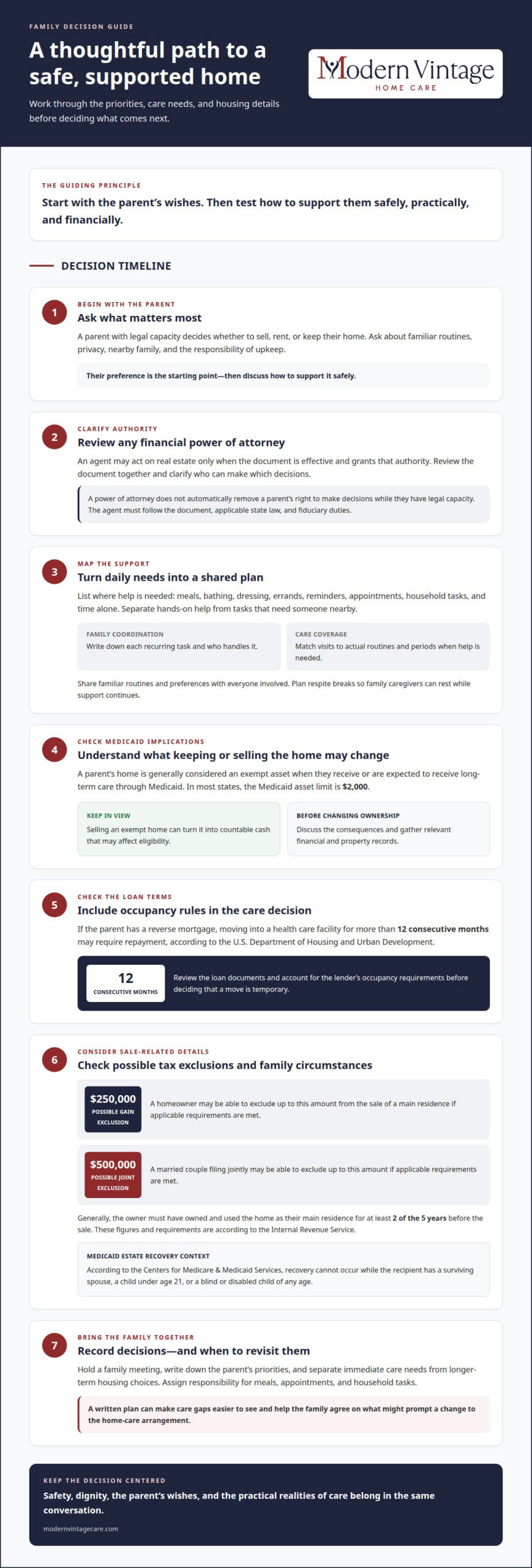
A parent with legal capacity decides whether to sell, rent, or keep their home. Begin by asking what matters most to them: familiar routines, privacy, nearby family, or less responsibility for upkeep. They may want to stay home while accepting help with meals or personal care. Treat their preference as the starting point, then discuss how to support it safely.
If a parent appoints someone through a financial power of attorney, that person may act on real estate only when the document is effective and grants that authority. The agent must follow the document, applicable state law, and fiduciary duties. Before discussing a sale or rental, review the document together and clarify who has decision-making authority. A power of attorney doesn’t automatically take away a parent’s right to make decisions while they have legal capacity.
Keeping the home can also affect Medicaid planning. A parent’s home is generally considered an exempt asset when they receive or are expected to receive long-term care through Medicaid. In most states, the Medicaid asset limit is $2,000, and selling an exempt home can turn it into countable cash that may affect eligibility. Discuss the consequences before changing ownership or selling, and gather relevant financial and property records.
Check mortgage terms before deciding that a move is temporary. A reverse mortgage may require repayment if a borrower moves into a health care facility for more than 12 consecutive months, according to the U.S. Department of Housing and Urban Development. A move can therefore affect both the parent’s care plan and their housing finances. Review the loan documents and include the lender’s occupancy requirements in the family’s decision.
A sale may also have tax consequences. A homeowner may be able to exclude up to $250,000 of gain from the sale of a main residence if applicable requirements are met, according to the Internal Revenue Service. A married couple filing jointly may be able to exclude up to $500,000 of gain if applicable requirements are met, according to the Internal Revenue Service. Generally, the owner must have owned and used the home as their main residence for at least two of the five years before the sale, according to the Internal Revenue Service.
Families may worry that keeping the home could affect future Medicaid estate recovery. According to the Centers for Medicare & Medicaid Services, recovery cannot occur while the recipient has a surviving spouse, a child under age 21, or a blind or disabled child of any age. Include these family circumstances when reviewing the home’s future, rather than treating the property decision as purely financial.
Caregivers can reduce burnout by sharing recurring tasks among family members and scheduling regular breaks. Write down who handles meals, appointments, household tasks, and time away, then revisit the plan as care needs change. Respite care can give a family caregiver time to rest while maintaining support for the parent.
Emotions can make practical discussions difficult, particularly when siblings disagree about fairness or responsibility. Schedule a family meeting, record the parent’s priorities, and separate immediate care needs from longer-term housing decisions. A written plan clarifies who handles each task and what might prompt the family to reconsider staying at home.
3. What home care options are available for aging parents?
Support at home can come from relatives, paid caregivers, or both. The right arrangement depends on what your parent can manage and where assistance is needed. Start with a practical list: meals, bathing, dressing, errands, reminders, and time alone. For example, a parent may manage breakfast independently but need help preparing dinner and getting ready for bed. Families considering keeping parents at home instead of a facility can use this list to pinpoint where support is most important.
Family members can share practical responsibilities without leaving one person to manage everything. One relative might handle grocery shopping, another could help with appointments, and someone nearby could check in after work. Write down each task and who owns it. This makes gaps easier to spot, such as evenings when no family member is available.
Paid in-home caregivers can assist with routines that are difficult to manage alone. Depending on the care arrangement, this may include help with dressing, bathing, moving around the home, meals, or companionship. Before planning support, note which activities need hands-on assistance and which only require someone nearby. A parent who needs help getting dressed may need a different schedule from someone who mainly wants company.
Some families arrange help at specific times of day, while others need more extensive coverage. A morning visit could support a getting-ready routine; an afternoon visit could offer company and help with a meal. If needs arise overnight or during family members’ work hours, update the plan to address those periods. Match coverage to actual tasks rather than assuming every hour requires the same support.
Memory-related needs can shape the kind of support a family seeks. A parent who becomes unsettled during familiar routines, for example, may benefit from consistent caregivers and predictable daily activities. Keep a written guide to preferred meals, calming conversation topics, and familiar routines. Share it with everyone involved to help provide steadier support.
Respite care is another option when a family caregiver needs time away. A relative might arrange temporary support to attend an appointment, rest, or manage household responsibilities. Plan breaks before exhaustion disrupts the care routine. Be clear about the tasks the covering caregiver will handle, such as preparing lunch or staying nearby during an evening routine.
Simple tools can also support independence. A calendar near the kitchen can show appointments, visitors, and planned meals. Clear pathways, frequently used items within reach, and written reminders can make familiar routines easier to follow. Review changes with your parent and adapt them to their preferences and abilities. A plan for keeping parents at home instead of a facility should change as their needs and preferences shift.
To build a workable plan, list the parent’s daily tasks, identify who can help, and mark uncovered times. Then decide whether family support alone is enough or whether additional in-home help would make routines more manageable. A personalized in-home support plan can help families consider how care might fit their parent’s routines.
Match caregiver support to specific tasks and times, such as bathing, meals, or companionship. When memory-related needs are involved, consistent caregivers and shared guidance about familiar routines can help create steadier support.
4. How does the cost of home care compare with assisted living and nursing homes?
No single cost structure fits every family. Compare the support your parent needs, the hours arranged, and the housing expenses that continue. Home care typically involves charges for caregiving while the family remains responsible for ongoing home costs. Assisted living generally combines housing and support, while nursing homes provide residential care with more extensive assistance. Compare what each option includes, not just its headline cost.
Start with a written monthly budget for your parent’s household. Include mortgage or rent, property taxes, utilities, food, transportation, and home maintenance. Then add the planned in-home care and any supplies or household help the family expects to arrange. A parent receiving morning assistance, for example, still needs a plan for meals, evening routines, and overnight safety.
In-home care costs depend on the type and amount of support arranged. A short visit for a specific task differs from support across several parts of the day. Pricing varies by care needs, hours, tasks, and schedule, and requires a personalized quote. Families can compare a proposed plan with their budget without treating every hour as equally necessary.
Assisted living may combine housing, meals, and supportive services. Review the agreement to see what is included and what costs extra. A parent who needs limited help may use only some of the available support, while someone needing frequent assistance may rely on more. Compare included services with the parent’s actual routines rather than assuming a bundled option costs less.
Nursing home costs reflect a residential setting and a higher level of care. If a parent needs extensive supervision or assistance throughout the day and night, compare the services included with the support required at home. Factor in any home-care hours, housing costs, meals, and household responsibilities that would remain. Use the same care needs to assess each option.
Family contributions also affect a practical budget. If relatives provide help with errands, meal preparation, or evening visits, record those responsibilities alongside paid support. This shows whether the plan depends on one person’s unpaid time or has reliable coverage throughout the week. A schedule that looks affordable may be hard to sustain if family availability changes.
Use a comparison sheet with three columns: home care, assisted living, and nursing home care. Under each, list housing, meals, personal assistance, supervision, transportation, and extra services. Mark what is included, what the family would arrange, and what depends on the parent’s needs. Then weigh the totals against convenience, privacy, and the parent’s preferred routine. This makes trade-offs clearer without relying on a single average price.
5. Does Medicare pay for in-home care for elderly parents?
Medicare generally does not cover non-medical home care. Families should distinguish this ongoing support from eligible medical services rather than assume all care at home is covered. Help with meals, dressing, or companionship is different from a health-related service. Before budgeting, list the specific tasks your parent needs and the purpose of each.
Start with a service-by-service checklist. Record each task, who provides it, how often it is needed, and whether it involves medical care or daily routines. For example, list medication reminders separately from help preparing lunch. This makes it easier to discuss coverage for a specific service instead of asking whether “home care” as a whole is covered.
Review your parent’s Medicare coverage documents and any plan materials they receive. Note the service name, eligibility conditions, and limits described. If your parent has Medicare Advantage, keep those plan documents with their Medicare information. Compare the written coverage details with the actual care plan, including each service’s provider, purpose, and schedule.
Keep records organized. Save care plans, appointment notes, bills, and explanations of benefits in one folder. If a claim is denied, read the reason and identify the service or requirement it addresses. A denial for one task does not automatically explain whether separate services are covered. Track each item individually, such as a covered medical visit and privately arranged help with bathing.
Separate Medicare questions from the overall cost of care. Even if a particular service is covered, the household may still need to budget for meals, supervision, companionship, or personal assistance. Add those needs to the same budget used to compare home care and residential options. This helps prevent families from treating a potentially covered service as payment for every daily task.
For a practical review, use these steps:
- List each task your parent needs help completing.
- Describe the purpose and schedule for every service.
- Match each service to the relevant Medicare or plan document.
- Record coverage decisions, bills, and follow-up actions.
- Update the list when your parent’s needs or care plan changes.
For example, if your parent needs help bathing and has a separate medical appointment at home, record those as distinct needs. Review how the written plan treats each service, then budget for daily assistance separately. This gives the family a clearer picture of what Medicare may contribute and what requires another funding plan. It also avoids confusing medical treatment with ongoing help around the home.
5. What Medicaid programs help pay for in-home care or family caregivers
Medicaid home-care assistance depends on the state and the parent’s circumstances. First identify where your parent lives, then contact that state’s Medicaid office to ask which programs support care at home. Ask about home- and community-based services waivers, personal care services, and options that let participants direct their support. Program names help focus the conversation, but services and eligibility rules vary by state.
Prepare by documenting your parent’s needs. List daily tasks that require help, such as bathing, dressing, meals, or moving safely around the home. Include examples of when support is needed and whether a family caregiver currently provides it. Specific details help explain the difference between occasional help and ongoing assistance.
Ask the Medicaid office how each program treats paid care from a family member. Some arrangements distinguish between relatives providing unpaid help and caregivers who may receive payment. Confirm which relatives, tasks, and service arrangements the state program considers. Don’t assume that a family member’s existing caregiving role automatically qualifies for compensation.
Keep financial and household details organized for the application process. Gather income and asset records, housing information, insurance details, and any existing care plans. Medicaid eligibility can involve financial and care-related criteria, while rules vary by state. The home is generally considered exempt when a parent receives or is expected to receive long-term care through Medicaid. In most states, the asset limit is $2,000, and selling an exempt home can turn it into countable cash that may affect eligibility.
Ask how the program assesses care needs and which documents support that assessment. A dated note showing that your parent needs help dressing each morning, for example, is more useful than a general statement that help is needed. Keep copies of forms and note the date, office, and next step after each conversation. Use the same organized file to respond if the state requests more records.
Before including Medicaid funding in a family budget, get the program’s written explanation of covered services, caregiver payment rules, and participant responsibilities. Separate those details from expenses the household still expects to manage. A written decision gives relatives a shared reference when discussing who can provide care and which tasks need another arrangement.
Medicaid estate recovery is another planning issue. According to the Centers for Medicare & Medicaid Services, recovery cannot occur while the recipient has a surviving spouse, a child under age 21, or a blind or disabled child of any age. Include these circumstances when reviewing the long-term effect of a Medicaid-supported care plan.
Modern Vintage Home Care: Alzheimer’s & Dementia Care
Modern Vintage Home Care provides Alzheimer’s & Dementia Care for families supporting a parent at home. When memory changes make familiar routines harder, individualized, non-medical support can assist with daily needs while respecting the parent’s preferences. Companionship offers conversation and a familiar presence, while Personal Care supports everyday routines such as dressing and bathing.
Reach out when your family is weighing in-home support or needs help making daily care more manageable. Share which routines your parent finds challenging and what assistance would suit their preferences. Contact Modern Vintage Home Care to discuss Alzheimer’s and dementia care for your family.
Take the next step with a care plan that fits
Keeping parents at home instead of a facility is a family decision that can evolve as needs and routines change. You don’t have to settle every future question at once. Start by writing down the support your parent needs now, what they value most about home, and where relatives need help sharing responsibilities. This gives everyone a clearer basis for a thoughtful conversation.
If your family is considering added support, Modern Vintage Home Care offers 24-Hour Care for parents who need consistent assistance at home. Discussing your parent’s daily routine and care needs can help you explore whether that support fits your family’s plan.
Contact Modern Vintage Home Care to talk about your family’s next step. A considered plan can help your parent feel supported while giving loved ones a clearer way forward.
Frequently Asked Questions
How much does in-home care for seniors cost in the United States?
There’s no single U.S. price for in-home senior care; costs depend on the support arranged. Pricing varies by location, care level, schedule, and tasks, and requires a personalized quote. Families in Sugar Land, Missouri City, and southwest Houston can estimate their needs by listing the help required and when it’s needed, then requesting a tailored quote.
