

A single hourly figure can be misleading: hourly home care rates in Sugar Land depend on the hours needed and the type of support involved. To compare costs, consider the care schedule and services together rather than treating the hourly rate as the whole budget.
It’s understandable to want a simple number when planning support for someone you love. A fair comparison also accounts for how needs may differ between a few scheduled hours and more regular help.
This article explains what shapes home care pricing, how Sugar Land compares with Houston and Katy, and what to consider when comparing care options. It also shows how care hours and support needs shape a plan, so you can weigh costs alongside your family member’s comfort, routines, and independence.
Key Takeaways
- Compare the planned care schedule and type of support, not just the hourly rate, to understand the overall budget.
- Local rate comparisons can help you place Sugar Land alongside Houston and Katy, but the care arrangement also shapes the cost.
- Account for factors such as caregiver type, transportation, and agency overhead when evaluating pricing.
- Include minimum shifts and possible weekend or holiday premiums in your cost comparison.
- Medicare generally doesn’t cover non-medical home care; Medicaid, veterans’ benefits, and long-term care insurance may be options to explore.
What Does Senior Care Cost in Sugar Land, TX?
Senior care budgets depend on the schedule, level of support, and setting. Comparing weekly care hours with monthly residential costs can help families weigh home care against other options.
Weekly and Monthly Home Care Costs
Weekly and monthly home care costs reflect the hours scheduled and the support provided. To estimate monthly hours, multiply weekly hours by 4.33, the average number of weeks in a month. For example, a 20-hour weekly schedule becomes about 86.6 hours monthly. This helps families compare schedules consistently, though it doesn’t supply a rate for a particular care plan.
The number of seniors in Sugar Land provides useful context for local planning. According to the U.S. Census Bureau, persons 65 years and over make up 19.3% of the population. A family’s budget still depends on the individual’s needs, such as whether support is needed for personal routines, companionship, or dementia-related supervision.
Home care takes place in a person’s home, while assisted living and nursing homes include a residential setting. These figures provide context, but the settings and services are not interchangeable.
Compare the same type of care across nearby cities, such as Houston and Katy, rather than treating every published average as equivalent. Schedules, caregiver arrangements, and support needs can differ between estimates. Home health is also distinct from non-medical help at home, so its costs are not a direct match for personal care or companionship.
Estimating Round-the-Clock Care Costs
Round-the-clock care means continuous coverage across every hour of the month. A practical estimate starts with roughly 720 hours monthly, then multiplies that total by the applicable hourly rate. The result illustrates why continuous coverage differs substantially from a part-time schedule. Families can also compare the coverage needed overnight with daytime support when considering how hours are arranged.
For a fair comparison, keep the setting and schedule consistent: assisted living costs include a residential arrangement, while home care budgets depend on hours provided at home. Families in Sugar Land, Houston, or Katy can compare similar schedules and types of assistance. This distinction makes average cost figures more useful and avoids treating nursing, assisted living, and in-home support as identical services.
Factors that affect agency and caregiver pricing
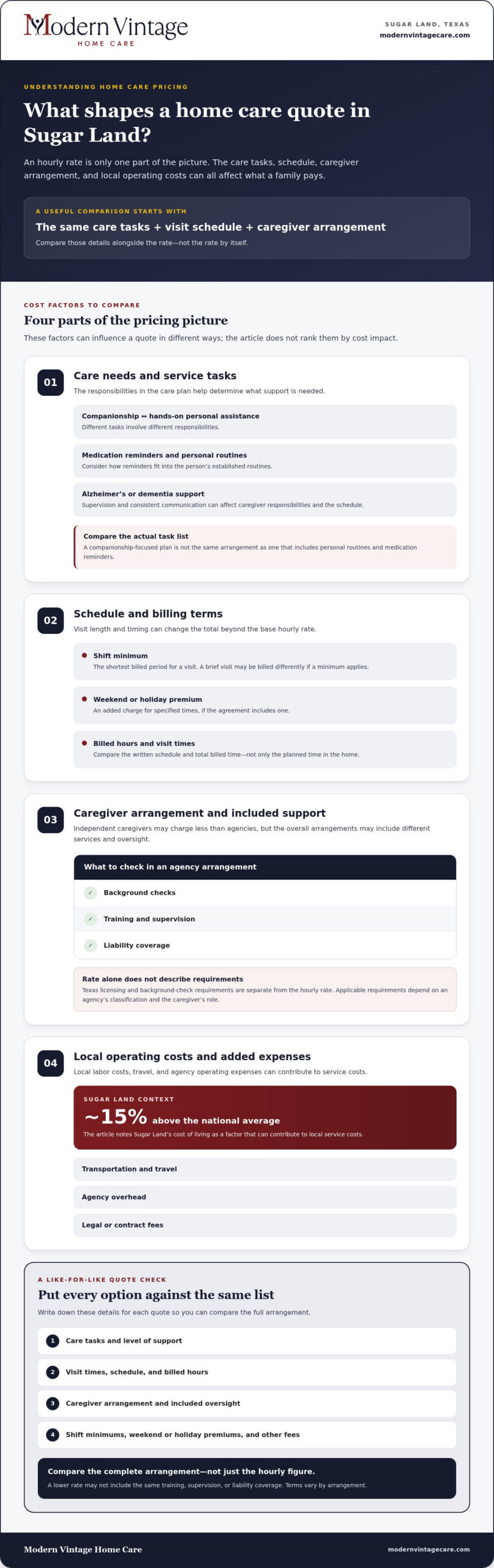
Home care pricing reflects the requested support, schedule, caregiver arrangement, and local operating costs. In Sugar Land, comparing these details can help explain why hourly quotes differ.
Texas licensing and background-check requirements are separate from an hourly rate. Applicable requirements depend on an agency’s classification and the caregiver’s role, so price alone does not describe them.
Care Needs and Service Pricing
The tasks and level of support in a care plan shape its cost. Companionship and hands-on personal assistance involve different responsibilities. Medication reminders may also need to fit established routines. Alzheimer’s or dementia care can involve supervision and consistent communication, affecting the caregiver’s responsibilities and the schedule a family arranges.
For a useful comparison, list the specific tasks and when they’re needed. A plan focused on companionship, for example, differs from one that includes help with personal routines and medication reminders. Home care costs reflect the actual arrangement, not just the service label.
Local Factors Affecting Rates
Local factors include labor costs, travel, and agency operating expenses. Sugar Land’s cost of living is about 15% above the national average, a factor that can contribute to local service costs.
Transportation, agency overhead, and legal or contract fees can affect a family’s expenses. Independent caregivers may charge less than agencies, while agency arrangements may include background checks, training, supervision, and liability coverage. Compare the full arrangement to weigh the hourly rate against the support included.
Shift Minimums and Premium Charges
A shift minimum is the shortest billed period for a visit, while a premium is an added charge for specified times, such as weekends or holidays. Both can increase the total beyond the base hourly rate, so they matter when care involves short or nonstandard visits.
A brief morning visit, for example, could be billed differently if a minimum shift applies. A weekend schedule may also cost more if the agreement includes a premium. Terms vary by arrangement, so compare the written schedule, billed hours, and any added charges.
Agencies and independent caregivers can differ in how they structure services and oversight. A lower hourly figure may not include the same training, supervision, or liability coverage as an agency arrangement. Compare those components alongside duties, schedule, and total billed time rather than weighing the rate alone.
Use a simple comparison: write down the care tasks, visit times, caregiver arrangement, and any minimum-shift or premium terms. Then compare each quote against that same list. If medication routines are part of the plan, medication management support is one service to consider when matching care needs with the schedule.
Average hourly home care rates in Sugar Land
An average hourly rate is a market benchmark, not a universal price for every care arrangement. For Sugar Land families, compare equivalent services and schedules, then use the average as context, not as a quote.
Published estimates may show a starting rate, maximum rate, or median. These measures describe different points in a market and shouldn’t be combined into one figure. Comparing Sugar Land’s starting-rate estimate with Houston’s maximum, for example, would exaggerate the difference.
Local comparisons are most useful when they use the same definition of home care. Compare Sugar Land with Houston and Katy using the same measure, such as starting rates, and the same type of assistance. An estimate with a different service mix or caregiver arrangement may not represent comparable costs.
The hourly figure also doesn’t show the full budget. A brief scheduled visit and a longer recurring arrangement use different amounts of care time, even if their hourly rates match. Write down the expected schedule and requested tasks first to see how the rate translates into planned home care.
Service descriptions matter, too. Companionship and help with everyday routines differ from skilled nursing, a separate category of care. Identify whether an estimate covers non-medical assistance or skilled services. Matching the service category prevents an average for one type of support from being mistaken for another.
Local market figures are snapshots, not guarantees of a particular arrangement. A published Sugar Land average can offer a starting point for comparison, while caregiver type, schedule, and requested duties shape an individual quote. A specific care price depends on schedule, tasks, caregiver arrangement, and care needs, and is provided after a quote request.
For a practical comparison, place each estimate beside the same details: care tasks, timing, service category, and whether the figure is a starting rate, maximum, or median. Then compare Sugar Land with Houston and Katy on that basis. This helps families understand what an hourly figure represents before weighing it against their needs.
Do Sugar Land agencies require minimum shifts or charge weekend and holiday premiums?
No single minimum-shift rule or weekend premium applies to every Sugar Land agency. Billing depends on the schedule and pricing terms in the care agreement, so the base hourly rate may not show the full charge.
A minimum shift sets the shortest visit an agency will schedule or bill. A family requesting a brief morning visit, for example, could be billed for a longer minimum period, depending on the agreement. This changes the effective cost per hour of care received, even if the stated hourly rate stays the same.
Weekend and holiday premiums are separate pricing terms. An agreement may define certain days or hours as premium periods, while another schedule may use the same rate throughout the week. The agreement should clearly define “holiday,” since families and agencies may interpret holiday dates differently.
Compare a weekday visit with a similar weekend visit using the same tasks and duration. If the weekend total differs, identify whether the cause is a premium, a shift minimum, or both. This side-by-side comparison separates the base hourly rate from schedule-related charges.
Minimums matter most for short visits. A family arranging help with a morning routine, for instance, should compare the billed visit length with the time care is scheduled. A minimum may matter less for longer visits, but premiums can still affect the total. Keep the schedule consistent when comparing options.
For a clear budget, organize the care plan by day and time. Mark weekday, weekend, and holiday visits separately, then note each visit’s duration and any minimum billing period. This breakdown highlights where a premium could apply and whether a recurring schedule has different terms across the week.
Written pricing terms should distinguish the hourly rate, minimum shift, and any weekend or holiday premium. They should also explain how changing a visit’s length affects billing. Extending a scheduled visit may add billed time, while shortening it may not reduce charges if a minimum applies.
When comparing care arrangements in Sugar Land, use the same calendar and visit pattern for each estimate. A weekday-only schedule and one that includes weekend coverage are not equivalent. Separating these terms gives families a clearer view of the budget and helps them understand which schedule fits the support needed at home.
Medicare & Medicaid Coverage for Texas Home Care
Payment options depend partly on whether planned support is non-medical home care or skilled home care. In Texas, Medicare, Medicaid, veterans’ benefits, and long-term care insurance are distinct options, and they do not all apply to the same services.
Medicare generally doesn’t cover non-medical home care, such as help with everyday activities. Families planning ongoing help at home shouldn’t assume Medicare will pay for companionship or routine personal support. Separate these services from any skilled care when estimating what the family may need to fund.
Medicare may cover intermittent skilled home care when services are medically necessary and prescribed by a physician. The key distinctions are the type of care, whether it is intermittent, and whether medical necessity and a physician’s prescription apply. Regular non-medical help at home, for example, is not equivalent to intermittent skilled care.
Families in Texas may also explore Medicaid for home care costs. Mentioning Medicaid does not establish that a particular service or person qualifies. Keep the planned care tasks clear, and consider Medicaid separately from Medicare rather than assuming the programs have the same coverage rules.
Veterans’ benefits and long-term care insurance are also possible options to explore. For insurance, the policy terms matter, including which types of care it covers. Start by identifying the relevant benefit or policy, then compare its stated coverage with the services and schedule being considered.
A practical coverage review starts with a written list of care needs. Separate non-medical assistance from skilled services, then note whether skilled care is intermittent, medically necessary, and physician-prescribed. This clarifies the Medicare distinction. Next, consider Medicaid, veterans’ benefits, and long-term care insurance separately, without treating them as interchangeable sources of payment.
If a family needs ongoing help with daily routines, Medicare’s general exclusion of non-medical home care is directly relevant. If intermittent skilled care is also involved, assess that need separately against Medicare’s stated criteria. Keeping the needs distinct can make a household budget easier to organize and prevent unlike services from being grouped together.
Once the coverage picture is clearer, families can plan the support that fits their relative’s daily needs. Explore in-home care support as a next step for building a practical care plan.
Modern Vintage Home Care: Alzheimer’s & Dementia Care
Modern Vintage Home Care provides Alzheimer’s and dementia care for families in Sugar Land, Missouri City, and SW Houston seeking support with changing memory-related needs at home. When daily routines become harder to manage, personalized care can help maintain familiarity and provide practical assistance.
Depending on the person’s needs, support may include companionship or personal care alongside dementia care. Families can consider these services when planning help that respects their loved one’s routines and independence.
Contact Modern Vintage Home Care to discuss support for your family.
Choose a Care Plan That Fits What Comes Next
As your family considers hourly home care rates in Sugar Land, focus on the support that could make daily life more manageable. Think about which routines need help, when your family member feels most comfortable receiving care, and how needs may change. These priorities can guide a conversation about a suitable schedule without reducing the decision to an hourly figure.
Modern Vintage Home Care offers Alzheimer’s & Dementia Care, 24-Hour Care, and Companionship. Families can discuss which type of support aligns with their loved one’s needs and preferred routines. A clear picture of those priorities can make the next planning conversation more focused and personal.
Contact Modern Vintage Home Care to discuss care for your family. Taking the next step can help you move from comparing options to considering support with greater confidence.
Frequently Asked Questions
What is the average hourly rate for in-home care in Sugar Land, Texas?
Sugar Land’s average starting-rate estimate is about 7% below Texas’s average and 18% below the national average. These comparisons describe market starting rates, not a specific care plan’s price. The actual budget also depends on the schedule, caregiver arrangement, and assistance needed. For a useful estimate, first outline the days, visit lengths, and tasks the household expects.
What are current hourly rates for nonmedical home care agencies in Sugar Land?
There isn’t one rate that represents every non-medical care arrangement in Sugar Land. The schedule, requested tasks, caregiver arrangement, and pricing terms all shape the total. Compare estimates using the same visit pattern and service needs. Also distinguish a starting rate from a maximum or median, since these measures describe different market points, not one standard charge.
How much do private-pay caregivers charge per hour in Sugar Land?
Private caregivers may charge less than home care agencies, but they may not provide insurance benefits. The hourly figure alone doesn’t show what support or protections are part of an arrangement. Compare the duties, schedule, and any related costs alongside the rate. For instance, a family should distinguish the caregiver’s direct hourly charge from agency pricing that may reflect overhead and supervision.
How do Sugar Land home care rates compare with Houston and Texas averages?
Sugar Land’s average starting rate is about 7% below the Texas average, and the local starting-rate estimate is lower than Houston’s. The comparison changes depending on whether figures represent starting rates, maximum rates, or medians. Use the same measure across locations, then compare the same kind of nonmedical care. That gives families a more meaningful view than placing unlike estimates side by side.
What services are included in hourly home care in Sugar Land?
Hourly home care can include companionship, personal care, Alzheimer’s and dementia care, and medication reminders, depending on the plan. Medication management means reminders and prompts, not medication administration. To define the support needed, list daily tasks, such as companionship or help with personal routines, and note when each is needed. This clarifies the care being considered.
How much does hourly home care cost for overnight or 24-hour care in Sugar Land?
Continuous 24-hour coverage requires roughly 720 hours per month. To estimate a schedule’s total, multiply its hourly rate by the hours covered; overnight-only support uses fewer hours than continuous coverage. The final plan also depends on whether the family needs supervision throughout the night or care across every hour. Separating those schedules makes the budget comparison more useful without confusing overnight visits with round-the-clock care.
