

Imagine opening a folder and seeing a monthly estimate for round-the-clock care that exceeds your entire household budget. For many families in the Lone Star State, the initial sticker shock of professional support can feel like a door closing on the dream of aging at home. You want your loved one to stay in the place they love, surrounded by memories, yet the financial reality feels overwhelming. Learning how to pay for 24-hour home care in Texas doesn’t have to mean draining every cent of a hard-earned life savings. It’s a matter of looking past the surface and finding the specific programs designed to help.
We understand that this is a sensitive transition, and you deserve a clear map through the maze of 2026 regulations and benefit updates. Whether you’re trying to figure out if you meet the $2,982 monthly income limit for the STAR+PLUS waiver or searching for updated VA Aid and Attendance rates, there are viable paths forward. This guide breaks down four strategic ways to fund care, including how to qualify for Texas-specific aid and how to use smart technology to manage costs. You’ll discover that keeping your relative safe and independent at home is possible when you layer the right resources together.
Key Takeaways
- Understand the critical differences between 24-hour care and live-in options to ensure the highest level of safety for seniors with wandering or fall risks.
- Discover how to pay for 24-hour home care in Texas by leveraging private assets like home equity or strategically navigating long-term care insurance waiting periods.
- Identify if your loved one qualifies for 2026 Texas-specific benefits, such as the STAR+PLUS waiver or the VA Aid and Attendance pension, which can significantly reduce out-of-pocket expenses.
- Learn how a “hybrid care” model combines professional caregiver shifts with automated monitoring technology to provide a cost-effective safety net.
- Explore how personalized care plans for Alzheimer’s and dementia can be adapted to meet both your relative’s complex needs and your family’s financial goals.
Understanding the Cost of 24-Hour In-Home Care in Texas (2026)
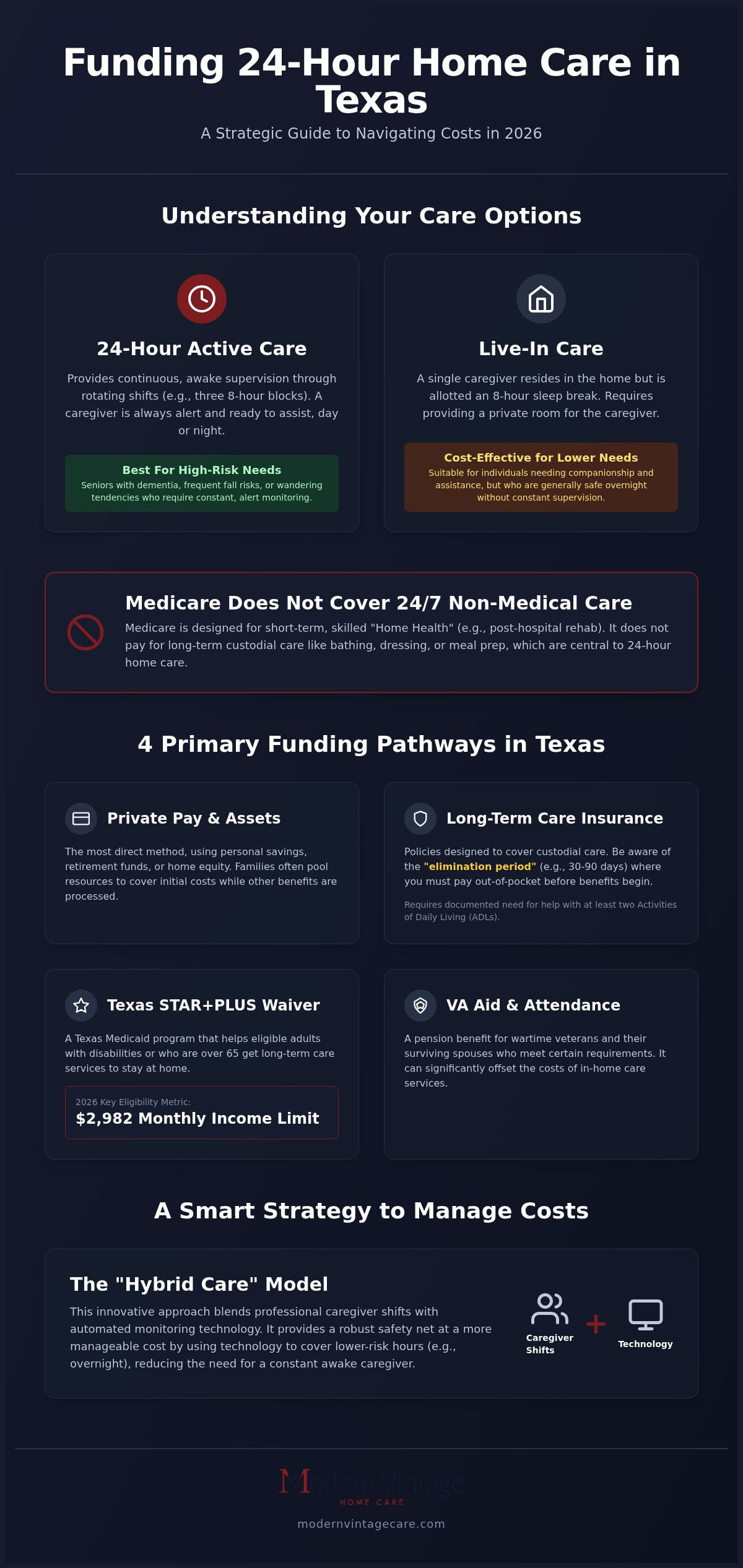
When a loved one requires continuous support, the first step is understanding exactly what 24-hour care entails. Unlike standard visits, this model provides continuous, awake supervision through rotating shifts, usually involving three 8-hour blocks or two 12-hour sessions. This ensures that someone is always alert and ready to help, whether it’s 2 PM or 2 AM. In 2026, labor trends across Texas, particularly in metropolitan hubs like Houston and Sugar Land, show an increased demand for skilled caregivers. This upward pressure on wages means that families must plan carefully. If you are researching how to pay for 24-hour home care in Texas, you’ll find that this level of commitment is more intensive than traditional part-time help.
Most professionals use the “720-hour month” calculation to help families visualize the scale of support. Since a week contains 168 hours, providing 24/7 care requires roughly 4.3 times the staffing of a standard 40-hour work week. This constant presence accounts for the total peace of mind that comes with knowing a professional is there every single second. While the math can be startling, it ensures your loved one is never left alone during vulnerable moments, providing a level of safety that part-time care simply cannot match.
24-Hour Care vs. Live-In Care: Financial Implications
Families often compare 24-hour care with “live-in” care to balance safety and cost. In a live-in model, a caregiver resides in the home but is permitted eight hours of sleep, requiring a private room. While less expensive, this isn’t ideal for those with high-risk conditions. If your relative wanders or falls frequently due to late-stage dementia, they need the constant alertness that only rotating shifts provide. This ensures a professional is always fully alert and ready to respond to any need, regardless of the hour.
Why Medicare Does Not Pay for 24-Hour Non-Medical Care
Medicare is designed for “Home Health,” focusing on medical needs like physical therapy after a hospital stay. It typically covers a short window, often limited to 20 or 100 days for skilled rehab, and excludes 24/7 supervision. If you are evaluating how to pay for 24-hour home care in Texas, you will likely rely on personal assets or Long-Term Care Insurance. Because these tasks are considered custodial rather than medical, they fall outside the scope of traditional government health insurance.
Non-medical home care is a specialized service focused on safety and assisting with activities of daily living (ADLs) such as bathing, dressing, and meal preparation. These services prioritize quality of life and the preservation of independence in a familiar setting. Understanding this distinction early helps you avoid unexpected gaps in your financial plan and allows you to focus on finding sustainable private or state-specific solutions.
Primary Funding Sources: Private Pay and Long-Term Care Insurance
Finding sustainable ways to fund round-the-clock support often requires a multi-pronged approach. For many families in the Houston area, private pay is the most immediate solution while they wait for other benefits to activate. If you are exploring how to pay for 24-hour home care in Texas, you’ll likely start by reviewing personal assets, savings, or retirement accounts. However, relying solely on cash flow can be taxing, which is why siblings often choose to split the cost “gap” during the first few months of care. This shared responsibility ensures the financial burden doesn’t fall on a single family member while providing your loved one with the consistent presence they need.
Long-Term Care Insurance (LTCI) is a powerful tool, but it requires careful navigation to be effective. To trigger a payout, a policyholder must typically demonstrate a need for help with at least two Activities of Daily Living (ADLs), such as bathing, dressing, or transferring. Most policies also include an “elimination period,” which acts like a deductible in the form of time. You might need to cover the costs out-of-pocket for 30, 60, or even 90 days before the insurance company begins its daily reimbursements. Understanding this waiting window is essential for budgeting during the initial transition into 24-hour support.
Maximizing Long-Term Care Insurance Payouts
Insurance companies require strict documentation to approve 24/7 care claims. They often mandate that services be provided by a licensed agency to ensure safety and quality standards are met. Working with a professional team like Modern Vintage Home Care helps streamline this process, as they provide the detailed care logs and licensing credentials your insurer demands. To manage the elimination period, some families choose to start with a “hybrid” schedule, gradually increasing to 24-hour care as the policy activation date approaches.
Tapping into Home Equity in the Houston Market
In the 2026 Fort Bend County real estate market, home equity remains a significant source of liquidity for seniors in Sugar Land and Missouri City. A Home Equity Line of Credit (HELOC) or a reverse mortgage can provide the necessary funds to stay at home rather than moving to a facility. While a reverse mortgage allows homeowners to convert part of their equity into cash without monthly payments, it is a complex decision that impacts the estate. It’s always wise to consult with a financial advisor before liquidating retirement accounts or committing to a loan. For those with a military background, these private funds can eventually be supplemented by benefits like VA Aid and Attendance, creating a more sustainable long-term financial plan for how to pay for 24-hour home care in Texas.
Texas-Specific Benefits: VA Aid and Attendance & STAR+PLUS
Texas offers specific programs that can act as a financial bridge for families who want to avoid facility placement. If you are researching how to pay for 24-hour home care in Texas, these state and federal benefits are often the most effective way to sustain long-term support. While the application processes require patience, the monthly assistance they provide can transform a stressful budget into a manageable care plan. These programs recognize that most seniors prefer the dignity of their own home, and they provide the funding necessary to make that a reality.
Qualifying for VA Aid and Attendance in 2026
For those who served, the VA Aid and Attendance benefit is an essential resource. In 2026, the maximum monthly benefit for a single veteran is $2,424, while a married veteran can receive up to $2,874 to cover care costs. To qualify, a veteran must have served at least 90 days of active duty, with at least one day during a recognized wartime period. The VA also looks at net worth, which has a 2026 limit of $163,699, including annual income. Proving the “medical necessity” for 24-hour supervision involves documenting a regular need for help with activities like dressing or staying safe from falls. If you need local assistance with medical documentation, the Houston VA Medical Center is a vital resource for Fort Bend County residents. For a deeper look at these options, you can explore veterans home care benefits Sugar Land to see how these specific rates can support your family.
Navigating the Texas STAR+PLUS Waiver
The STAR+PLUS program is the primary Medicaid waiver in Texas that allows seniors to receive 24-hour care at home instead of moving to a nursing facility. Eligibility is based on both medical need and strict financial limits. In 2026, the individual income limit is $2,982 per month, with a resource limit of $2,000. For couples, the income limit is $5,964 with a $3,000 resource cap. This program is delivered through Managed Care Organizations (MCOs) that coordinate with providers to ensure your loved one’s needs are met. You can apply through the Texas Health and Human Services (HHS) website, but it’s vital to act quickly. Most home-based waivers in Texas have an “Interest List,” which is effectively a waiting list. Starting the process early is the best way to secure future funding as you plan how to pay for 24-hour home care in Texas.
Strategic Ways to Lower 24-Hour Care Expenses
Many families feel that 24/7 support is an “all or nothing” financial commitment. However, finding sustainable ways for how to pay for 24-hour home care in Texas often involves a “hybrid” approach. This model doesn’t rely solely on around-the-clock human presence. Instead, it blends professional shifts with family involvement and smart technology. By identifying the specific times of day when your loved one is most at risk, you can prioritize professional help for those windows while using more affordable alternatives during stable periods. This strategy respects both your family’s budget and your relative’s need for independence.
This layered approach is particularly effective in Sugar Land and Missouri City, where families often have strong local support networks. By coordinating care roles, you can ensure your loved one receives high-quality attention without feeling the full weight of the “720-hour month” calculation. It’s about being proactive rather than reactive, using every available tool to create a safe environment at home.
Layering Technology with Human Care
Technology serves as a vigilant, low-cost companion that never tires. Automated medication reminders are a prime example; they ensure your relative takes the right dose at the right time, which drastically reduces the risk of expensive hospital readmissions. Motion sensors and senior check-in services Sugar Land families trust can monitor movement during “unstaffed” hours. Modern Vintage Home Care’s automated check-ins provide a 24/7 safety net for less, ensuring someone is always monitoring your loved one’s status without the cost of a full-time companion. This layer of security allows you to sleep better knowing that help is just a notification away.
Shared Care and Respite Strategies
Another effective strategy is utilizing respite care for family caregivers. If siblings or adult children can cover certain shifts, professional care can be reserved for the overnight hours or complex morning routines. This reduces the total number of billed hours each month while preventing family burnout. Additionally, “Quick Care Services” offer a targeted solution for high-need tasks. Instead of booking a full eight-hour shift for a simple morning routine, a shorter visit can handle bathing and medication management. This flexibility is a key part of how to pay for 24-hour home care in Texas without compromising on quality.
Consider these cost-saving layers to make care more sustainable:
- Morning/Evening Quick Care: Focus professional hours on the most physically demanding parts of the day.
- Overnight Awake Shifts: Use professional caregivers when the risk of wandering or nighttime falls is at its highest.
- Midday Tech Monitoring: Rely on automated check-ins and sensors when your loved one is typically resting or engaged in low-risk activities.
If you’re ready to build a customized plan that balances safety with your family’s budget, explore our personalized 24-hour care options today.
Personalized 24-Hour Care Solutions with Modern Vintage Home Care
At Modern Vintage Home Care, we believe that high-quality support shouldn’t feel like a one-size-fits-all solution. When families ask how to pay for 24-hour home care in Texas, they’re often looking for a partner who understands their unique financial and emotional landscape. We specialize in creating personalized care plans that prioritize the dignity of your loved one while remaining sensitive to your budget. By focusing on the specific needs of residents in Sugar Land and the greater Houston area, we ensure that every hour of care provides maximum value and peace of mind. Our approach isn’t just about filling shifts; it’s about building a sustainable environment where your relative can thrive in the comfort of their own home.
We work closely with you to identify which hours require the most intensive “awake” supervision and where “Quick Care” or technology can bridge the gaps. This collaborative process ensures that you aren’t overpaying for services you don’t need, while never compromising on the safety of your family member. Whether you are layering long-term care insurance with private funds or navigating the initial steps of a VA benefit application, we act as a steady advocate throughout the transition.
Specialized Memory Care at Home
For families managing Alzheimer’s or other forms of dementia, 24-hour care is often the gold standard for safety. Wandering and “sundowning” behaviors can make the nighttime hours particularly stressful for family members who need to rest. Our caregivers are specifically trained in dementia home care services Sugar Land families rely on to manage these complex scenarios. We provide a steady, calm presence during the evening, helping to redirect confusion and maintain a soothing routine that promotes better rest for everyone involved. This constant supervision is vital for preventing falls and ensuring that your loved one remains in a familiar, secure environment.
The Modern Vintage Difference in Houston
Our roots are firmly planted in the Sugar Land and Missouri City communities. We aren’t just a service provider; we’re your neighbors. This local connection means we understand the specific resources available to you and can help you navigate how to pay for 24-hour home care in Texas using the strategies we’ve discussed. To enhance safety without always increasing the cost of human shifts, we integrate automated medication reminders and check-ins into our care models. These tools act as a constant safety net, ensuring that medication schedules are followed and wellness is monitored around the clock. Our commitment to independence means we focus on what your loved one can do, supporting their spirit through meaningful companionship and personalized attention.
The first step toward a sustainable care plan is understanding your options. We invite you to schedule a free in-home assessment where we can discuss your family’s needs and financial goals in detail. Contact us today for a personalized 24-hour care consultation and let us help you create a path forward that honors your loved one’s wish to age at home.
Securing a Sustainable Path for Home-Based Care
Finding the right way to support a parent or spouse doesn’t have to be a journey you take alone. By layering private assets, leveraging VA benefits, and utilizing Texas-specific programs like STAR+PLUS, you can build a sustainable plan. We’ve explored how to pay for 24-hour home care in Texas by using hybrid models that combine professional shifts with innovative technology. This strategic approach ensures safety while respecting your family’s financial boundaries and long-term goals.
As specialized Alzheimer’s and dementia care experts, we understand the nuances of providing around-the-clock support. Our team serves Sugar Land and Greater Houston with compassion, incorporating innovative automated safety monitoring to provide an extra layer of protection for every client. You can keep your loved one in the home they cherish with a plan tailored specifically to their needs and your budget. Request a Free In-Home Care Assessment in Sugar Land today to start building a secure and dignified path forward for your family.
Frequently Asked Questions
Is 24-hour home care in Texas tax-deductible?
Most 24-hour home care expenses in Texas are tax-deductible if the care is medically necessary. If a licensed healthcare professional certifies that your loved one is “chronically ill” and requires help with at least two activities of daily living, you can often deduct these costs. This is considered a qualified medical expense on your federal tax return. It’s best to consult a tax advisor to ensure you meet the specific 2026 IRS requirements for long-term care deductions.
Can I use my loved one’s life insurance policy to pay for home care?
You can use a life insurance policy to fund care through options like accelerated death benefits or a life settlement. Many modern policies allow you to access a portion of the benefit early if the policyholder is diagnosed with a chronic illness or requires 24-hour supervision. Selling a policy through a life settlement can also provide a lump sum for families navigating how to pay for 24-hour home care in Texas without draining other retirement assets.
Does the Texas STAR+PLUS program have a waiting list for 24-hour care?
The Texas STAR+PLUS program does have an “Interest List,” which functions as a waiting list for home-based services. Depending on the specific region and current state funding, the wait for a waiver slot can range from 6 to 18 months. Because of this timeline, it’s vital to place your loved one on the list as soon as you anticipate a need for long-term support. While you wait, you can explore other bridge funding options like VA benefits.
What is the average hourly rate for 24-hour care in Houston in 2026?
The hourly rate for professional care in Houston is influenced by current labor trends and the specialized nature of the support provided. In 2026, rates in major metropolitan areas reflect the increased demand for caregivers who are trained in Alzheimer’s and dementia safety. While individual agency rates vary, families should budget for the cost of continuous, awake supervision. This ensures that a professional is always alert and ready to assist during both day and night shifts.
Can VA benefits be combined with private pay for 24-hour care?
VA benefits like the Aid and Attendance pension can be combined with private pay to make 24-hour care more affordable. In 2026, a married veteran can receive up to $2,874 per month, which can be applied directly to the cost of professional home care. This layering of federal benefits with personal savings or long-term care insurance is a common way to sustain a high level of support at home while protecting the family’s overall financial health and independence.
What happens if my loved one runs out of money while receiving 24-hour care?
If your loved one exhausts their private funds, they may transition to the Texas STAR+PLUS Medicaid waiver program. This state benefit is designed to help seniors with limited income and assets receive 24-hour care at home rather than moving to a nursing facility. To qualify in 2026, an individual’s monthly income must be $2,982 or less. Planning for this transition early by joining the state’s Interest List ensures there’s no gap in your loved one’s essential care.
Does the state of Texas provide grants for senior home care?
Texas doesn’t offer traditional grants, but it provides state-funded assistance programs for those who don’t yet qualify for Medicaid. The Community Care Services Eligibility (CCSE) program is one such resource that can help with non-medical tasks and personal care. These programs provide a safety net for seniors, helping families manage the complexities of how to pay for 24-hour home care in Texas. Local Area Agencies on Aging can help you identify these specific state resources.
Is 24-hour care cheaper than a high-end nursing home in Sugar Land?
24-hour care at home can be more cost-effective than high-end nursing homes in Sugar Land when you utilize a hybrid model. While a private room in a top-tier facility is expensive, home care allows you to pay only for the specific shifts and technology layers you need. The one-on-one attention provided at home often leads to better health outcomes and fewer hospital visits, which can save your family significant money on medical costs over the long term.