

Did you know that Aid and Attendance is one of the most under-claimed benefits in the country, often because families assume their income is too high to qualify? It’s a common misconception that stops many from even applying for VA Aid and Attendance in Texas to help with rising care costs. If you’re feeling overwhelmed by the high cost of 24-hour home care or the complex stack of VA paperwork, you aren’t alone. Many families find the distinction between federal regulations and local Texas resources confusing, leading to unnecessary delays. We understand the stress of trying to balance your loved one’s dignity with the reality of a fixed budget.
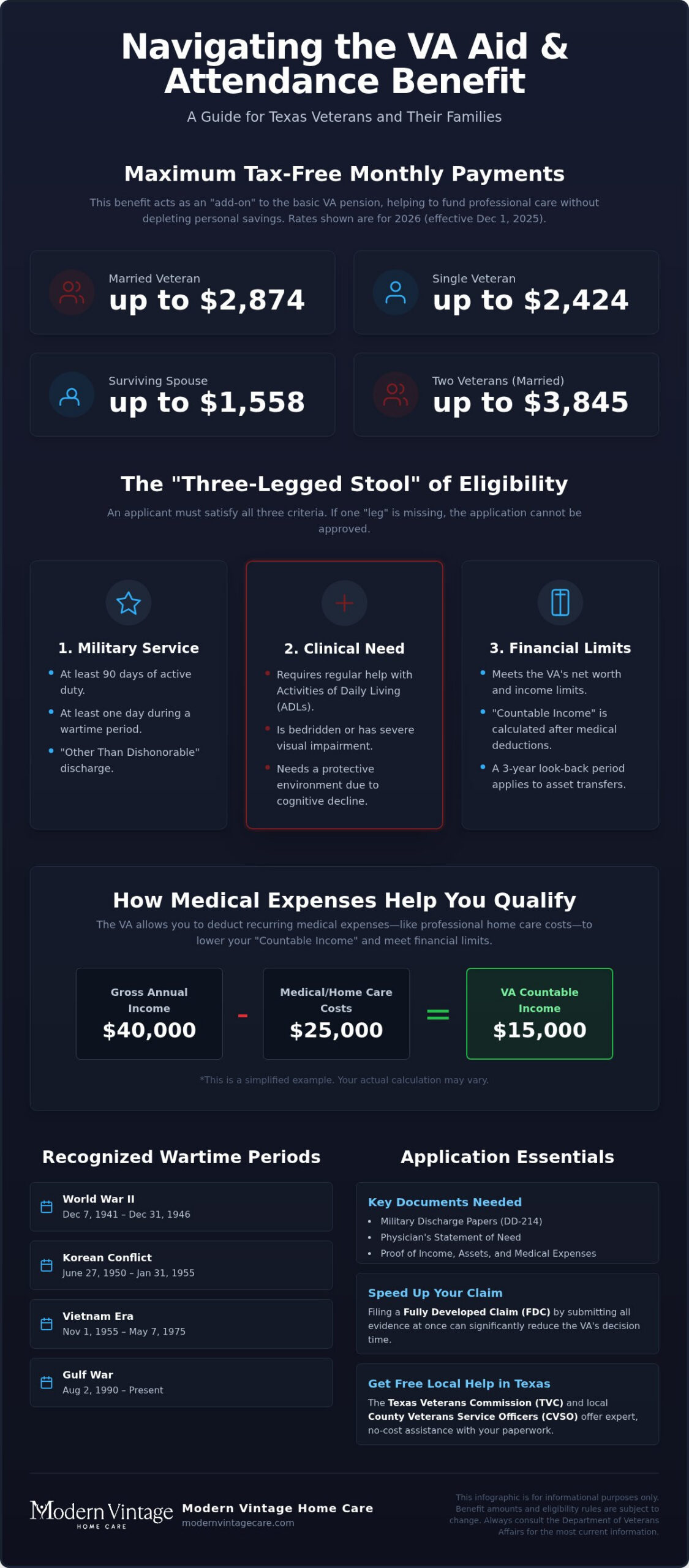
This article will clarify the application process, ensuring you have the tools to secure up to $2,874 per month for a married veteran or $2,424 for a single veteran. You’ll learn how the 2026 net worth limits work and why your “countable income” might be much lower than you think once you deduct medical expenses. By following our roadmap, you can navigate the three-year look-back period and connect with local care providers who truly understand veteran needs. We’ll walk you through every step, from completing the physician’s forms to leveraging the Texas Veterans Commission, so you can focus on your family’s peace of mind.
Key Takeaways
- Understand the “Three-Legged Stool” of eligibility, including specific wartime service requirements and the 2026 clinical standards for daily living assistance.
- Discover the most efficient path for applying for VA Aid and Attendance in Texas by choosing between a standard claim and a time-saving Fully Developed Claim (FDC).
- Learn how to access free, local advocacy through the Texas Veterans Commission and County Veterans Service Officers to navigate complex federal paperwork with ease.
- See how professional home care expenses can be used as a deductible medical expense to help your family meet the VA’s strict income and asset limits.
- Identify the essential documentation you’ll need, from military discharge papers to physician-led medical records, to prevent application delays or denials.
What is the VA Aid and Attendance Benefit for Texas Veterans?
The VA Aid and Attendance benefit is a tax-free, monthly monetary payment that goes beyond the standard VA pension. It’s specifically designed for veterans and surviving spouses who require the regular assistance of another person to manage their daily lives. For families across the Lone Star State, applying for VA Aid and Attendance in Texas is often the most effective way to fund professional care without depleting personal savings. It acts as a specialized “add-on” to the basic pension, providing the extra financial support needed to pay for personal care, companionship, and safety supervision at home.
In 2026, the financial impact of this benefit is more significant than ever. Based on the rates effective December 1, 2025, eligible individuals can receive a substantial monthly boost to cover their care needs. A single veteran may qualify for up to $2,424 per month, while a married veteran can receive up to $2,874. For surviving spouses, the benefit provides up to $1,558 monthly. If both spouses are veterans and both qualify, the combined benefit can reach as high as $3,845 every month. These funds are intended to help you maintain your independence and dignity in the comfort of your own home.
The Difference Between Aid and Attendance and Housebound Benefits
When you’re exploring your options, you might encounter “Housebound” benefits. It’s important to know that you cannot receive both Housebound and Aid and Attendance benefits at the same time. You’ll need to choose the path that best reflects your current health status. Housebound status is generally reserved for those with a permanent disability that confines them to their home. In contrast, Aid and Attendance focuses on your clinical need for help with activities of daily living (ADLs). This includes needing help with bathing, dressing, or even protection from the hazards of your environment due to physical or cognitive limitations.
Who Can Benefit Most from This Pension?
This program is a vital resource for those who need more than just occasional help. It’s particularly beneficial for:
- Veterans who require 24-hour home care in Houston to stay safe and healthy throughout the night.
- Surviving spouses of wartime veterans who live alone and find it difficult to manage medication or meal preparation.
- Seniors facing cognitive decline or Alzheimer’s who need a “protective environment” to prevent accidents.
By applying for VA Aid and Attendance in Texas, you’re taking a proactive step toward ensuring your loved one receives high-quality care while preserving the family’s financial stability. It’s a way to bridge the gap between needing help and being able to afford the specialized support that makes aging in place a reality.
Eligibility Requirements: Do You Qualify in 2026?
Understanding the eligibility landscape is the first step toward securing the support your family deserves. The VA views eligibility as a “three-legged stool.” If one leg is missing, the application cannot stand. When you’re applying for VA Aid and Attendance in Texas, you must satisfy requirements across three specific areas: your military service history, your current clinical needs, and your household’s financial limits. Missing even one small detail can lead to a denial, which is why reviewing the official VA eligibility requirements is a critical starting point for every family.
Wartime Service Periods Explained
To qualify, the veteran must have served at least 90 days of active duty, with at least one day occurring during a recognized wartime period. You don’t need to have seen combat or served overseas; the requirement is simply active duty during these specific dates:
- World War II: December 7, 1941, to December 31, 1946.
- Korean Conflict: June 27, 1950, to January 31, 1955.
- Vietnam Era: November 1, 1955, to May 7, 1975 (for those who served in the Republic of Vietnam); otherwise, August 5, 1964, to May 7, 1975.
- Gulf War: August 2, 1990, through a date yet to be set by law.
The veteran’s discharge must be “Other Than Dishonorable.” You’ll use the DD-214 form to verify these dates and status. If you’ve misplaced this document, local Texas resources can often help you request a replacement. It’s a vital piece of the puzzle that establishes your right to these hard-earned benefits.
The Clinical ‘Activities of Daily Living’ (ADL) Test
The clinical requirement focuses on your physical or cognitive need for assistance. The VA looks for a consistent need for help with “Activities of Daily Living” (ADLs). These include bathing, dressing, feeding, toileting, and basic mobility. For many seniors, medication management for elderly safety is a primary driver for seeking care, as forgetting doses or mixing prescriptions can lead to dangerous health complications. A physician must document these needs on VA Form 21-2680 to prove that the individual requires a protective environment or the regular aid of another person.
Finally, we must look at the financial component. For 2026, the net worth limit is set at $163,699. This figure includes your annual income and assets, though your primary home and one vehicle are usually excluded. Be aware of the three-year look-back period. The VA reviews asset transfers made within the last 36 months to ensure assets weren’t gifted or sold below market value to meet the limit. If you’re unsure how your current assets impact your claim, our team can help you understand how personalized Veterans Care expenses might adjust your countable income.
Step-by-Step: How to Apply for Aid and Attendance in Texas
Applying for VA Aid and Attendance in Texas requires a methodical approach to ensure your paperwork accurately reflects your loved one’s needs. The process begins with gathering essential documents that tell the story of your veteran’s service and current health. You’ll need the veteran’s DD-214, comprehensive medical records, and detailed financial statements from the past three years. If you don’t have these on hand, it’s best to start collecting them now, as missing pieces often lead to frustrating delays. Once your evidence is ready, you’ll complete either VA Form 21P-527EZ for veterans or 21P-534EZ for surviving spouses. These forms are eventually submitted to the Pension Management Center (PMC), which handles claims for our region.
The Power of the Fully Developed Claim (FDC)
The most efficient way to navigate the system is through a Fully Developed Claim (FDC). By submitting all your medical and financial evidence at the same time as your application, you signal to the VA that no further research is required on their part. This proactive strategy can save months of waiting compared to a standard claim where the VA must request documents from third parties. If you aren’t ready to submit everything today when applying for VA Aid and Attendance in Texas, use the “Intent to File” feature on the official VA website. This simple step locks in your effective date; it means your back-pay will be calculated from the moment you expressed intent, rather than when the final stack of paper arrives at the PMC. The FDC path is the fastest way to receive benefits in 2026.
Essential Medical Evidence from Your Doctor
The heart of your application is the medical evidence provided by a physician, typically documented on VA Form 21-2680. It’s vital that your doctor understands the specific criteria the VA is looking for to approve the claim. Rather than just listing a diagnosis like “arthritis” or “memory loss,” the records should clearly explain why the veteran requires personal care for seniors in Houston to maintain their safety and hygiene. For those living with dementia, the doctor should specifically describe the “hazards of the daily environment.” This might include the risk of wandering, inability to recognize danger, or leaving appliances unattended. Every medical diagnosis must be directly linked to a specific physical or cognitive limitation that necessitates another person’s regular assistance. This level of detail ensures the VA reviewer sees the full, compassionate picture of the care required for your loved one.
Local Resources: Navigating the Texas Veterans Commission (TVC)
While the VA is a federal entity, the Texas Veterans Commission (TVC) acts as your state-level advocate, ensuring your voice is heard in a massive system. When you’re applying for VA Aid and Attendance in Texas, you don’t have to walk the path alone. The TVC employs Claims Benefit Advisors who work specifically to bridge the gap between your local needs and the federal government’s requirements. These professionals understand the nuances of Texas law and can often track your claim’s progress in real-time, providing updates that the national hotline might miss.
We highly recommend working with a County Veterans Service Officer (VSO). Their services are completely free of charge. These officers are trained to spot potential issues in your paperwork before you submit it, which is crucial for avoiding the common “request for evidence” delays that can stall a claim for months. For families in Sugar Land and Missouri City, having a local partner means you can meet face-to-face with someone who truly cares about your veteran’s legacy and well-being.
Fort Bend County Veterans Service Offices
Fort Bend County provides dedicated VSO support to help residents navigate the complexities of veteran benefits. The primary office is located in Richmond, serving the broader Sugar Land and Missouri City area. Before your first appointment, ensure you have your “veteran’s toolkit” ready. This should include the original DD-214, marriage certificates, a list of all recurring medical expenses, and current income statements. A VSO doesn’t just help with the initial filing; they act as a steady guide if the VA requires additional clarification on your clinical need for daily support.
Texas-Specific Survivor and Family Support
The state of Texas offers unique layers of support for the families of those who served. Surviving spouses in the Houston area can access specialized counseling through the TVC to ensure they are receiving every benefit they are entitled to. If the primary caregiver is feeling the weight of 24-hour responsibilities, respite care for family caregivers can be a life-saving resource. State-level programs often work in tandem with the Aid and Attendance pension to ensure the individual remains safe and socially engaged. Additionally, the TVC’s Women Veterans Program provides tailored advocacy for the growing number of female veterans in our community who may require specialized personal care as they age. If you’re ready to see how these benefits can fund a higher quality of life, our Veterans Care specialists are here to help you coordinate your home care plan.
Maximizing Your Benefits with Specialized Veterans Care
One of the most powerful aspects of the Aid and Attendance pension is how it interacts with your household budget. The VA calculates your “Income for VA Purposes” (IVAP) by taking your gross income and subtracting unreimbursed medical expenses. If your income seems too high to qualify, the cost of professional Veterans Care can often bring that number within the required limits. By hiring a professional agency, you aren’t just improving your loved one’s quality of life; you’re also creating the clinical and financial conditions necessary for a successful claim. When you’re applying for VA Aid and Attendance in Texas, choosing an agency that understands these nuances is essential for long-term stability.
Modern Vintage Home Care acts as a bridge between the financial benefit and the physical care your family needs. We understand that veterans have unique perspectives and values, often prioritizing structure, reliability, and independence. It’s why we encourage families to explore veterans home care benefits in Sugar Land as a way to transition from the exhaustion of family caregiving to a professional support system. This shift allows you to return to being a daughter, son, or spouse while we handle the complex daily tasks that ensure your loved one stays safe at home.
The Modern Vintage ‘Veterans Care’ Approach
Our approach is rooted in the belief that every veteran deserves a care plan that respects their history and preserves their dignity. We provide the reliable routine that many seniors find comforting, especially those requiring specialized Alzheimer’s and dementia care in Sugar Land. Whether it’s managing medication, assisting with personal hygiene, or providing companionship during a meal, our caregivers are trained to meet the specific “Aid and Attendance” criteria used by the VA. We focus on the small details that preserve the individual’s spirit while ensuring their safety in a familiar environment.
Next Steps: Starting Your Care Journey Today
If you’re ready to move forward, the first step is a simple conversation. We offer a free in-home assessment to document the specific care needs that will form the backbone of your medical evidence. We’ll work alongside you to coordinate with your VSO, ensuring that your professional care plan aligns perfectly with your claim for benefits. Don’t wait until a health crisis forces a decision. Contact Modern Vintage Home Care today for a consultation on how our Veterans Care program can support your family and help you successfully complete the process of applying for VA Aid and Attendance in Texas.
Securing the Care Your Veteran Deserves
You now have a clear roadmap for navigating the VA’s complex requirements. Whether it’s verifying wartime service dates or documenting clinical needs through a physician, every step brings you closer to the financial support your family earned. Remember that professional home care isn’t just a comfort; it’s a strategic tool that can help you meet financial eligibility through deductible medical expenses while providing your loved one with the dignity they deserve. Applying for VA Aid and Attendance in Texas is a significant undertaking, but with the right documentation and local advocacy from the Texas Veterans Commission, it’s a goal within reach.
At Modern Vintage Home Care, we are proud to offer a specialized Veterans Care program that serves families across the Sugar Land and Houston area. Our team provides compassionate, person-centered support tailored to the unique lives of those who served. We invite you to Schedule a Free Veterans Care Assessment with Modern Vintage Home Care today. We’ll help you document the clinical needs required for your claim and design a care plan that ensures safety and independence. You’ve looked after our country; now let us help look after you.
Frequently Asked Questions
Can I receive Aid and Attendance if I already live in an assisted living facility in Texas?
Yes, you can certainly receive this benefit while residing in an assisted living facility. The VA allows these funds to cover the costs of care provided within a facility setting, just as it does for in-home care. When you’re applying for VA Aid and Attendance in Texas, the facility must provide a statement clarifying the specific personal care services you receive to help establish your clinical need.
How long does it take for the VA to approve an Aid and Attendance application in 2026?
Processing times generally range from four to nine months, depending on the complexity of your file. If you submit a Fully Developed Claim (FDC) with all medical and financial evidence included at the start, you may see an approval in as little as 90 to 120 days. Standard claims where the VA must gather evidence on your behalf typically take much longer to finalize.
Is the Aid and Attendance benefit retroactive to the date I applied?
Yes, the benefit is retroactive to the first day of the month following the date the VA received your application. If you filed an “Intent to File” notice earlier, your back-pay will be calculated from that date instead. This makes it vital to lock in your effective date as early as possible to ensure you receive the maximum financial support for your care journey.
Do I have to be 100% disabled to qualify for VA Aid and Attendance?
No, you don’t need a 100% disability rating or even a service-connected disability to qualify. Eligibility for this pension is based on your clinical need for assistance with activities of daily living, such as bathing or dressing. Whether your needs stem from age-related decline or a non-service condition, you can still be eligible if you meet the wartime service and financial requirements.
Can a surviving spouse of a veteran apply for this benefit even if the veteran never did?
Yes, a surviving spouse can apply for the Survivors Pension with Aid and Attendance independently. As long as the deceased veteran met the wartime service requirements and the spouse meets the clinical and financial criteria, the benefit is available. This provides a crucial financial safety net for spouses who now require personal care or safety supervision to remain living safely in their own homes.
What are the income limits for VA Aid and Attendance in Texas for 2026?
The 2026 net worth limit is $163,699, which includes both your assets and your annual income. However, the VA subtracts your unreimbursed medical expenses from your gross income when calculating eligibility. This means many families who initially believe they earn too much actually qualify once the costs of professional home care or medication management are factored into the equation.
Can the VA take away my benefits if my health improves?
Yes, it’s possible for benefits to change if your clinical situation improves significantly. Since the pension is based on the regular need for another person’s assistance, a medical recovery that restores your independence might lead the VA to re-evaluate your eligibility. However, for most seniors with chronic conditions or cognitive decline, the benefit remains a steady and reliable source of support for their long-term care needs.
What happens if my application for Aid and Attendance is denied?
If your application is denied, you have several options for appeal, including a Higher-Level Review or a Supplemental Claim. Many denials are simply the result of missing documentation or a lack of detail in the physician’s report. When applying for VA Aid and Attendance in Texas, working with a County Veterans Service Officer can help you identify the specific reason for denial and submit the necessary evidence to reverse the decision.