
The most expensive option for a senior’s future isn’t always found on a price sheet; often, it’s the hidden cost of losing one’s sense of home and independence. While many families assume a move is the only way to guarantee safety, the reality for the 21,181 seniors living in Sugar Land is that personalized support in a familiar environment often leads to better health outcomes. You’re likely feeling the heavy pressure of this choice right now, balancing the heartfelt desire to keep your parent happy with the practical need for daily help. It’s a difficult transition, and the confusion surrounding in-home care vs assisted living Sugar Land only adds to the emotional weight.
We understand the quiet anxiety that comes with wondering if a large facility might lead to isolation, or if staying home is truly safe as needs change. You deserve a clear path forward that honors your loved one’s dignity and your peace of mind. This guide provides a detailed comparison of care levels, lifestyle impacts, and the new 2026 safety regulations to help you decide which path fits your family’s unique needs. We’ll give you a framework to justify your choice to other relatives and show you how a tailored care plan can make aging in place the safest, most fulfilling option available.
Key Takeaways
- Understand the fundamental differences between receiving professional support in a private residence and moving to a shared residential community.
- Identify the risks of Relocation Stress Syndrome and how 1-on-1 care helps maintain cognitive stability and personal dignity.
- Navigate the financial landscape of in-home care vs assisted living Sugar Land by identifying hidden facility fees and the flexibility of hourly support.
- Follow a practical framework to assess home safety and social needs, providing a clear justification for your family’s decision.
- Learn how modern safety technology, such as automated check-ins and medication reminders, ensures a secure environment at home.
Choosing Between In-Home Care and Assisted Living in Sugar Land
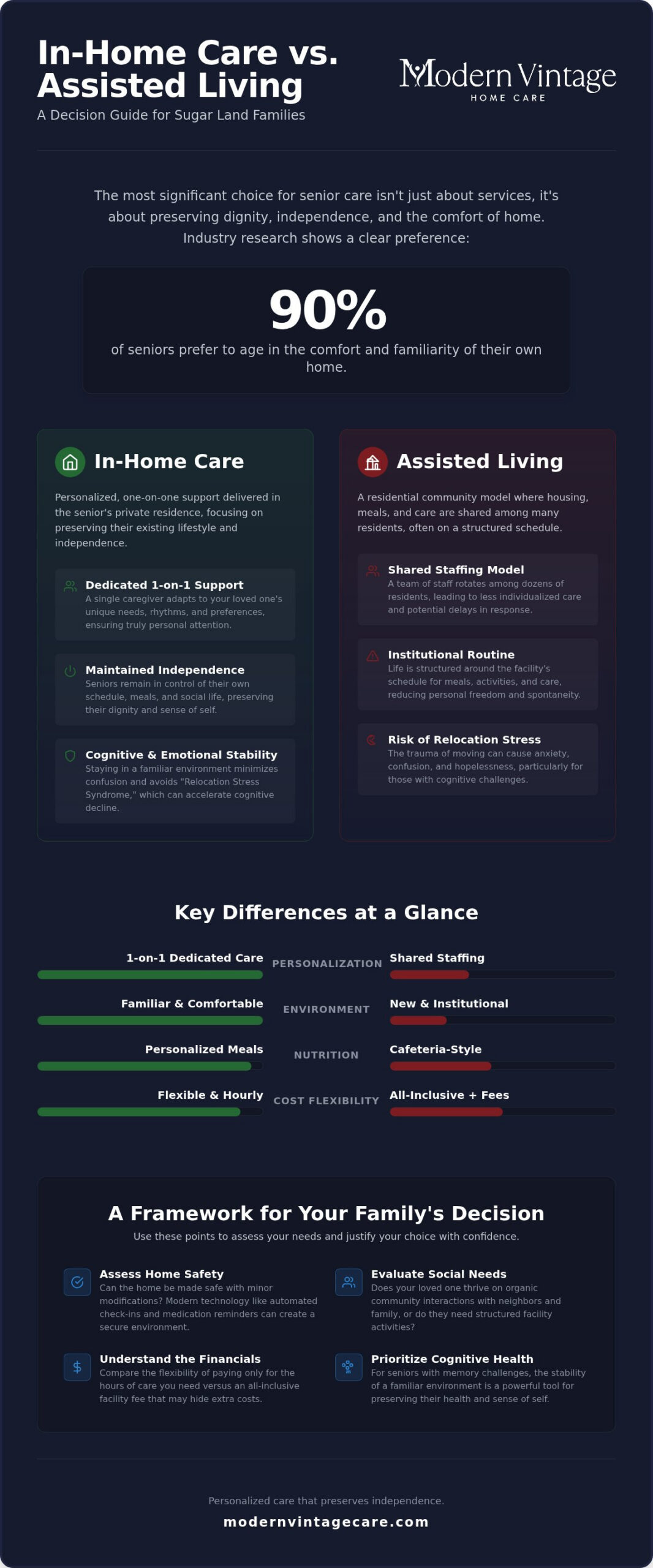
Deciding on the right path for a parent often begins with a clear understanding of the fundamental Elderly care options available today. In-home care refers to professional support delivered directly in a senior’s private residence; it’s designed to help them maintain their lifestyle in familiar surroundings. Assisted living, on the other hand, involves moving into a residential community that provides housing, meals, and care shared among many residents. While both models aim to provide security, choosing between in-home care vs assisted living Sugar Land requires looking at more than just a list of services. It’s about the daily experience of the person receiving the care.
Industry research suggests that nearly 90% of seniors prefer to age in place, staying in the homes where they raised families and built their lives. In Sugar Land, where the 65+ population is growing seven times faster than younger age groups, families are increasingly moving away from traditional facility models. They’re looking for ways to preserve the independence that a large institution simply can’t replicate. With the right support, staying home isn’t just a preference; it’s a proactive choice for a higher quality of life.
Understanding the Core Differences
The primary distinction in the in-home care vs assisted living Sugar Land debate is the level of personalization. In a facility, a small team of staff members rotates between dozens of residents. This often results in a structured, institutional schedule that doesn’t always account for individual preferences or spontaneous needs. In-home support offers dedicated 1-on-1 care where the caregiver adapts to your loved one’s specific needs and rhythm. Your parent remains the ‘boss of the house’ rather than a resident following a facility’s timetable. This environmental stability is a powerful tool for preserving dignity and cognitive health.
The Role of Non-Medical Support
Both care models primarily focus on assisting with Activities of Daily Living (ADLs). These are the essential tasks of life, such as bathing, dressing, and meal preparation. If your parent is finding these routines difficult, personal care for seniors Houston provides the necessary support without the trauma of a move. This non-medical approach prioritizes social companionship and gentle physical assistance. It focuses on the individual’s spirit and routine, ensuring they stay connected to their community while receiving the help they need to live safely. This bridge of support allows seniors to maintain their social ties in Sugar Land while getting the specific help they require.
Lifestyle and Safety: Comparing Care Environments
The choice between in-home care vs assisted living Sugar Land isn’t just about logistics; it’s about the air your loved one breathes every day. Many families assume facilities are inherently safer because of the constant staff presence, but communal living carries hidden risks. Hospital-like environments with slick floors and long, unfamiliar hallways can actually increase the chance of a fall. In contrast, staying at home allows a senior to navigate a layout they’ve known for decades, where muscle memory helps them move with confidence. Nutrition also shifts significantly in institutional settings. While facilities offer dining halls, these often rely on mass-produced, cafeteria-style meals. Home care allows for personalized meal preparation that respects specific dietary needs and lifelong tastes.
Clinicians often point to “Relocation Stress Syndrome” as a primary concern for seniors during a move. It’s a cluster of symptoms, including intense anxiety, confusion, and hopelessness, that occurs when an older adult is uprooted from their familiar environment. For those already facing cognitive challenges, this stress can accelerate memory loss and lead to a rapid decline in physical health. Social engagement also feels different at home. Instead of forced facility activities like scheduled bingo, seniors can maintain organic community interactions with neighbors, friends, and family members who drop by on their own terms.
Memory Care and Cognitive Stability
Maintaining a sense of self is much easier when surrounded by the physical markers of a life well-lived. This is why dementia home care services Sugar Land focus on keeping seniors in their own homes. Facilities often struggle with “sundowning,” a period of increased agitation in the evening. This confusion is frequently triggered by the strange shadows of unfamiliar hallways or the loud, unpredictable noises of a large facility. Caregivers at home use storytelling and shared history to ground the individual, turning a difficult evening into a quiet, familiar routine that preserves cognitive stability.
Staffing Ratios and Individual Attention
The reality of facility life often involves a single caregiver responsible for 8 to 15 residents at once. This means your parent is just one of many competing for attention. If they need help, they press a call button and wait for a busy staff member to finish with someone else. Opting for 24 hour home care Houston changes that dynamic entirely. Because the caregiver is focused only on your loved one, they can anticipate needs before they become urgent. A dedicated caregiver provides an immediate response that a call-button system can’t match, ensuring your parent never has to wait for basic assistance. If you’re ready to explore how this 1-on-1 support works, you can learn more about our personalized approach to senior safety.
The Cost-to-Value Ratio: Facility Fees vs. Personalized Support
Many families in Fort Bend County initially gravitate toward the ‘all-inclusive’ pricing marketed by residential communities. However, this is often a myth that masks the true financial impact of in-home care vs assisted living Sugar Land. While a base rent might seem predictable, facilities frequently add surcharges for every extra hand your loved one needs. In a car-dependent city like Sugar Land, where the intense Texas heat makes walking to local appointments impossible, transportation fees alone can balloon a monthly budget. Choosing home care provides a more transparent alternative; you only pay for the specific hours of support your family requires, allowing you to scale care up or down as needs change.
Another factor to consider is the long-term value of the family home. When a senior moves into a facility, the home is often sold to cover the high monthly rent, which effectively transfers a family asset into a corporation’s monthly revenue. By utilizing respite care for family caregivers, you can maintain the senior’s safety while preserving the home as a generational asset. This approach allows you to invest in people and personalized support rather than institutional overhead and real estate costs.
Evaluating In-Home Care Costs
The ‘Quick Care’ model is a highly efficient way to manage expenses without sacrificing safety. Instead of paying for a full day of supervision, short, focused visits can handle specific tasks like morning routines or meal prep. For those who served, veterans home care benefits Sugar Land can significantly offset these costs, making professional support much more accessible. We also recommend automated check-ins as a low-cost supplement to physical visits, ensuring your loved one is safe and reminded of their medications without the immediate need for a 24-hour presence.
Facility Costs: Beyond the Base Rent
It’s vital to ask about ‘level-of-care’ surcharges before signing a facility contract. As a senior’s health naturally declines, facilities often move them into higher-priced tiers, charging extra for help with bathing, dressing, or even walking to the dining hall. These ‘extras’ often include laundry fees, medication management, and even basic concierge services that families assume are included in the rent. Beyond the monthly bill, there are also broader financial risks to consider. Sudden management changes or facility bankruptcy can lead to unexpected price hikes or the stress of a forced relocation, making the stability of staying in one’s own home even more valuable.
Making the Decision: A Framework for Fort Bend Families
Choosing between in-home care vs assisted living Sugar Land is a significant family milestone that requires a methodical approach. Instead of making a choice based on fear or immediate crisis, we recommend using a structured framework to evaluate what will actually provide the best quality of life. This process begins with a thorough home safety audit. You’ll want to determine if the physical layout can support aging in place with minor modifications, such as better lighting or grab bars. Next, evaluate your loved one’s social appetite. While some seniors crave the bustle of large crowds, many find intimate, 1-on-1 connection much more meaningful and less overwhelming.
It’s also vital to assess the primary caregiver’s health. If you’re feeling the weight of burnout, professional backup isn’t a luxury; it’s a necessity for your family’s stability. Finally, consider the flexibility of a trial period. One of the greatest benefits of home care is that it’s easy to ‘test’ with a few hours a week. A move to a residential community is a permanent legal and real estate commitment that’s difficult to undo if the senior doesn’t thrive in that environment.
The Local Sugar Land Perspective
Living in Fort Bend County presents unique lifestyle challenges that influence care decisions. Navigating traffic between Missouri City and Sugar Land for medical appointments can be exhausting for a senior. A professional caregiver acts as a local ‘social secretary,’ handling these errands and ensuring your parent stays connected to their community without the stress of driving. The local climate is another safety factor. The intense Texas heat makes precise climate control and hydration monitoring essential. In a private home, these environmental factors are managed meticulously, whereas large facilities may have inconsistent cooling in communal areas or long walks to dining halls that risk heat exhaustion.
When Home Care is the Clear Winner
Professional support at home is often the superior choice for seniors in the early to mid-stages of dementia. Familiar surroundings act as a cognitive anchor, preventing the agitation and ‘sundowning’ often triggered by new environments. It’s also the ideal path for those with deep roots in their local neighborhood or church groups. If your family wants to remain the primary decision-makers regarding daily routines and care standards, staying home allows you to maintain that level of control. If you’re ready to see how a customized plan can work for your family, contact us today for a personalized consultation.
The Modern Vintage Solution: Personalized Care That Preserves Independence
At Modern Vintage Home Care, we believe that the choice between in-home care vs assisted living Sugar Land shouldn’t feel like a compromise on safety or professional oversight. Our philosophy centers on merging a “vintage” respect for the individual’s life story with “modern” safety technology. We provide a vital bridge for families who want the security of a residential community without the institutional atmosphere. By choosing to stay home, seniors retain their personal spirit while our team provides the high-standard oversight needed to navigate the complexities of aging. Our commitment to the Sugar Land and Missouri City communities is rooted in being a reliable, nurturing presence for every family we serve.
We achieve facility-level safety through specialized tools that support daily life. Our automated check-ins and medication management for elderly seniors offer a layer of protection that ensures routines are followed and potential risks are mitigated. These systems allow for a proactive approach to care, where safety is integrated into the home environment rather than forced through a move. This concierge-level attention goes beyond basic tasks; it focuses on enhancing the overall quality of life through attentive, personalized support that adapts to your family’s unique rhythm.
A Focus on Dignity and Joy
We don’t simply assign a caregiver; we match a partner based on personality, interests, and shared values. This ensures that the support provided feels like a natural extension of the family unit rather than a clinical service. We facilitate outings to local Sugar Land landmarks, such as the Town Square or local parks, to ensure seniors remain active participants in the community they love. Our approach to holistic social wellness ensures that every interaction nourishes the mind, body, and spirit through meaningful engagement and consistent, compassionate companionship.
Getting Started with a Compassionate Consultation
Taking the first step toward professional support begins with a thorough, in-home assessment. During this initial visit, we listen to your concerns and evaluate the specific requirements of your loved one to ensure every detail is covered. We then customize a plan that is designed to grow and evolve as your parent’s needs change, providing a scalable solution that prioritizes their independence at every stage. The peace of mind that comes from working with a locally owned, Texas-licensed agency means you have a steady advocate right here in Fort Bend County, dedicated to the dignity and well-being of your family.
Securing a Safe and Dignified Future in Fort Bend County
Choosing the right path for a parent is one of the most significant decisions your family will ever face. We’ve explored the critical differences in in-home care vs assisted living Sugar Land, from the cognitive benefits of familiar surroundings to the transparent value of personalized, hourly support. You now have a framework to evaluate safety, social needs, and the true cost of care without the pressure of institutional schedules. By prioritizing 1-on-1 attention and leveraging modern safety technology, you can ensure your loved one remains the “boss of the house” while receiving expert assistance.
As a Texas Licensed Care Agency and specialized memory care experts, we’re dedicated to serving Sugar Land and Missouri City families with the heart of a dedicated caregiver and the confidence of seasoned professionals. You don’t have to navigate this transition alone. Our team is here to act as your steady advocate, providing the reassurance and reliability your family deserves. Take the next step toward a tailored care plan that honors your loved one’s spirit and independence. Schedule a Free In-Home Care Consultation in Sugar Land today and discover how we can help your parent thrive in the home they love.
Frequently Asked Questions
Is in-home care safer than assisted living for someone with dementia?
Yes, in-home care is often safer for those with dementia because familiar environments reduce the risk of agitation and wandering. In a large facility, unfamiliar hallways can lead to confusion and “sundowning” behaviors. Home care provides dedicated 1-on-1 supervision where the caregiver can focus solely on the individual’s safety and routine, which is difficult to achieve in communal settings where staffing ratios are much higher.
What are the average costs of assisted living in Sugar Land for 2026?
Based on 2026 industry data for the Houston area, a private room in a licensed facility typically ranges from $3,800 to $6,500 per month. When comparing in-home care vs assisted living Sugar Land, remember that memory care units often add an additional $1,000 to $1,500 monthly surcharge. These costs frequently exclude extra fees for medication management or transportation, which can make the final bill significantly higher than the base rent.
Can home care provide 24-hour supervision like a facility?
Yes, professional agencies provide 24-hour care through shift-based caregivers to ensure constant, around-the-clock supervision. This model offers a level of safety similar to a facility but with the added benefit of 1-on-1 attention. Whether your loved one needs help during the night or constant monitoring for fall prevention, a dedicated caregiver remains present in the home to respond immediately to any needs that arise, day or night.
What happens if my parent’s health needs increase while they are at home?
If your loved one’s needs evolve, home care plans are designed to be flexible and scalable. You can increase the frequency of visits or transition to round-the-clock support as required. Because you aren’t tied to a facility’s rigid “levels of care,” you can customize the support to match specific health changes. This ensures your parent receives the exact level of help needed without the trauma of moving to a new environment.
Does insurance or Medicare cover in-home care in Texas?
Traditional Medicare typically does not cover long-term personal assistance or non-medical care in Texas. However, some long-term care insurance policies and specific Veterans benefits can help offset these expenses. Families should review their policy details or consult with a benefits specialist to understand which portions of in-home care vs assisted living Sugar Land might be eligible for financial assistance or reimbursement through private or military programs.
How do automated check-in services improve safety for seniors living alone?
Automated check-in services provide a low-cost safety net by verifying a senior’s well-being at scheduled intervals throughout the day. If a senior doesn’t respond to a prompt, the system immediately alerts family members or designated caregivers. This technology complements physical visits by ensuring someone is always aware of the senior’s status, significantly reducing the risks associated with living alone between scheduled care shifts or during late-night hours.
What is ‘Relocation Stress Syndrome’ and why does it matter?
Relocation Stress Syndrome is a psychological condition characterized by anxiety, confusion, and physical decline following a move to a new environment. For seniors, especially those with cognitive impairment, losing their familiar home can lead to rapid health deterioration. Staying at home avoids this trauma entirely, allowing the individual to remain in a setting where they feel secure, grounded, and in control of their daily life and personal possessions.
How do I talk to my parent about bringing a caregiver into their home?
Start the conversation by focusing on their independence rather than their limitations. Position the caregiver as a “personal assistant” or “concierge” who handles chores they dislike, such as laundry or meal prep, so they can enjoy more leisure time. Emphasize that bringing in support now is a proactive way to ensure they can stay in their own home longer, rather than waiting for a crisis to force a decision.